Tag Archives: Filmmaking

Scorcese film ‘Silence’ about 17th century Christians in Japan set for December premiere

Posted by Larry Gleeson

By Jardine Malado

Oscar-winning director Martin Scorsese announced that his the long awaited film Silence will be released in theaters on Dec. 23.

Silence, based on a novel by Shusaku Endo, tells the story of two Jesuit priests who encountered brutal persecution when they attempted to spread Christianity in 17th century Japan.

The production of the movie has been delayed several times. According to The Hollywood Reporter, the film took 26 years to make and it has been the subject of various legal battles.

Martin Scorsese

Scorsese was sued multiple times by Cecchi Gori Pictures for choosing to finish other films ahead of Silence. Court papers revealed that he blamed the delay partly on “a cloud on the title to the Picture.”

The film was almost shutdown during its pre-production in Taiwan in 2014 for lack of funds. Filming began in early 2015 after Fabrica de Cine and Morah Media offered to provide capital.

There was also a lawsuit regarding the writing credits of the film but the parties involved decided to settle the case in order to avoid causing a delay in the release of the movie.

Scorsese said that he went to the places that were mentioned in the book and interviewed the descendants of hidden Christians. Japanese Christians practiced their faith underground during the 17th century due to severe persecution. They only came out of hiding in the 1860s when Japan ended its self-imposed isolation.

“What came out of that for me was the extraordinary power and sacrifice, the commitment and conviction of their ancestors who were martyrs to the faith,” the filmmaker said to AFP. “For me this was almost like meeting one of the hidden Christians from the 17th century and it changed my perception of how to deal with those scenes and the characters,” he added.

Slash Film reported that the movie was initially supposed to run for 195 minutes but it has been cut down to 159 minutes.

The cast of “Silence” includes Andrew Garfield, Liam Neeson, Adam Driver and Tadanobu Asano.

(Source: http://www.christiantimes.com)

FILM REVIEW: Eraserhead (David Lynch, 1976): USA

Reviewed by Larry Gleeson. Viewed at the Egyptian Theatre, AFI film festival, Hollywood, Calif.

screen-shot-2016-10-24-at-4-47-43-pmEraserhead, directed by David Lynch, the 2010 AFIfest’s guest director, continues to mesmerize audiences with its stark portrayal of the many all too human desires. As NY Times’ Manohla Dargis so eloquently writes “The black-and-white world of Eraserhead disturbs, seduces and even shocks with images that are alternately discomforting, even physically off-putting. It also amuses with scenes of preposterous, macabre comedy, among them a memorable family dinner involving a cooked bird that wiggles obscenely on its plate while it gushes forth a menacing dark liquid.” Consequently, Henry Spencer, played by John Nance is informed that he has fathered a child with girlfriend Mary X, played by Charlotte Stewart. However, the child is born as a mutated fetus. The doctors aren’t even sure the baby is human any longer. The baby appears with shuffling eyes and a bulbous wet head that looks like a skinned lamb and just lies on a table, cackling and cooing – more an emblem of dread than a bundle of joy. Henry and Mary move into Henry’s single-room apartment where the baby’s constant crying keeps them awake at night. Their existence is dominated by the overwhelming banality of Henry’s single apartment and its outlook onto a brick wall. Eventually, Mary walks out, leaving Henry with sole charge of the baby. Henry is left with what is some men’s greatest nightmare – of being left with the sole responsibility for  raising an unwanted child.

Throughout Eraserhead, Lynch plays with a good deal of sexual imagery and sexual energy which seems to be the through action of the film. In the opening moments, we see Henry floating through space dreaming and what look like sperm emerging from his mouth. When domestic life with the baby starts going wrong, Henry is seen pulling sperm out of the sleeping Mary’s mouth as though trying to symbolically reverse the pregnancy. The sex in the film seems tinged with disgust – Henry’s future mother-in-law questions Henry about whether he and Mary have had sexual intercourse and proceeds to come onto Henry by slobbering on his check and neck. Later  Henry hooks up with the seductive, attractive woman from across the hallway. However,  Henry’s bed turns into a glowing swamp. Henry’s pick up attempt comes full circle as he sees the woman seducing another man. She teasingly turns to Henry and laughs at him somewhat menacingly. The only happiness Henry seems to find is in his radiator dream-land where a girl with puffy pock-cheeked cabaret-style dancer  nervously sings and moves on stage as sperm drop on her. Perhaps as Richard Schieb suggests “this latter seems to be arguing that masturbation is the only safe form of sex – certainly, this would seem to be the case at the climax of the film, which sees Henry going off to join the pure and innocent puff-cheeked girl in radiator dream-land in a blaze of white light that may be the hereafter.” And who is the mysterious man depicted at the beginning and at the end of the film? He appears to be “the man behind the curtain” pulling the lever that controls Henry’s fate. Moreover, he quite possibly may represent Henry’s bloodline with his disfigured appearance shadowed by the flying sperm-like images. Or, maybe he represents a higher duality of fear and omniscience as Henry, in the opening scene, is seen confessing a wrongdoing and receiving forgiveness. This first scene sets the tone for Eraserhead. It is open to your interpretation.

Eraserhead certainly defies any type of classification. Lynch literally seems to have tapped into his subconscious. He uses dreams and dream-like imagery. Overall, Eraserhead  seems to symbolize industrial dehumanization to a post-holocaust nuclear proliferation era with powerful sexual overtones. Henry lives in the midst of an industrial wasteland. The only views we get of the outside world are of cold, dirty factories. The only greenery we see is in Henry’s room consisting of two piles of dirt, one on his dresser and one on his bedside table where branches have sprouted. And, as Scheib so poignantly asks, “What do the pencil erasers represent – do they, as some pedantic academic suggested, symbolically represent the mind’s ability to repress or ‘erase’ matter?” Indeed.

Eraserhead was produced by the American Film Institute (AFI). AFI is known for its Lifetime Achievement Awards and for its production of over 250 short films.  Eraserhead appeared at the 1976 Chicago International Film Festival, at the Filmex Film Festival in 1977 and at the 1978 Avoriaz Fantastic Film Festival garnering the Antennae II Award. In 2004, The USA National Film Preservation Board named Eraserhead to the National Film Registry. It took Mr. Lynch five years to complete it. Other notable films by Mr. Lynch include Mulholland Drive (2001), Blue Velvet (1986), Twin Peaks: Firewalk with Me (1992). Recommended.

The AFI FEST Interview: I AM NOT YOUR NEGRO Director Raoul Peck

Raoul Peck joins us in person for the inaugural World Cinema Masters in Conversation section at AFI FEST. He will sit down for an in-depth discussion with Toronto International Film Festival Artistic Director Cameron Bailey at the festival’s screening of I AM NOT YOUR NEGRO.

James Baldwin’s unfinished final book “Remember This House” was entrusted to Peck by the writer’s estate. Drawing on this precious inheritance, Peck has crafted an incisive, elegant lm essay that examines what it means to be black in America. Narrated by Samuel L. Jackson, the film links racial violence in the 1960s (the assassinations of Medgar Evers, Malcolm X and Martin Luther King, Jr., specifically) to current events surrounding the deaths of unarmed black men at the hands of police, and is edited so that disturbing images spanning almost half a century find even more heightened power together. As a Haitian filmmaker, Peck is able to add an outsider’s viewpoint to the proceedings, while also furthering the idea that the black experience transcends borders and national identities.

AFI: James Baldwin’s unfinished final book “Remember This House” was entrusted to you by the writer’s estate. Did you feel pressure to do it justice?

Raoul Peck: Because it is rare for any estate to give such access to an author’s body ofscreen-shot-2016-10-24-at-8-36-54-am work, and even more unusual when it is one of the most important authors in modern America, it was less the pressure than the responsibility that laid heavy on my shoulders.

If there was any pressure, it was the self-inflicted pressure to do right by Baldwin — to figure how to be faithful to his words, in a world that asked, at every moment, for simple answers to complicated issues. The film industry being what it is, I knew that I only had one shot

I wanted to have Baldwin center-stage, without any talking heads interpreting or second-guessing him. It seems politically urgent to put Baldwin’s word “in the streets,” as he would have personally done, and make sure that these words were uncensored, unapologetic, direct and raw. He was to be the message; I just wanted to be the messenger.

AFI: How did Samuel L. Jackson become involved as the film’s narrator?

RP: As we were approaching the final phase of editing, we started thinking about who would carry this heavy responsibility of Baldwin’s words. For these words, I needed more than an accomplished actor. We knew this person should be renowned, but also someone with the political maturity, credibility and confidence to be self-effacing and convey Baldwin’s forthright language. And finally, we needed a familiar voice and presence that would not distract from what was essential.

I came up with a list of major black actors, and [there were] three who really fit the criteria. But when you do these things you cannot approach everybody at the same time, you need to prioritize. And Samuel L. Jackson was on the top of my personal list. Through my lawyer Nina Shaw, we asked if he could watch the edit and come on board. We got a yes within a few days.

A month later, as Samuel was shooting in Sofia, Bulgaria, we went there in a studio to record the voice. I am very grateful to him that he embraced the film and its approach. 

AFI: Can you talk about the process of editing the film, selecting the final images that made it into the film and the emotional toil of working with these images that span almost half a century?

RP: The process was an unusual one for making a documentary. It started with the text. I went through all my James Baldwin books. Most were already heavily underlined from many rereads over the years and with the help of “Remember This House” as the main storyline, I assembled a coherent, dramatically impactful first “manuscript.” And somehow the film was there.

In the meantime, my team had already started working on the archival research and acquisition process and we basically went through everything that existed about, with and around James Baldwin in film, radio and television. I was already familiar with a lot of it and some of it was part of my own emotional iconography. When we identified enough archival material (photos, films and all sort of footage), I put everything on the floor in a very large room and started to formally build a first possible editing structure from start to finish.

The rest is a perpetual back-and-forth between images and text, one affecting the other, with the additional difficulty of rights availability, quality of material and budget requirements.

Except for the footage from Ferguson, where we had someone shooting images for us, all the shooting came last. By then, we knew exactly what we needed.

At the end of the day, a film is also the result of a whole life, not just the actual making of it. This film has been bubbling inside me for the last 35 years, probably since the very first time I read Baldwin.

AFI: Does your experience as a Haitian filmmaker inform this film about being black in America? 

RP: I come from a country where we knew from day one who we were and where we came from — most importantly from a country which made history by freeing itself, on the battlefield, from its masters, and got its independence in 1804.

Contrary to the legend, the first totally free Republic of the Americas is not the United States, but Haiti. The slaves had liberated themselves. And we paid a heavy price for it. So, I know where I come from.

Then again, like most children around the world, I also grew up with the mythology of American cinema and its images. At that time it was called cultural imperialism. Today it is called soft power. Like many children in the third world, I learned very early on how to decipher and deconstruct these images.

As Baldwin put it, “I discovered that Gary Cooper killing off the Indians, that the Indians were me.”

This is probably the ideological part of my answer. The other part is just the lessons you learn daily.

As James Baldwin wrote quite eloquently in his very direct and figurative language: “When a nigger quotes the Gospel, he is not quoting. He is telling you what happened to him today.”

Haitian or not, being black is the first identifier people acknowledge. It is part of your daily life. It is life itself, an ongoing experience that never stops, and it will be until there are real, fundamental and structural changes in this country and elsewhere.

 Free tickets for the Masters in Conversation screening of I AM NOT YOUR NEGRO will be available on AFI.com beginning November 1.

afi_logo_official

(Source: blog.afi.com)

‘Michael Moore In TrumpLand’ Lands On iTunes & Sets Global Airdates – Update

Posted by Larry Gleeson

By Greg Evans

Michael Moore In TrumpLand is now available on iTunes, and the surprise self-distributed documentary has also lined up presentations around the globe. The film will air on October 30 in the UK (Channel 4), Australia (Ten Network), Netherlands (VPRO), New Zealand (TVNZ), Denmark (TV2), Sweden (SVT), Finland (Nelonen), Norway (NRK) and Iceland (365).

The film, currently available on iTunes for $4.99, broke the house record at the IFC Center cinema in New York on Wednesday, according to a Moore spokesman, who reported ticket sales of $6,972. The film, dubbed Moore’s October Surprise, is also playing at the Laemmle Town Center 5 in Encino in Los Angeles, where it has been the top-grossing film since it opened.

Moore was expected to make appearances at New York screenings this weekend.

screen-shot-2016-10-23-at-8-46-10-pm

(Source: http://www.deadline.com)


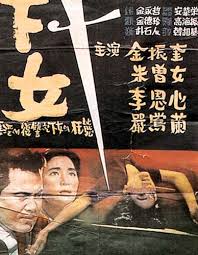
FILM REVIEW: The Housemaid (Ki-young Kim,1960): South Korea

Reviewed by Larry Gleeson. Viewed during AFI FILMFEST 2010.

Considered by many to be one of the top three Korean films of all time, The Housemaid (1960), was directed by the legendary Ki-yong Kim. Kim is known for films Fire Woman (1970),  and Goryeo jang (1963). The film was produced by the production company of Kuk Dong, known for the Godzilla movies and The Three-Headed Monster. Kuk Dong was also a distributor for Harry Potter and the Chamber of Secrets (2002)  and The Sorcerer’s Stone (2001). The film also waas screened at the 2008 Tokyo Int’l Film Festival and at the 2009 Buenos Aires International Festival of Independent Cinema. The film’s cinematographer was Deok-jun Kim, known for Thirsty Trees (1964), Water Lady (1979) and It Goes Well (1989).

The Housemaid (1960) was shown as the second half of a double feature. The first half of the feature was a 2010 remake of the Housemaid. The 2010 version was directed by Kim’s old directing adversary’s son, Sang-soo Im. In my opinion, the 1960 version has stood the test of time. Shown in B&W, it’s a domestic thriller with mounting intensity up to and through the climax. It’s at the very end of the film when a most unusual resolution occurs that finally allows the light of day! The storyline is based on a news flash and focuses on a very traditional four-member Korean family. The family has moved into a new two-story home that forces both husband and wife to work demanding jobs to meet their bills. The wife is unable to work and keep the house. Begrudgingly, the happy couple makes the decision to hire a young eager Korean girl to be their housemaid.

Kim’s portrayal of the young housemaid is nothing short of brilliant. A working girl who becomes impregnated by her male employer rises up to run the household. In essence she has turned the table on the “ruling” class. Furthermore, Kim uses rats and rat poison so adroitly throughout the film to heighten the intensity. Couple the heightened intensity with the housemaid’s portrayal of envy and grossly overt sexual wantonness and the viewer is thrust into an unforeseen and dark thematic element of the expanding Korean middle class circa 1960. Despite the apparent housemaid’s scheming and havoc-wreaking behavior, ultimately leading to the fatal destruction of the family unit, not all hope is lost as Kim surprises the audience with a comical ending assuring the viewer that the situation depicted in the film won’t happen if he has learned the lesson so eloquently taught in The Housemaid (1960).

Highly recommended. A classic!

‘Barry,’ The Young Obama Netflix Movie Will Tell Things People Don’t Know About The Outgoing President

Posted by Larry Gleeson

By Joseph S.

Barry, the young Obama movie is just right on the dot as President Barack Obama is cleaning out his desk at the oval office before he finally returns to private life. Some people are already feeling nostalgic about him leaving the White House. This movie would be an apt tribute to the first black President of what is regarded as the most powerful nation on earth.

The Movie’s Premiere Was A Hit

When Barry premiered at the Toronto Film Festival, it was an instant hit. The role of the president was played by Devon Terrell, a newcomer. The story revolves around the president’s younger years while he was studying at Columbia University in New York City in the early ’80s.

This Is The Official Plot Summary

The plot of the real-life story of the U.S. President goes like this: “In a crime-ridden and racially charged environment, Barry finds himself pulled between various social spheres and struggles to maintain a series of increasingly strained relationships with his Kansas-born mother, his estranged Kenyan father, and his classmates. Barry is the story of a young man grappling with those same issues that his country, and arguably the world, are still coming to terms with 35 years later.”

The Trailer Is A Real Teaser

In the trailer, young Obama is always showing his back to the viewer.He is constantly moving forward, perhaps giving the image that his life’s approach is always to look and move forward. It is only at the end of the teaser where the young Obama’s face was revealed – in the mirror – since his back is still on the viewer. He was arranging his tie before he goes out.

A report from Entertainment Weekly indicated that Netflix has just acquired the film last month when it was shown at the Toronto Film Festival. IMDB rates the film at 7.8 while Rotten Tomatoes gave it 92 percent. It was directed by the director of “Vice,” Vikram Gandhi and written by Adam Mansbach. Netflix will air the movie on Dec. 16. Take a peek at the first trailer below.

(Source: http://www.itechpost.com)

JACKIE to Screen at AFI FEST 2016

Fox Searchlight’s JACKIE, directed by Pablo Larraín, will screen as a Centerpiece Gala at AFI FEST 2016 presented by Audi. Starring Academy Award® winner Natalie Portman, the film will screen on Monday, November 14, at the TCL Chinese Theatre.

JACKIE is a searing and intimate portrait of one of the most important and tragic moments in American history, seen through the eyes of the iconic First Lady, then Jacqueline Bouvier Kennedy portrayed by Natalie Portman. JACKIE places us in her world during the days immediately following her husband’s assassination. Known for her extraordinary dignity and poise, here we see a psychological portrait of the First Lady as she struggles to maintain her husband’s legacy and the world of “Camelot” that they created and loved so well. JACKIE is directed by Larraín and written by Noah Oppenheim. In addition to Portman, the film stars Peter Sarsgaard, Greta Gerwig, Billy Crudup and Academy Award® nominee John Hurt. JACKIE is produced by Juan De Dios Larraín, Academy Award® nominee Darren Aronofsky (AFI Class of 1992), Mickey Liddell, Scott Franklin and Ari Handel.

afi-fest-2011-logo-and-free-tickets

(Source: http://www.blog.afi.com)

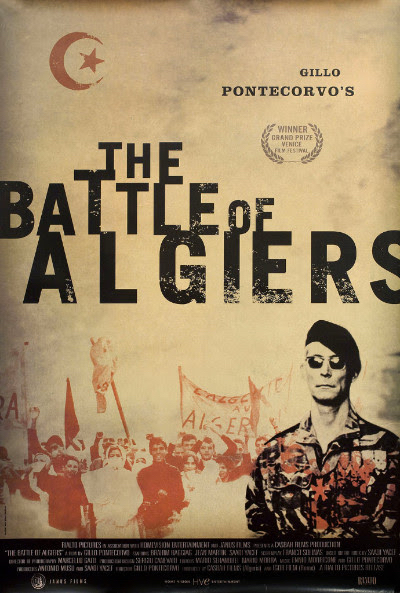
SBIFF The Showcase – The Battle of Algiers

NEW RESTORATION OF THE 1967 ITALIAN FILM MASTERPIECE!

THE BATTLE OF ALGIERS
Directed by Gillo Pontecorvo
Written by Franco Solinas, Gillo Pontecorvo
Starring Brahim Haggiag, Jean Martin, Saadi Yacef
Country of Origin: Algeria/Italy
Running Time: 123 min
Subtitled

 algiers

New restoration of one of the most influential political films in history, The Battle of Algiers (1966), vividly re-creates a key year in the tumultuous Algerian struggle for independence from the occupying French in the 1950s. As violence escalates on both sides, children shoot soldiers at point-blank range, women plant bombs in cafés, and French soldiers resort to torture to break the will of the insurgents. Shot on the streets of Algiers in documentary style, the film is a case study in modern warfare, with its terrorist attacks and the brutal techniques used to combat them. Pontecorvo’s tour de force has astonishing relevance today.

 Here’s what other leading critics are saying:

“ASTONISHING! A political thriller of unmatched realism!”
A.O. Scott, The New York Times

“A GREAT FILM…Everything about this film says it’s real, it’s happening now, it’s important.”
Kenneth Turan, Los Angeles Times

“PULSES WITH ENERGY! As urgent, intense, prescient as ever!”
Ann Hornady, The Washington Post

Screening:
Sunday October 23 @ 2:00pm
Monday October 24 @ 7:30pm
Tuesday October 25 @ 5:00pm
Wednesday October 26 @ 7:30pm
at the Riviera Theatre
2044 Alameda Padre Serra

riviera

See you at the movies!

santa-barbara-riviera-theater1

(Source:sbiff.org release)

Pak classic Jago Hua Savera is a true gem that wowed Cannes

Posted by Larry Gleeson

By Gautaman Bhaskaran

One of the classics at Cannes Film Festival in May was AJ Kardar’s 1959 black and white movie, Jago Hua Savera (Day Shall Dawn).

The film, which was to be screened as part of the Restored Classics Section of Jio MAMI 18th Mumbai Film Festival starting October 20, has been dropped.

Made in 1959 in what was then East Bengal, Kardar’s work was to have screened at Mumbai. But the prevailing political climate has not allowed this.

screen-shot-2016-10-21-at-10-40-43-am

In a section titled, Restored Classics — which has become quite a hit at Cannes since it was introduced some years ago and which has seen the works of some Indian masters like Satyajit Ray and Mrinal Sen figuring — Jago Hua Savera was described as a gem.

Be that as it may, Jago Hua Savera is a haunting piece of celluloid that was also Pakistan’s first ever submission to the Foreign Language Oscars. The year was 1960. A moving story of fishermen in East Pakistan, the movie traces their weaknesses and strengths — clearly underlying their never-say-die spirit in the face of a hostile nature and prowling man-eating tigers.A Cannes brochure said: “By many standards, life in these far flung tiny villages is dull and monotonous, yet, for the people who live there, life is full of trials and turbulence. This is the story of the people of the river to hunt for fish. This is the story of one such man, of many such men, each aspiring to own their own boat.” The simple folk had a simple aspiration – to own a fishing boat, but caught in a web of loans, they lost even before they began their fight. The big sharks were too powerful for these small fish.

After all these years, what strikes as truly remarkable about Jago Hua Savera was its truly international crew and cast. The revolutionary Pakistani poet, Faiz Ahmad, wrote the screenplay and even penned lyrics for this quasi-documentary fiction, while a German-born British cameraman, Walter Lassally, caught the fantastic rural scenes with a kind of unforgettable magic. He used the Arriflex camera with superb dexterity to capture a set of rank amateur actors as they went about their mundane lives on the banks of Meghna. The style was true realism.

The original story came from West Bengal’s Manik Bandhopadhyay, the lead actor, Tripti Mitra, too. She was a member of the Indian People’s Theatre Association. And Indian music director, Timir Baran, co-composed along with Pakistan’s producer-composer Nauman Taseer. Shanti Chatterjee, an assistant of Satyajit, was also part of the crew. And one can see Ray’s influence in Kardar’s work.

Cut to present. The movie was restored with the help of the Nauman Taseer Foundation. Picture and the Deluxe Restoration in London. Taseer had been the financial backbone of Jago Hua Savera in its original avatar. Now his son, Anjum, took it upon himself to reconstruct a long-forgotten classic. He dug up the prints from France, London and Karachi, screened them at festivals like the Three Continents at Nantes (France) and New York, before he got restoration teams to work on the film, a painstaking job.

When the digitally-remastered movie was shown at Cannes, Faiz’s daughter and celebrated poet now living in Lahore, Salima Hashmi, had tears welling up, and she called the experience “emotional”. Understandably so. For, her father was in jail — as part of the anti-Communist crackdown by Pakistan’s General Ayub Khan — when Jago Hua Savera premiered in London. The movie went on to win a Gold at the 1959 Moscow Film Festival, and nothing was heard of it after that. Till it re-emerged as a brand new print at Cannes.

And Kardar’s life like that of the fishermen in the film ran parallel to the sea and the surf and the sand. He initially worked as a sailor and then went to London to study cinema. His first dabble with the megaphone was Jago Hua Savera.

In an important way, Kardar’s brilliant piece of creativity was a turning point in not only the cinematic fortunes of East Bengal — which really had no money for the arts and was always subjugated culturally by the rich and powerful West Pakistan — but also that of the country as a whole. After the 1947 partition of the Indian sub-continent, the thriving film industry in Lahore shifted to what was then Bombay. Talent migrated, and Bombay became Maya Nagari, while the movie industry in Lahore floundered and perished. Jago Hua Savera came as a whiff of fresh air, injecting oxygen into Pakistan’s business of cinema. But the glory was not allowed to last by Pakistan’s military rulers, who saw a threat — real or imagined — in the emergence of cinema in their eastern wing, which boasted of several men of letters.

It is, therefore, not surprising that the number of films produced annually in Pakistan is well under 20, while India churns out about 1300. After, Jago Hua Savera, Pakistan did not submit anything for the Oscars till 1963 (Ghunghat). It was a long gap after that — till 2013, when the country sent Zinda Bhag.

Jago Hua Savera was a landmark work all right, and it is a pity that it will not be screened at Mumbai Film Festival.

mami-banner360

(Source: http://www.hindustantimes.com)