Category Archives: Venice International Film Festival

White Sun to premiere at Kimff 2016

Nepali feature film White Sun (Seto Surya) will open the 14th Kathmandu International Mountain Film Festival (Kimff), slated to be held at the Kumari Hall in Kamal Pokhari in the Capital, starting Dec 8. White Sun, which was recently screened in Toronto International Film Festival and Venice Film festival, is slated for an all-Nepal release from Dec 9.

Speaking during an event hosted in the Capital earlier this week, Tsering Ritar Sherpa, producer of the film, shared, “We are very excited with the response the film received after being screened at the Venice Film Festival. The film, based on the 10-year Maoist insurgency, has been garnering positive reviews internationally; hopefully, the audience at home will like it too.”

According to Sherpa, the film tries to explore the psychological impact the insurgency had on Nepalis.

Directed by Deepak Rauniyar, White Sun features actors Dayahang Rai, Raj Kumar Baniya and Sumi Malla in lead roles.

Along with White Sun, Kimff 2016 will feature a total of 80 films—features, animations, short films and documentaries—from 28 different countries.

The film fest will also hold a short film competition under the theme: Strengthening Nepal’s Public Services.

This year’s festival is slated to run through Dec 12.

screen-shot-2016-10-29-at-11-03-23-am

(Source: http://www.kathmandupost.ekantipur.com)


EDITORIAL: Messages and meaning at the Middleburg Film Festival

Posted by Larry Gleeson

By Times-Mirror Editorial Board

In just four years, the Middleburg Film Festival has earned a place among such iconic film festivals as Sundance, Telluride, Tribeca, Toronto, Melbourne, Berlin, Venice and Cannes. The film festival’s quaint venues – a converted ballroom at Salamander Resort, a performing arts auditorium at an elementary school, a library-museum for horse enthusiasts, a spartan reception hall in Upperville and the barrel room of a local winery – differentiate the festival from the glitz and glamour of Hollywood’s showplaces.

Middleburg brings something more meaningful to the conversation about movies: an intimacy with the stories and the people of the movies.

The charming town tucked in Virginia hunt-and-horse country is more than just a setting for a cozy film festival. Middleburg is also a character in the movies shown there.

Over four postcard-perfect days, about 4,000 people traveled to what looks like a back lot for idyllic moviemaking. Film buffs took Route 50, the two-lane road that follows the rolling hills, stone fences and horse farms to the charming town in Loudoun’s southern tier. Nearing the town, two oversized Trump banners greeted visitors from a private parcel of land on the roadside – seemingly out of place and out of character in a setting known for its style and discretion.

The wearisome soundbites of the presidential campaign become a faint echo at Middleburg’s one stoplight, a few hundred feet down Route 50 where it becomes Washington Street. Make a right turn, or a left, and you are at an unexpected venue for a movie. Or you can follow scenic side roads to the festival’s more distant venues.

At this place, in this time, Middleburg is about movies. But something more, too.

screen-shot-2016-10-29-at-2-40-48-pm

In Loving,the quiet and courageous love story of Richard and Mildred Loving, the Virginia countryside is both prominent and familiar, enhancing the realism of rural racism in the commonwealth at the time. The movie follows the courtship and marriage of Mildred Jeter, a black woman, and Richard Loving, a white man, who are arrested and sentenced to prison in Virginia in 1958 because their interracial marriage violates the state’s anti-miscegenation laws. Exiled to Washington, they sue the Commonwealth of Virginia in a series of proceedings leading to the Supreme Court’s unanimous decision in Loving v. Virginia, which holds that laws prohibiting interracial marriage are unconstitutional.

The film, scheduled for release in the U.S. on Nov. 4, was shown at the new National Museum of African American History and Culture in Washington on Monday. But at a discussion following the screening on Sunday, Virginians were able to better appreciate the continuing relevance of Loving as its British producer and former U.S. Attorney General Eric Holder gave the story context. Following the program, dozens of attendees swarmed Holder, the first African American to serve as Attorney General (2009-2015).

Middleburg also had a brief role in the screening of Jackie, Natalie Portman’s riveting portrayal of Jacqueline Kennedy’s private grief as she coped with her public persona and the nation’s reaction to the assassination of her husband, President John F. Kennedy.

The movie would not have been screened in Middleburg but for a photograph of Jackie attending mass with JFK at the Middleburg Community Center, which now serves as the box office for the film festival. The distributors of Jackie had initially rejected the advance screening of the movie in Middleburg, a young festival with a relatively small audience in rural Virginia. But the photo provided a meaningful connection between Jackie Kennedy and Middleburg, where she spent private time away from Washington riding at her farm.

As Middleburg presented itself as a haven away from the front lines of the nation’s capitol 43 miles down the road, the film festival also provided a conversation that played to the politics of the moment. A conversation about presidents, politics and the movies quickly turned to “the elephant in the room,” as CNN political analyst David Gergen observed: Donald Trump.

Who would play Trump in the movie about the current presidential race? Alec Baldwin, of course, came the response to a joke that was apparently known to all in the audience. Film clips from movies about past presidents then left attendees to wonder whether art imitates life or life imitates art.

Middleburg’s messages echoed beyond. The Eagle Huntress followed Aisholpan, a 13-year-old girl who trains to become the first female in 12 generations of her Kazakh family to become an eagle hunter and rises to the pinnacle of a tradition that has been handed down from father to son for centuries. While there were many old Kazakh eagle hunters who vehemently rejected the idea of a female taking part in their ancient tradition, Aisholpan’s father, Nurgaiv, believed that a girl could do anything a boy can, as long as she was determined.

That idea brought cheers from the denizens in Virginia that included local Girl Scout troops that came to honor Aisholpan. The girl and her father traveled from Mongolia to Middleburg to acknowledge the cheers and to demonstrate how ordinary people could do extraordinary things. The cheers came again when it was announced that Aishholpan would become a character in a super-heroes cartoon.

So we come to superheros and the deeper meaning of the Middleburg Film Festival. In just four years, Sheila Johnson has exceeded her dream of turning her passion for cinema into a festive gathering of fellow film aficionados in the chic yet comfy venues of Northern Virginia’s horse country. The entrepreneur, philanthropist and film producer has made Middleburg a metaphor for creative endeavor with a social purpose. She has provided a lens to view the important films about our our culture, as well as perspective that is authentically Virginia.

But perhaps Johnson’s greatest gift is bringing together movies and people who make us think, feel and belong. Devoid of cynicism, these are the stories of our times. Johnson presents them as a kindred spirit in a place called Middleburg.

(Source:www.loudountimes.com)

16_05_middleburyfilmfest_event2


The Movie Studio, Inc. Premiers Latest Feature Film Bad Actress for Worldwide Release at the 2016 American Film Market in Los Angeles, California

The Movie Studio has announced the premier of its latest feature film BAD ACTRESS with exclusive worldwide distribution rights at the 37th edition of The American Film Market (AFM) in Los Angeles, California November 2nd – 9th 2016.
BAD ACTRESS — www.badactressthemovie.com will join the “BAD” movie genre:
BAD TEACHER — http://www.sonypictures.com/movies/badteacher/ — $200 mm Worldwide
BAD GRANDPA — http://www.imdb.com/title/tt3063516/ — $160 mm Worldwide
BAD MOM — http://stxmovies.com/badmoms/ — $179 mm Worldwide
BAD SANTA — http://www.miramax.com/movie/bad-santa/ — $77 mm Worldwide
BAD SANTA 2 — http://www.badsanta2.com — COMING SOON! In Theaters November 23rd 2016

Movie Studio President and CEO, Gordon Scott Venters, announced, “The premier release of ‘BAD ACTRESS’ at AFM the timing could not be better with the Video on Demand (VOD) market being driven by title, genre or star. Following the locomotive Blockbusters in the BAD genre, ‘BAD ACTRESS’ could produce significant distribution interest. The Movie Studio’s formula of developing vertically integrated sponsors, locations and product placements that create substantial production value in contrast with the true capital expenditures of the movie, could monetize the asset in both foreign and domestic markets.”

About The Movie Studio Inc.
The Movie Studio, Inc. is a vertically integrated motion picture production and distribution Company with completed motion picture and production assets. The Company acquires, develops, manufactures, and distributes independent motion picture content for worldwide consumption in Theatrical, Video on Demand (VOD), Foreign Sales and on various media devices. For more information, visit www.themoviestudio.com.

screen-shot-2016-10-25-at-10-26-46-pm

(Excerpt from The Movie Studio, Inc. press release.)

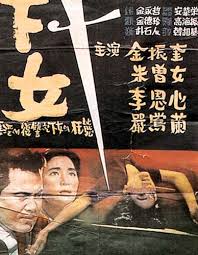
FILM REVIEW: The Housemaid (Ki-young Kim,1960): South Korea

Reviewed by Larry Gleeson. Viewed during AFI FILMFEST 2010.

Considered by many to be one of the top three Korean films of all time, The Housemaid (1960), was directed by the legendary Ki-yong Kim. Kim is known for films Fire Woman (1970),  and Goryeo jang (1963). The film was produced by the production company of Kuk Dong, known for the Godzilla movies and The Three-Headed Monster. Kuk Dong was also a distributor for Harry Potter and the Chamber of Secrets (2002)  and The Sorcerer’s Stone (2001). The film also waas screened at the 2008 Tokyo Int’l Film Festival and at the 2009 Buenos Aires International Festival of Independent Cinema. The film’s cinematographer was Deok-jun Kim, known for Thirsty Trees (1964), Water Lady (1979) and It Goes Well (1989).

The Housemaid (1960) was shown as the second half of a double feature. The first half of the feature was a 2010 remake of the Housemaid. The 2010 version was directed by Kim’s old directing adversary’s son, Sang-soo Im. In my opinion, the 1960 version has stood the test of time. Shown in B&W, it’s a domestic thriller with mounting intensity up to and through the climax. It’s at the very end of the film when a most unusual resolution occurs that finally allows the light of day! The storyline is based on a news flash and focuses on a very traditional four-member Korean family. The family has moved into a new two-story home that forces both husband and wife to work demanding jobs to meet their bills. The wife is unable to work and keep the house. Begrudgingly, the happy couple makes the decision to hire a young eager Korean girl to be their housemaid.

Kim’s portrayal of the young housemaid is nothing short of brilliant. A working girl who becomes impregnated by her male employer rises up to run the household. In essence she has turned the table on the “ruling” class. Furthermore, Kim uses rats and rat poison so adroitly throughout the film to heighten the intensity. Couple the heightened intensity with the housemaid’s portrayal of envy and grossly overt sexual wantonness and the viewer is thrust into an unforeseen and dark thematic element of the expanding Korean middle class circa 1960. Despite the apparent housemaid’s scheming and havoc-wreaking behavior, ultimately leading to the fatal destruction of the family unit, not all hope is lost as Kim surprises the audience with a comical ending assuring the viewer that the situation depicted in the film won’t happen if he has learned the lesson so eloquently taught in The Housemaid (1960).

Highly recommended. A classic!

FILM REVIEW: GIGOLA (CHARPENTIER, 2011)

Reviewed by Larry Gleeson. Viewed at the Santa Barbara International Film Festival 2011.

Gigola, directed by Laure Charpentier, is a French film with subtitles set in the early 1960’s Paris containing themes of adult sexuality and gender issues. The film made it’s debut at the Cannes Film Festival. From there Gigola was shown at the Hamburg Film Festival in Germany and finished out the year at the Paris Gay & Lesbian Film Festival, in Paris, France. The mise-en-scene is in Gigola is remarkable. The costumes, make-up, and lighting are spectacular conveying images reminiscent of That’s Entertainment (1974), and Moulon Rouge (2001).

The film opens with a teenage school girl named George, played by Lou Dillion, as a  young and slender coming of age debutante, and her teacher, an attractive mid 30ish woman. Playful background music provides energy for a highly sexually charged, sensual transaction between George and her teacher.

Charpentier jumps ahead to 1963 Paris nightlife scene. George’s boy friend has committed suicide. George has decided to withdraw from school and announces to the night-time partiers that she has flunked out of medical school seemingly intentionally.

Next time we see George she is in a Parisian bistro and we are introduced to a Carol Channing like character. George has reinvented herself.

A comment is made  to George, “You look like a gigolo.”

George coolly replies, “Gigola.”

We now see George as Gigola, the name she has given her new self. A well-to-do matron comes to the bistro and Gigola is into action. Dressed in a black tuxedo, Gigola escorts the matron onto the dance floor for a spin. Soon the pair leave the bistro together and head to the matron’s estate. With grace, elegance and a touch of class Gigola seduces the matron in an erotic bedroom scene with a snake-headed cane and white gloves.

Gigola, if nothing else, knows what she wants and she goes after it. She threatens to leave her new found matron unless she receives more money. The matron has already given Gigola a signet ring and a red MG convertible. The matron capitulates handing over to Gigola a large cache of currency. We now witness Gigola expanding her “business” with new girls working under her discretion.

Meanwhile, Gigola’s father, an opium addict, is squandering away the family’s estate as he cogently leads the life of a Parisian gentlemen. Eventually Gigola confronts her father brandishing a loaded revolver after repeatedly warning her father to stay away and, in turn, pleading with her mother to cut him off.

After an attempted suicide, Gigola finds herself under the care of a psychiatrist who bears a striking resemblance to her former teacher. She suggests having a baby to Gigola. Gigola is less than optimistic but the psychiatrist is able to connect with Gigola. Never one to miss an opportunity, Gigola deftly makes clear her intentions to the attractive psychiatrist. When the psychiatrist makes a “house call” Charpentier uses a wrestling take down move to portray the mixed emotions the psychiatrist has – she is attracted to Gigola but she is married and lives according to her principles as a married woman – a defining characteristic of the times. The psychiatrist cares about Gigola and they have dinner together where she tells Gigola that Gigola needs to let go.

Again without missing a beat Gigola moves deeper into the nightclub scene in Paris meeting a Mr. Tony Pasquale, a Sicilian. The two gain a mutual respect for each other and Tony ends up impregnating Gigola. Gigola has the baby and it seems as though Gigola has accepted normalcy and is conforming to societal norms. Gigola has left and George has come back.

However, before a sigh of relief can be expressed, in tromps the cast from the bistro. A raucous scene ensues in the hospital room with Gigola consenting to have her locks cut – a symbol of Gigola’s re-emergence.

The film closes with Gigola adhering to her somewhat circular, misguided idealism. She has turned over the care of her child to her mother and she is shown in tuxedo walking down a Parisian cobblestone alley way with her back back to the camera just before sunrise.

Amazing Friday night film for the right audience. Gigola is currently available on Amazon Prime.

JACKIE to Screen at AFI FEST 2016

Fox Searchlight’s JACKIE, directed by Pablo Larraín, will screen as a Centerpiece Gala at AFI FEST 2016 presented by Audi. Starring Academy Award® winner Natalie Portman, the film will screen on Monday, November 14, at the TCL Chinese Theatre.

JACKIE is a searing and intimate portrait of one of the most important and tragic moments in American history, seen through the eyes of the iconic First Lady, then Jacqueline Bouvier Kennedy portrayed by Natalie Portman. JACKIE places us in her world during the days immediately following her husband’s assassination. Known for her extraordinary dignity and poise, here we see a psychological portrait of the First Lady as she struggles to maintain her husband’s legacy and the world of “Camelot” that they created and loved so well. JACKIE is directed by Larraín and written by Noah Oppenheim. In addition to Portman, the film stars Peter Sarsgaard, Greta Gerwig, Billy Crudup and Academy Award® nominee John Hurt. JACKIE is produced by Juan De Dios Larraín, Academy Award® nominee Darren Aronofsky (AFI Class of 1992), Mickey Liddell, Scott Franklin and Ari Handel.

afi-fest-2011-logo-and-free-tickets

(Source: http://www.blog.afi.com)

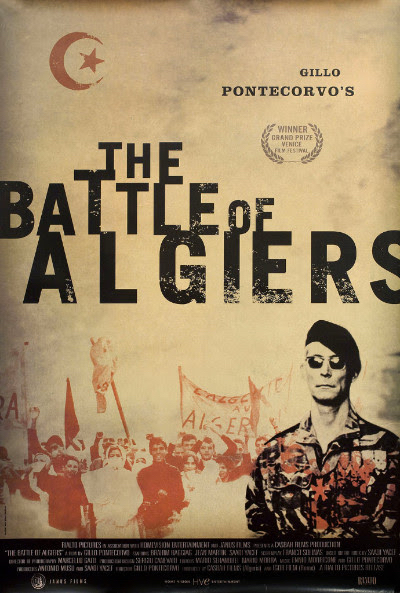
SBIFF The Showcase – The Battle of Algiers

NEW RESTORATION OF THE 1967 ITALIAN FILM MASTERPIECE!

THE BATTLE OF ALGIERS
Directed by Gillo Pontecorvo
Written by Franco Solinas, Gillo Pontecorvo
Starring Brahim Haggiag, Jean Martin, Saadi Yacef
Country of Origin: Algeria/Italy
Running Time: 123 min
Subtitled

 algiers

New restoration of one of the most influential political films in history, The Battle of Algiers (1966), vividly re-creates a key year in the tumultuous Algerian struggle for independence from the occupying French in the 1950s. As violence escalates on both sides, children shoot soldiers at point-blank range, women plant bombs in cafés, and French soldiers resort to torture to break the will of the insurgents. Shot on the streets of Algiers in documentary style, the film is a case study in modern warfare, with its terrorist attacks and the brutal techniques used to combat them. Pontecorvo’s tour de force has astonishing relevance today.

 Here’s what other leading critics are saying:

“ASTONISHING! A political thriller of unmatched realism!”
A.O. Scott, The New York Times

“A GREAT FILM…Everything about this film says it’s real, it’s happening now, it’s important.”
Kenneth Turan, Los Angeles Times

“PULSES WITH ENERGY! As urgent, intense, prescient as ever!”
Ann Hornady, The Washington Post

Screening:
Sunday October 23 @ 2:00pm
Monday October 24 @ 7:30pm
Tuesday October 25 @ 5:00pm
Wednesday October 26 @ 7:30pm
at the Riviera Theatre
2044 Alameda Padre Serra

riviera

See you at the movies!

santa-barbara-riviera-theater1

(Source:sbiff.org release)