Category Archives: Feature Film

THE WEDDING PLAN

Posted by Larry Gleeson

OPENS IN NEW YORK ON MAY 12 AND LOS ANGELES MAY 19

The Wedding Plan

Official Selection 2017 Tribeca Film Festival  

Official Selection 2017 Palm Springs International Film Festival

Official Selection 2016 Telluride Film Festival

2016 Haifa International Film Festival – Winner Best Actress Noa Kooler 

2016 Venice Film Festival – Nominated for Best Film

key_1_through_the_wall__norma_productions1484251068-5000x3333
Noa Koler in THE WEDDING PLANNER (Photo credit: Courtesy of Roadside Attractions)

At 32, Michal (Noa Koler), an Orthodox Jewish woman, is finally looking forward to the comfort and security of marriage, when she is blindsided by her fiancé’s decision to call off the wedding with only a month’s notice. Unwilling to return to lonely single life, Michal decides to put her trust in fate and continue with her wedding plans, believing Mr. Right will appear by her chosen date. Confident she will find a match made in heaven, she books a venue, sends out invitations and buys a wedding dress, as her skeptical mother and sister look on with trepidation.


During Michal’s month-long search for a spouse, she enlists the help of two different matchmakers, goes on a series of disastrous blind dates and finds an unexpected connection with a charming but utterly unsuitable pop star (Oz Zehavi) — all while dismissing pleas by concerned friends and family members that she reconsider her risky plan. As the day of the ceremony grows closer and no suitor appears, Michal puts everything on the line to find happiness.


The second film from American-Israeli writer and director Rama Burshtein, THE WEDDING PLAN is a poignant and funny romantic comedy about love, marriage and faith within life’s infinite possibilities.


A nominee for Best Film at the 2016 Venice Film Festival, the film stars Noa Kooler, Amos Tamam, Oz Zehavi, Irit Sheleg, Ronny Merhavi, Dafi Alpern, Karin Serrouya, Erez Drigues, Oded Leopold, Udi Persi and Jonathan Rozen.


The Wedding Plan was written and directed by Rama Burshtein and produced by Assaf Amir. Associate producers are Tammy Cohen and Adar Shafran. The cinematographer is Amit Yasur. The film was edited by Yael Hersonski. The art director is Uri Aminov. Costume designs are by Hava Levi Rozelsky. The casting director is Michal Koren. Original music by Roy Edri. A Roadside Attractions release.

RAMABURSHTEIN_THEWEDDINGPLAN1485382251

*Press Materials courtesy of Marina Bailey

First edition of the Kenyan NBO Film Festival

Posted by Larry Gleeson

big-image-66368270ffd51418ec58bd793f2d9b1bKenya’s film industry has seen a revival in recent years as the first edition of the NBO Film Festival was opened last Thursday.

The main feature at the first edition of the Film Festival was a drama entitled “Kati Kati ”, about the mystery that surrounds death.

‘Kati Kati’ a Swahili word , means Middle, it narrates the story of a young woman called ‘Kaleche’ who dies and moves on to the next life where others who have gone before her are trapped in a posthumous commune run by ‘Thoma’.

The film was written and directed by Mbithi Masya, a first time filmmaker, who said the story was deeply personal for him and his co-writer Mugambi Nthiga.

Kati Kati made its public Kenyan debut at a cinema in a Nairobi suburb where Hollywood and Bollywood films make up for almost all ticket sales.

The film won the Prize for the International Federation of Film Critics (FIPRESCI) at the 2016 Toronto International Film Festival (TIFF).

According to the organizers, the festival is aimed at growing cinema-going audiences for notable content from around the world, but mostly to give local films a platform to help take the industry to the next level.

Creative players in the industry say there is little support from the government to grow local talent and not enough projects to offer regular professionals work despite claims by the Kenya Film Commission saying it was worth 2 billion US dollars in 2016 up from 600 million in 2007.

(Source: africanews.com)

Japanese cast of Scorsese’s Silence speak of masterwork for the ages

Posted by Larry Gleeson

By Kenta Kato

Japanese stars heap praise on American auteur’s direction in his searching adaptation of Shusaku Endo’s novel about religious persecution.

“God is silence. You have to go into your soul and search for the answer by yourself.”

Thus Yosuke Kubozuka meditated on Martin Scorsese’s new film, Silence, at the Foreign Correspondents’ Club of Japan (FCCJ) on January 12.

Scorsese’s long-awaited project – based on the acclaimed Japanese novel by Shusaku Endo, a story of religious prosecution in 17th-century Japan, where Christianity was prohibited – has finally been realized. Karen Severns, the FCCJ’s film programmer, praised Scorsese’s film as “a slow-burn masterwork, with a message that has contemporary resonance, reverberating across the centuries.”

The FCCJ screened the movie back in its home country in partnership with Kadokawa Corporation, then hosted a discussion with three of its Japanese stars – Kubozuka, Tadanobu Asano and Issey Ogata.


Ogata, who plays the grand inquisitor, Inoue Masashige, said of Scorsese’s direction:

americancinemathequetributemartinscorsesemymw369-kaxl
Japanese Actor Issey Ogata plays the Grand Inquisitor, Inoue Masashige, in Martin Scorcese’s Silence. (Photo via zimbio.com)

“He never really instructs you to act in a certain way, but lets you bring what you have to the table. He never ever said anything negative about what I have to provide for him. In that way, it is really inspiring for actors and leads to many other ideas.”


screen-shot-2017-01-17-at-9-47-42-am
Yosuke Kubozuka (AsianWiki)

According to Kubozuka, “Scorsese is the king on set. Just being there makes acting so much easier. He is like a mirror that makes me look like twice or three times bigger, and you can kind of think of yourself as a wonderful actor.”


Ogata, who tried to read Endo’s novel when he was younger but couldn’t finish, said Scorsese had developed his character beyond what was is laid out in the book. “Scorsese made so much effort to build the character of Inoue… by using imagination as much as possible. That gave me a lot of room to act in free style.”


The director himself has said: “The conflicts that occur – the persecution of religious minorities, the testing of faith – are timeless.” The film takes place in the insular Japan of the 17th Century, but its themes and characters reverberate across the ages.


Asano, who plays a translator involved in prosecuting Portuguese Jesuits, noted:

screen-shot-2017-01-17-at-9-55-47-am
Tadanobu Asano (AsianWiki)

“I empathized with the character that I played, and I don’t see him as a vicious figure. He was probably a Christian himself but no longer able to carry on his faith. That led him to the line of work he is in.”


One of the most unforgettable characters in Silence is Kichijiro, an indecorous character who succumbs easily to the pressure applied by his prosecutors, who force Christians to trample on a ‘fumie’, a crudely carved image of Christ. According to Kubozuka, Kichijiro “is depicted as a weak, ugly, cunning, and dirty character. But he does commit fumie over and over again, which makes me wonder if he is really weak or actually strong. He is kind of two sides of the same coin.”

The film hints at the fragile morality that exists in the heart of all mankind. “When I went to the United States on 5 January, I asked this question about whether Americans would step on the picture of Jesus Christ in this day,” claims Kubozuka, “And a lot of people said, ‘I guess everybody would.’ So, by having this character Kichijiro, this story becomes something that is relevant to this modern age.”

Silence has been well-received by critics all over the world. Already, Ogata has been named runner-up in the Best Supporting Actor category by the Los Angeles Film Critics Association. Asked about the growing Oscar buzz, Asano jokes: “If it were not nominated, I suspect God would say something that he should not have said.”

(Source: atimes.com)


Top 3 Christmas Movies

With Christmas Day upon us, I wanted to revisit my three all-time favorite Yuletide films.

It’s A Wonderful Life – From Paramount Studios, American Frank Capra’s Christmas fantasy/drama based on Philip Van Doren’s short story, “The Greatest Gift,” tops the list.

A Christmas Story – Nipping at Capra’s heels’ masterpiece is Bob Clark’s comedy based on Jean-Shepherd’s anecdotes.

Home Alone – American classic comedy from  John Hughes and Cris Columbus tells the story of a small Chicago boy who is left behind while his family flies to Paris for the holidays.

Merry Christmas!

FILM REVIEW: Ukrainian Sheriffs (Roman Bondarchuk, 2015): Ukraine

Ukrainian Sheriffs, a documentary from real-life partners, Director/Writer Roman Bondarchuk and Producer/Writer Dar’ya Averchenko, tells the story of two men who received mayoral appointments to act as “sheriffs” in Southern Ukraine. The two men are a retired police officer with the look and demeanor of American television and film actor enforcer, Chuck Norris, and a Tony Soprano look-alike with a strong powerful presence who handles the heavier work including mechanical, electrical, and even plumbing!

Ukrainian Sheriffs is set in a remote village, Stara Zburjivka, near the Crimea in Southern Ukraine. It was shot over a period of three years culminating in a hundred and fifty hours of footage. The real story, however, begins to unfold in 2016. Russia has invaded the Crimea. Russian pro-separatists are taking up arms. Infiltrators orchestrate a political coup in the name of reform and progress at a town hall meeting. The locals, however, won’t hear their bombastic appeals and walk out after the level-headed mayor affirms their commitment to each other and their belief in each other. Shortly thereafter, the mayor makes a bold move and hires two men to help keep the peace and restore some semblance of normal and civil human behavior. He does the hiring by cajoling the men to be MacGyvers taking on various responsibilities that normally fall under the auspices of maintenance and public works.

Ukrainian Sheriffs starts out in what might seem like a comical fashion as the film’s two protagonists are fixing up a rather dilapidated looking, small yellow sedan with an upright, tiny Ukrainian flag perched over the driver’s side window. As luck would have it, the flag has soon flown away and the journey of the two Ukrainian Sheriffs has begun as they traverse unpaved, dirt roads making the rounds in the countryside.

screen-shot-2016-12-08-at-3-59-34-pmOne of the first stops is at a rural shack that the sheriffs refer to a villa, possibly because there are two similar structures built next to one another. Neither structure is much bigger than a large tool shed. The sheriffs make a few remarks over why they are there before proceeding to knock on the door. The door rattles and a scraggly looking couple emerges onto the front step. The Chuck Norris sheriff begins asking if the man had been beating his wife. The man responded he had but that he had good reason, though he couldn’t remember why, and that he and his woman had resolved it. The sheriffs asked the woman if she brought it on herself and she said she had. The man reached over and affectionately touched the woman. The sheriff then reprimanded the man for getting drunk and not showing up for work. He instructed the man to call his employer and let him know that he would be drinking and partying too hard to make it in to work the next day. This was good comic relief to some extent.

Unfortunately, the man winds up in prison by the film’s end sending his tearful little woman love letters. She pondered and mused over love and their existence together in a very heartfelt, life-affirming manner. Unbeknownst, the man had been coerced a few years earlier into signing a complaint levied against him in order to make a law enforcement quota mandated from a remote office miles and miles away. The man was sent to prison for stealing a bicycle due to his prior “conviction.”

In addition to this story thread, several more scenarios play our revealing a very human screen-shot-2016-12-08-at-3-57-51-pmculture where the citizens are struggling to survive on a day-to-day basis in a setting close to a war zone with peripheral fallouts taking place right in their midst. Through these vignettes an indomitable spirit is revealed as the citizenry comes together despite their difference and find a way to not only survive but to progress as a community, thanks largely to efforts and foresight of the mayor.

Ukrainian Sheriffs is the Official Submission of Ukraine to the Academy of Motion Arts and Science for Best Foreign Language Film. Definitely worthy of consideration. In addition, this slice-of-life documentary reveals the spirit of what I believe the French historian, diplomat and political scientist, Alexis de Tocqueville uncovered in his travels in early 19th Century America penned in two volumes (1935 and 1940) titled “Democracy in America.”

After seeing the film, participating in the Q & A ,and attending the dinner reception that followed the screening, I agree with Director Bondarchuk’s understated statement about the film, “I made a very honest film. I would call it a tragic documentary comedy.” Yes, it is all that. And, it’s more than that. To me, it’s a film treatise wrapped up in a cozy documentary blanket. Nevertheless, Bondarchuk and Averchenko capture revealing prominent sociological and political tenets of a region under immense pressure amid heightened tensions. And they do it remarkably well with an often, and much needed, touch of comic relief. Highly recommended film.

screen-shot-2016-12-08-at-3-56-18-pm

David Lynch and Johnny Depp are helping a teenager with stage four cancer make a gory zombie film

Posted by Larry Gleeson

By Olivia Waring

Horror fan Anthony Conti has stage four kidney cancer, but thanks to the Make A Film Foundation, his short film The Black Ghiandola, starring Depp, Lynch, Laura Dern and JK Simmons, is in post-production.

It was also co-directed by three massive Hollywood names — Evil Dead director Sam Raimi, Twilight director Catherine Hardwicke and St Vincent director Ted Melfi — during the five-day shoot.

screen-shot-2016-12-08-at-1-24-56-am

The synopsis of the film, which Conti wrote himself, reads: ‘The Black Ghiandola centers on a young man, played by Anthony Conti, who risks his life to save the girl he loves, after his family is wiped out during a zombie apocalypse.’

Conti, who lives in Hollywood, already had experience making his own comedy/sci-fi YouTube series, The Satanic Zucchini Show.

He later managed to get this new project off the ground after contacting Make A Film Foundation to get hold of a copy of one of their other movies.

Writing The Black Ghiandola apparently helped Conti fight his cancer, and stars involved in the project have paid tribute to the ‘courageous’ youngster in touching a video from the foundation.

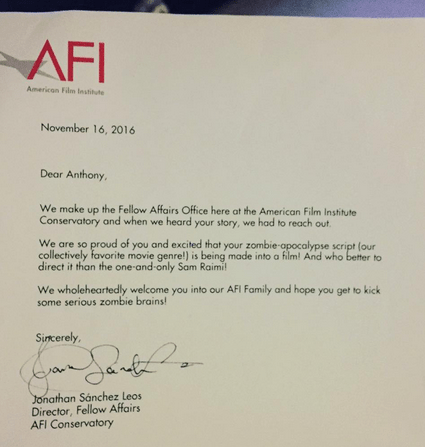
The teen also uploaded a shot of the letter he received from the American Film Institute telling him Sam Raimi would be directing his movie, which must have been a huge moment for him.

screen-shot-2016-12-08-at-1-27-36-am

Conti, who is undergoing chemotherapy, received financial help from dozens of Hollywood businesses, including channel AMC who make his fave show The Walking Dead, plus family members and online supporters.

Snaps from the set of the film show just how much fun all those taking part had, and how much fake blood was deployed, too.

screen-shot-2016-12-08-at-1-29-07-am

Depp appears to be playing a doctor who gets attacked by flesh-eating zombies, a role he no doubt relished.

screen-shot-2016-12-08-at-1-30-40-am

*Photos from @ThatOneAnt22 Instagram

(Source: http://metro.co.uk)

Martin Scorsese’s #SILENCE

Martin Scorsese’s SILENCE tells the story of two Christian missionaries (Andrew Garfield and Adam Driver) who face the ultimate test of faith when they travel to Japan in search of their missing mentor (Liam Neeson) – at a time when Christianity was outlawed and their presence forbidden. The celebrated director’s 28-year journey to bring Shusaku Endo’s 1966 acclaimed novel to life will be in theaters this Christmas.

(Source: Paramount Studios)

Film Capsule: FRAUD (Fleischer-Camp, 2016): USA

Reviewed by Larry Gleeson. Viewed during AFIFEST 2016 presented by Audi.

Fraud, the new fifty-two minute documentary from director, editor New York Times’ children’s book author, Dean Fleischer-Camp, tells the story of one American family’s economic struggles. Culled from over a hundred hours of uninhibited, raw footage, Fleischer-Camp pieces together an obsessed man’s YouTube home movies shot during a period from 2008 to 2015 – an intimate, yet disturbing, portrait emerges as the worlds of reality and fiction are merged by Fleischer-Camp to create an apocalyptic, futuristic narrative. Highly Recommended.

Warner Bros. Entertainment to Acquire Machinima

Warner Bros. has signed an agreement to acquire Machinima, the global programming service focused on fandom and gamer culture, and it will become part of the recently founded Warner Bros. Digital Networks. The announcement was made today by Craig Hunegs, President, Business and Strategy, Warner Bros. Television Group and President, Warner Bros. Digital Networks.

screen-shot-2016-11-25-at-10-07-15-pm

“Machinima is a strong gamer and fandom content and social brand with enormous reach and high engagement with audiences that play our games and are big fans of DC films and television shows,” said Hunegs. “Machinima also produces great, high quality content for their community, and together we can create an even more compelling experience and do some really exciting things involving our key franchises. This acquisition is another meaningful move forward as Warner Bros. develops more direct relationships with our consumers.”

“Since making their first investment in Machinima in 2014, Warner Bros. has been an active business partner in our transformation, so we already have proof points as to how the companies can work together to accelerate Machinima’s growth plans,” said Chad Gutstein, CEO, Machinima. “We’ll now be able to take full advantage of Warner Bros.’ intellectual property, sales and distribution, while still creating content for social and premium digital platforms that gamers and geeks love. Plus, we’ll be fully embedded and can help Warner Bros. continue their incredible digital marketing successes. It’s honestly a win-win.”

In the past two years, Machinima has transitioned from a YouTube MCN to a global programming service and production company delivering popular programming to millions. Since joining Machinima in 2014, Gutstein revamped the executive team, brand, programming and business strategy. As part of that strategy, the company opened a full-service production studio and executed first-of-its-kind premium content partnerships with platforms, including Playstation Vue, Amazon Prime, Verizon’s go90, China’s Sohu and The CW Network. According to comScore, Machinima is the 10th largest digital video entertainment media company in the U.S. ranked by total unique viewers.

Machinima will operate as a wholly owned part of Warner Bros. Digital Networks, a division founded in June 2016 to grow the Studio’s digital and OTT offerings. As part of Time Warner’s overall strategy to reach audiences directly through company-owned current and yet-be-launched OTT services, WBDN works closely with Time Warner’s divisions Turner and HBO.

About Warner Bros.:
Warner Bros. is a leader in all forms of entertainment and their related businesses across all current and emerging media and platforms. The Studio stands at the forefront of every aspect of the industry, from feature film, television and home entertainment production, animation, comic books and video games. Warner Bros. manages one of the most successful collections of brands and franchises in the world, and has a library of more than 79,000 hours of programming, including nearly 7,500 feature films and 4,500 television programs comprised of tens of thousands of individual episodes.

About Machinima:
Machinima is the most notorious purveyor and cultivator of fandom and gamer culture. The FIRST! Many2Many programing service (M2M), we create, curate and celebrate the best fandom and gamer content across multiple video platforms. As one of the largest online video platforms in the world, Machinima programs to a community passionate about video games, animation, movies, TV, and the other endless forms of pop culture. With a focus on scripted, topical and gaming programing, and a talent network of thousands of programmers, Machinima reaches nearly 150 million viewers each month.

###

FILM REVIEW: Mifune: The Last Samurai (Okazaki, 2015): Japan

Reviewed by Larry Gleeson

Viewed during AFIFEST 2016 presented by Audi, Mifune: The Last Samurai, directed by Steven Okazaki, is a feature-length documentary about the life and films of legendary Japanese actor Toshiro Mifune. Okazaki utilizes archival clips, photographic stills and interviews with those who worked with Mifune. The film is narrated by Keanu Reeves.

Interestingly, the film is more of a creative interpretation of specific formative elements, both personal and cultural, that led to Mifune’s distinct personality. Okazaki presents Mifune is a non-linear fashion. He opens the film with the infamous rape scene from Rashomon. From there he discusses Mifune’s approach to some of his Rashomon scenes. Apparently, to embody the untamed animal instinct of his character, Mifune studied the movements and behavior of a lion. To add substance to such a claim, Okazaki shows, much to the audience’s delight, Mifune closing in on his samurai opponent in a lion-like fashion.

Screen Shot 2016-11-26 at 5.41.05 PM.png
Iconic Japanese Director Akira Kurasaw, left, and legendary Japanese Actor Toshiro Mifune, during a set break.

The 1950’s and 60’s were a Golden Age for Japanese Film. Iconic Japanese Director Akira Kurasawa had won the Golden Lion at Venice with Rashomon in 1951 putting Japanese films on the world scene. Kurasawa and Mifune would go on to collaborate on 16 films over an eighteen year period including renowned, classic films such of Rashomon (1950), Seven Samurai (1954), Throne of Blood (1957) and Yojimbo (1961). 

Telling interviews from Kyoko Kagawa, Takeshi Kato, Haruo Nakajima, Yosuke Natsoki and Sadao Nakajima reveal Mifune’s ardent preparation for roles, painstakingly researching and laborious rehearsal processes. Kurasawa rarely, if ever, gave Mifune specific direction on creating characters. Other interviews came from American directors Martin Scorcese and Steven Spielberg revealing the admiration and respect Mifune garnered not only in Japan but in Hollywood as well.

With the advent of war in 1931 and Japan invading Manchuria every able-bodied Japanese male was conscripted into service including Mifune. Mifune and his parents were Japanese Nationalists living in China at the time. Mifune’s early experiences in the war consisted of a lot of beatings as his superior officers found his tone of voice off-putting and insubordination charges followed. By war’s end males as young as eleven years old were brought into the army and referred to as Little Citizens and Children of the Emperor. Mifune’s role became training the young men as Kamakazi’s. Both of Mifune’s parents were casualties of the war.

After the war, time were tough for the Japanese. Men sold their suits and women sold their socks just to have enough to eat. Mifune made himself a pair of trousers and a matching coat from his army blanket. Such a look, coupled with his strong voice, gave Mifune a big presence. He applied for a camera assistant position with a film studio and got the position. However, in 1947, Mifune made his entrance as an actor in Kurasawa’s Snow Trail. Kurasawa was impressed with Mifune’s work and began writing bigger and better roles for Mifune. Mifune would not go back to being a camera assistant.

Kurasawa was a well-known director in Japan before the war and continued filmmaking during the war years with propaganda films. The US banned swordplay films after the war for seven years. When the ban was lifted Kurasawa was ready with one of the great films in cinematic history, Seven Samurai, with Mifune playing a often humorous, wanna-be Samurai. Mifune’s father had been a photographer and young Toshiro often posed as a Samurai for photos.

Mifune became an inspiration for young actors who found his minimalist approach accessible. Often referred to as the John Wayne of Japan, Toshiro Mifune is The Last Samurai. Warmly recommended…a cinephile’s dream!