Tag Archives: film festivals

AFM 2016: Kaleidoscope Film Distribution Lands A Dark Song Overseas

Kaleidoscope Film Distribution has picked up worldwide (excluding North America) rights to A Dark Song, ScreenDaily reports.

Liam Gavin’s occult horror flick stars Sightseers’ Steve Oram and Catherine Walker and follows a young mother who is determined to avenge the murder of her child with the help of a hard-drinking occultist. Locking themselves into an isolated house, they perform a magic ritual to enlist the help of the supernatural world, but secrets from their pasts unleash darker powers.

screen-shot-2016-10-27-at-7-44-10-am

After its world premiere at Galway Film Fleadh, the film has screened at Fantastic Fest, Sitges, and BFI London Film Festival. It will make its sales debut at the upcoming American Film Market (AFM).

We’re thrilled to be working on Liam’s debut, a film which is both darkly unsettling and ultimately moving. After a stream of critical acclaim, we look forward to sharing this gem with international buyers,” commented Michael Chapman, acquisitions & development executive of KFD. The deal was signed by Kaleidoscope’s Spencer Pollard and Chapman in conjunction with David Collins of Samson Films.

Collins added: “We are delighted at the festival response to A Dark Song. It’s a great vote of confidence in the film that Kaleidoscope have stepped up so quickly to handle the world sales and to release it theatrically in the UK and Ireland. Together with XYZ, who represent the film in North America, we now have all of the bases covered for AFM.

Produced by David Collins, Tim Dennison, and Cormac Fox, the film was financed by The Irish Film Board and Ffilm Cymru Wales, with additional support from the Irish S481 tax incentive and Windmill Lane Post Production.

(Sources: http://www.bloody-disgusting.com, http://www.dreadcentral.com)

FILM REVIEW: Rear Window (Alfred Hitchcock, 1954): USA

Reviewed by Larry Gleeson. Viewed at the Mann Chinese theater as part of the AFI film festival, Hollywood, Calif.

alfred_hitchcockRear Window, directed by Alfred Hitchcock, is a brilliantly filmed movie, adapted from Cornell Woolish’s, “It had to be Murder”, of a man, L.B. Jeffries, an injured war photographer/correspondent, played by James Stewart of It’s a Wonderful Life (1946),  who believes he has witnessed a murder in the apartment complex where he lives. Hitchcock uses this window view to film his entire story. John Michael Hayes wrote the screenplay. His other credits include The Man who Knew too Much (1956) and To Catch A Thief (1955). George Tomasini provides the editing as he also worked on other Hitchcock classic films Psycho (1960) and North by Northwest (1959). The viewer is treated to a look into all the neighboring dwellings as seen from the protagonist’s, L.B. Jeffries’ window – seemingly many New York apartment dwellers partake in the alluring fascination of peeping through neighboring windows. The cinematography is credited to Robert Burks. Bruks other works include Vertigo (1958) and North by Northwest (1959). The production design was done by Sam Comer and Ray Moyer of Sunset Blvd (1950) and Breakfast at Tiffany’s (1961) fame. James C. Katz is listed as producer having produced the epic Spartacus (1960) and Vertigo (1958). Paramount Pictures with over six thousand pictures to its credit, is listed as the production company.

Hitchcock, known for powerhouse suspense films like Psycho (1960), Birds (1963) and North by Northwest (1959), shows cooped up newlyweds, a buxom young skimpily-clad, shapely exercise-crazed maiden, a lonely, love sick lady, a socially-inclined, romantic-minded musician and a seemingly ordinary housewife married to a seemingly normal traveling salesman, whom Stewart’s character, Jeffries, claims has murdered the wife. Jeffries doesn’t actually see the murder. Nevertheless, he is convinced the salesman murdered his wife after witnessing several highly acute, suspicious events . Stewart’s facial expressions and what appear to be exaggerated eye movements key the viewer in on action as Stewart plays the role of Jeffries, a wounded war hero who confined to a wheelchair and who passes the time by peering out his rear window at the neighbors as they go about their everyday lives.  Jeffries also uses his camera with a telescopic lens to provide up-close detail of his subjects and he frantically uses exploding flashbulbs as he attempts to thwart the murdering salesman’s efforts to silence Jeffries.

Hitchcock  introduces and develops several strong and powerful characters, most notably in the form of Grace Kelly, later known as the Princess Consort of Monaco,  as Jeffries love interest. Kelly’s striking good lucks coupled with her patient, unrequited love for Jeffries provide the viewer a glimpse into Hitchcock’s portrayal of a 1950’s socialite. She credibly plays the role of murder investigator with a refreshing vim and vigor. In addition, Wendell Corey plays a rather uninteresting yet wary detective who also happened to be a war buddy of Jeffries. Thelma Ritter plays Stella, Jeffries’ physical therapist, who drops by for daily therapy and, at times colorful banter. And, Raymond Burr plays the antagonist, a wife-murdering,  traveling salesman who dwells across from the rear window. Rear Window is splendid film, an Academy Award Runner-up for Best Picture to the American drama film, On the Waterfront (1954), about longshoreman corruption and mob violence starring Marlon Brando, I recommend wholeheartedly.

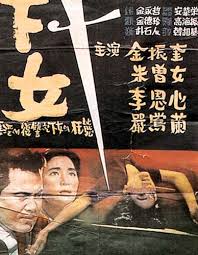
FILM REVIEW: The Housemaid (Ki-young Kim,1960): South Korea

Reviewed by Larry Gleeson. Viewed during AFI FILMFEST 2010.

Considered by many to be one of the top three Korean films of all time, The Housemaid (1960), was directed by the legendary Ki-yong Kim. Kim is known for films Fire Woman (1970),  and Goryeo jang (1963). The film was produced by the production company of Kuk Dong, known for the Godzilla movies and The Three-Headed Monster. Kuk Dong was also a distributor for Harry Potter and the Chamber of Secrets (2002)  and The Sorcerer’s Stone (2001). The film also waas screened at the 2008 Tokyo Int’l Film Festival and at the 2009 Buenos Aires International Festival of Independent Cinema. The film’s cinematographer was Deok-jun Kim, known for Thirsty Trees (1964), Water Lady (1979) and It Goes Well (1989).

The Housemaid (1960) was shown as the second half of a double feature. The first half of the feature was a 2010 remake of the Housemaid. The 2010 version was directed by Kim’s old directing adversary’s son, Sang-soo Im. In my opinion, the 1960 version has stood the test of time. Shown in B&W, it’s a domestic thriller with mounting intensity up to and through the climax. It’s at the very end of the film when a most unusual resolution occurs that finally allows the light of day! The storyline is based on a news flash and focuses on a very traditional four-member Korean family. The family has moved into a new two-story home that forces both husband and wife to work demanding jobs to meet their bills. The wife is unable to work and keep the house. Begrudgingly, the happy couple makes the decision to hire a young eager Korean girl to be their housemaid.

Kim’s portrayal of the young housemaid is nothing short of brilliant. A working girl who becomes impregnated by her male employer rises up to run the household. In essence she has turned the table on the “ruling” class. Furthermore, Kim uses rats and rat poison so adroitly throughout the film to heighten the intensity. Couple the heightened intensity with the housemaid’s portrayal of envy and grossly overt sexual wantonness and the viewer is thrust into an unforeseen and dark thematic element of the expanding Korean middle class circa 1960. Despite the apparent housemaid’s scheming and havoc-wreaking behavior, ultimately leading to the fatal destruction of the family unit, not all hope is lost as Kim surprises the audience with a comical ending assuring the viewer that the situation depicted in the film won’t happen if he has learned the lesson so eloquently taught in The Housemaid (1960).

Highly recommended. A classic!

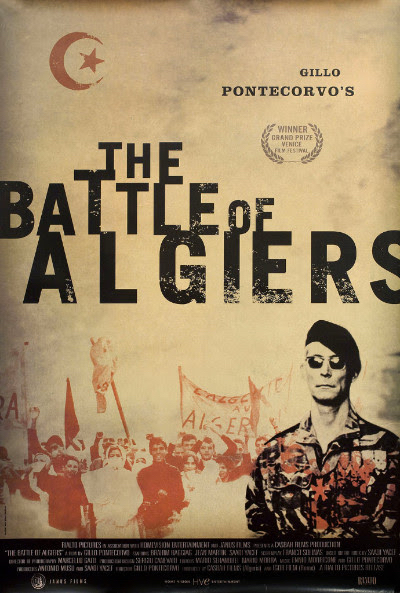
SBIFF The Showcase – The Battle of Algiers

NEW RESTORATION OF THE 1967 ITALIAN FILM MASTERPIECE!

THE BATTLE OF ALGIERS
Directed by Gillo Pontecorvo
Written by Franco Solinas, Gillo Pontecorvo
Starring Brahim Haggiag, Jean Martin, Saadi Yacef
Country of Origin: Algeria/Italy
Running Time: 123 min
Subtitled

 algiers

New restoration of one of the most influential political films in history, The Battle of Algiers (1966), vividly re-creates a key year in the tumultuous Algerian struggle for independence from the occupying French in the 1950s. As violence escalates on both sides, children shoot soldiers at point-blank range, women plant bombs in cafés, and French soldiers resort to torture to break the will of the insurgents. Shot on the streets of Algiers in documentary style, the film is a case study in modern warfare, with its terrorist attacks and the brutal techniques used to combat them. Pontecorvo’s tour de force has astonishing relevance today.

 Here’s what other leading critics are saying:

“ASTONISHING! A political thriller of unmatched realism!”
A.O. Scott, The New York Times

“A GREAT FILM…Everything about this film says it’s real, it’s happening now, it’s important.”
Kenneth Turan, Los Angeles Times

“PULSES WITH ENERGY! As urgent, intense, prescient as ever!”
Ann Hornady, The Washington Post

Screening:
Sunday October 23 @ 2:00pm
Monday October 24 @ 7:30pm
Tuesday October 25 @ 5:00pm
Wednesday October 26 @ 7:30pm
at the Riviera Theatre
2044 Alameda Padre Serra

riviera

See you at the movies!

santa-barbara-riviera-theater1

(Source:sbiff.org release)

Pak classic Jago Hua Savera is a true gem that wowed Cannes

Posted by Larry Gleeson

By Gautaman Bhaskaran

One of the classics at Cannes Film Festival in May was AJ Kardar’s 1959 black and white movie, Jago Hua Savera (Day Shall Dawn).

The film, which was to be screened as part of the Restored Classics Section of Jio MAMI 18th Mumbai Film Festival starting October 20, has been dropped.

Made in 1959 in what was then East Bengal, Kardar’s work was to have screened at Mumbai. But the prevailing political climate has not allowed this.

screen-shot-2016-10-21-at-10-40-43-am

In a section titled, Restored Classics — which has become quite a hit at Cannes since it was introduced some years ago and which has seen the works of some Indian masters like Satyajit Ray and Mrinal Sen figuring — Jago Hua Savera was described as a gem.

Be that as it may, Jago Hua Savera is a haunting piece of celluloid that was also Pakistan’s first ever submission to the Foreign Language Oscars. The year was 1960. A moving story of fishermen in East Pakistan, the movie traces their weaknesses and strengths — clearly underlying their never-say-die spirit in the face of a hostile nature and prowling man-eating tigers.A Cannes brochure said: “By many standards, life in these far flung tiny villages is dull and monotonous, yet, for the people who live there, life is full of trials and turbulence. This is the story of the people of the river to hunt for fish. This is the story of one such man, of many such men, each aspiring to own their own boat.” The simple folk had a simple aspiration – to own a fishing boat, but caught in a web of loans, they lost even before they began their fight. The big sharks were too powerful for these small fish.

After all these years, what strikes as truly remarkable about Jago Hua Savera was its truly international crew and cast. The revolutionary Pakistani poet, Faiz Ahmad, wrote the screenplay and even penned lyrics for this quasi-documentary fiction, while a German-born British cameraman, Walter Lassally, caught the fantastic rural scenes with a kind of unforgettable magic. He used the Arriflex camera with superb dexterity to capture a set of rank amateur actors as they went about their mundane lives on the banks of Meghna. The style was true realism.

The original story came from West Bengal’s Manik Bandhopadhyay, the lead actor, Tripti Mitra, too. She was a member of the Indian People’s Theatre Association. And Indian music director, Timir Baran, co-composed along with Pakistan’s producer-composer Nauman Taseer. Shanti Chatterjee, an assistant of Satyajit, was also part of the crew. And one can see Ray’s influence in Kardar’s work.

Cut to present. The movie was restored with the help of the Nauman Taseer Foundation. Picture and the Deluxe Restoration in London. Taseer had been the financial backbone of Jago Hua Savera in its original avatar. Now his son, Anjum, took it upon himself to reconstruct a long-forgotten classic. He dug up the prints from France, London and Karachi, screened them at festivals like the Three Continents at Nantes (France) and New York, before he got restoration teams to work on the film, a painstaking job.

When the digitally-remastered movie was shown at Cannes, Faiz’s daughter and celebrated poet now living in Lahore, Salima Hashmi, had tears welling up, and she called the experience “emotional”. Understandably so. For, her father was in jail — as part of the anti-Communist crackdown by Pakistan’s General Ayub Khan — when Jago Hua Savera premiered in London. The movie went on to win a Gold at the 1959 Moscow Film Festival, and nothing was heard of it after that. Till it re-emerged as a brand new print at Cannes.

And Kardar’s life like that of the fishermen in the film ran parallel to the sea and the surf and the sand. He initially worked as a sailor and then went to London to study cinema. His first dabble with the megaphone was Jago Hua Savera.

In an important way, Kardar’s brilliant piece of creativity was a turning point in not only the cinematic fortunes of East Bengal — which really had no money for the arts and was always subjugated culturally by the rich and powerful West Pakistan — but also that of the country as a whole. After the 1947 partition of the Indian sub-continent, the thriving film industry in Lahore shifted to what was then Bombay. Talent migrated, and Bombay became Maya Nagari, while the movie industry in Lahore floundered and perished. Jago Hua Savera came as a whiff of fresh air, injecting oxygen into Pakistan’s business of cinema. But the glory was not allowed to last by Pakistan’s military rulers, who saw a threat — real or imagined — in the emergence of cinema in their eastern wing, which boasted of several men of letters.

It is, therefore, not surprising that the number of films produced annually in Pakistan is well under 20, while India churns out about 1300. After, Jago Hua Savera, Pakistan did not submit anything for the Oscars till 1963 (Ghunghat). It was a long gap after that — till 2013, when the country sent Zinda Bhag.

Jago Hua Savera was a landmark work all right, and it is a pity that it will not be screened at Mumbai Film Festival.

mami-banner360

(Source: http://www.hindustantimes.com)

TOM FORD, MARC PLATT AND KENNETH LONERGAN TO BE HONORED AT THE 20th ANNUAL HOLLYWOOD FILM AWARDS®

Ford to Receive the “Hollywood Breakthrough Director Award” 

Platt to Be Awarded the “Hollywood Producer Award”

Lonergan will Accept the “Hollywood Screenwriter Award”

*James Corden Will Host Special Anniversary Ceremony on Sunday, November 6, 2016 at the Beverly Hilton Hotel

Hollywood, CA (October 19, 2016) – dick clark productions announced today that acclaimed new director and established fashion designer Tom Ford will receive this year’s “Hollywood Breakthrough Director Award” for “Nocturnal Animals,” Academy Award-nominated producer Marc Platt will receive the “Hollywood Producer Award” for his numerous films this year including “La La Land,” “Billy Lynn’s Long Halftime Walk,” and “The Girl on the Train,” and two-time Academy Award-nominated screenwriter Kenneth Lonergan will receive the “Hollywood Screenwriter Award” for his screenplay “Manchester by the Sea” at the 20th Annual Hollywood Film Awards.

The awards ceremony, celebrating its 20th anniversary as the official launch of the awards season®, will be hosted by actor and comedian James Corden, and will take place at the Beverly Hilton Hotel in Beverly Hills, on November 6, 2016. The Hollywood Film Awards honors some of the most acclaimed films and actors, as well as artists in Cinematography, Visual Effects, Film Composing, Costume Design, Editing, Production Design, Sound and Makeup & Hairstyling. Its honorees over the past 20 years have included the world’s biggest stars and more than 110 have gone on to garner Oscar nominations and/or wins.

Mr. Ford’s second film “Nocturnal Animals,” the hauntingly romantic thriller that explores the thin lines between love and cruelty stars Amy Adams and Jake Gyllenhaal as a divorced couple discovering dark truths about each other and themselves. The film premiered at the 73rd annual Venice Film Festival in 2016, where it won the Grand Jury Prize. Focus Features will release “Nocturnal Animals” in select cities beginning November 18th and nationwide on December 9th.

Tom Ford is a highly respected and successful fashion designer and film director. One of the most esteemed and prolific designers of his generation, Mr. Ford has won numerous awards for his distinguished work at Gucci, Yves Saint Laurent and his eponymous luxury brand TOM FORD, which launched in 2005. That same year, he formed his Los Angeles-based film production company Fade To Black through which he directed, produced and co-wrote his first feature film “A Single Man,” starring Colin Firth and Julianne Moore.  The film premiered at the 66th annual Venice Film Festival in 2009, where Mr. Firth was awarded Best Actor for his performance.  The critically acclaimed film went on to receive multiple awards and nominations including the Academy Award nomination for Best Actor.

Marc Platt’s producing career spans film, theatre and television with his projects garnering a combined 17 Oscar nominations, 18 Tony nominations, 17 Golden Globe nominations and 29 Emmy nominations. His films this year are “Billy Lynn’s Long Halftime Walk,” “The Girl on the Train,” and “La La Land.” Last year, Platt received a “Best Picture” Oscar nomination for “Bridge of Spies,” which was among the six earned for the film overall. Other credits include “Into the Woods,” “Drive,” “Rachel Getting Married,” “Scott Pilgrim vs. The World,” “Wanted,” “Nine,” “2 Guns,” “Cop Out,” “Ricki and the Flash,” “Legally Blonde,” “Legally Blonde 2,” “Honey,” “Josie and the Pussycats” and Disney’s upcoming “Mary Poppins Returns.”  He produced Broadway’s blockbuster musical, “Wicked,” and for television he earned an Emmy Award for executive producing “Grease Live!” and an Emmy and Golden Globe awards for HBO’s “Empire Falls.”  Prior to becoming an independent producer, Platt served as president of production for three movie studios — Orion, TriStar and Universal.

Kenneth Lonergan wrote and directed “You Can Count On Me” (2000 Academy Award® and Golden Globe® Nominee for Best Screenplay), “Margaret” (2011), and “Margaret” – Extended Edition (2012). He also co-wrote the screenplays for “Analyze This” (1999) and “Gangs Of New York” (2002 WGA® and Academy Award® nomination for Best Original Screenplay). Lonergan’s plays include Tony nominated “This Is Our Youth” (1996), Pulitzer Prize finalist “The Waverly Gallery” (2000), and Olivier Award nominated “Lobby Hero” (2001). He recently completed the television adaptation of E.M. Forster’s novel, “Howards End,” for the BBC. His upcoming film, “Manchester by the Sea,” which he both wrote and directed, stars Casey Affleck, Michelle Williams, Lucas Hedges and Kyle Chandler.  The film premiered to great acclaim at the 2016 Sundance, Telluride, Toronto, and New York Film Festivals, and will be released by Amazon Studios and Roadside Attractions on November 18, 2016.

Previously announced honorees for this year’s show include: “Hollywood Career Achievement Award,” Eddie Murphy; “Hollywood Actor Award,” Tom Hanks; “Hollywood Blockbuster Award,” “The Jungle Book”; “Hollywood Animation Award,” “Zootopia”; “Hollywood Cinematography Award,” Linus Sandgren; “Hollywood Film Composer Award,” Mychael Danna; “Hollywood Editor Award,” John Gilbert; “Hollywood Visual Effects Award,” Stephane Ceretti and Richard Bluff; “Hollywood Sound Award,” Christopher Boyes and Frank Eulner; “Hollywood Costume Design Award,” Albert Wolsky; “Hollywood Make Up & Hair Styling Award,” Shane Thomas, Angela Conte, Bec Taylor and Noriko Waztanabe; and “Hollywood Production Design Award,” Wynn Thomas.

(Source: Hollywood Awards Press Release)

Michael Douglas, Alec Baldwin, Politicos Jump-Start Oscar Race For Anti-NRA Documentary ‘Making A Killing’

Posted by Larry Gleeson

By Anita Busch

EXCLUSIVE: Hollywood has begun lining up to help get the word out on Robert Greenwald’s documentary feature Oscar contender Making A Killing:Guns, Greed And The NRA. Michael Douglas, Alec Baldwin and Tony Goldwyn are lending their names and voices and have done videos to help promote the film, which was executive produced by Beasts Of No Nation exec prod Bill Benenson and his wife Laurie. But so has California Lt. Gov. Gavin Newsom. And, Hillary Clinton’s running mate Sen. Tim Kaine — after seeing the film and meeting with the director — is also standing behind the film.

Newsom, who has been leading the charge in California for sensible gun legislation, has also advocated for the film on video as well. You can see all of the videos here.

The documentary about America’s gun issues comes after the fallout of Katie Couric’s editing debacle on Under The Gun. She and director Stephanie Soechtig are being sued for defamation to the tune of $12M after leaving out responses to questions from interviewees in the documentary.

Now that Under The Gun is unlikely to receive attention, Hollywood and political activists are putting their weight behind Making A Killing. The film got its Oscar-qualifying run courtesy of indie distributor Gravitas Ventures in August when it bowed in New York and Los Angeles. Last month, House Minority Leader Nancy Pelosi (D-Calif) scheduled a congressional screening for House members in D.C.

Even Kaine is getting into the act, offering up this promotional quote for the film: “Makingscreen-shot-2016-10-19-at-10-20-57-am a Killing shines a light on the inordinate power that gun manufacturers and the NRA exert on our political system and the countless tragedies that occur because of politicians’ unwillingness to stand up to that power. The stories of the victims of firearm loopholes are instrumental in exposing what’s wrong with our gun laws. I hope my colleagues in Congress will hear the voices in this film and find the courage to side with citizens over the gun lobby.”

screen-shot-2016-10-19-at-10-21-55-amThe documentary focuses on victims of gun violence while interspersing video and documents showing the amount of money that the NRA and gun manufacturers are amassing. Douglas, Baldwin, Goldwyn and Newsom are encouraging people to view the film and host screenings at their homes and churches.

Greenwald is a well-known documentary filmmaker that previously took on the Koch brothers (Koch Brothers Exposed), Walmart (The High Cost Of Low Price), the lead-up to the Iraq War (through several documentaries), the use of drones (Unmanned: America’s Drone Wars), the price of whistleblowing (War On Whistleblowers: Free Press And The National Security State) and Fox News (Outfoxed) through his Brave New Films moniker.

The filmmaker, who for decades has exposed the dark side of power via film, has yet to be nominated for an Oscar. However, his films have won other awards including a Peabody. Greenwald has also been honored with a DGA Award for his contribution to diversity, two NAACP Awards, and a TV Producer of the Year award from the American Film Institute for his body of work.

(Source: http://deadline.com)

CLOSET MONSTER

A fresh take on the coming-of-age story, this surreal tale follows the artistically driven Oscar (AMERICAN CRIME’s Connor Jessup) hovering on the brink of adulthood. Struggling to find his place in the world after a rough childhood and haunted by images of a tragic incident, Oscar dreams of escaping his small town. After he meets a mysterious and attractive new co-worker, Oscar follows the guidance of his pet hamster Buffy (voiced by Isabella Rossellini) and faces his demons to find the life he wants.

closet-monster

CLOSET MONSTER

Written & Directed

by

Stephen Dunn

Starring:

Connor Jessup, Aaron Abrams, Joanne Kelly, Aliocha Schneider,
Sofia Banzhaf, Jack Fulton, Mary Walsh, Isabella Rossellini

Country of Origin: Canada

 Running Time: 90 min


Screening at the Riviera Theater, 2044 Alameda Padre Serra, Santa Barbara, CA

Showtimes:

Sunday October 16 @ 2:00pm
Monday October 17 @ 7:30pm
Tuesday October 18 @ 5:00pm
Wednesday October 19 @ 7:30pm

Get Tickets Here

“An accomplished, courageous debut”
– Harry Windsor, The Hollywood Reporter

“A most auspicious debut.”
– Dennis Harvey, Variety

“A highly original spin on the coming-of-age drama”
– Wendy Ide, Screen Daily

“There’s always a new coming-of-age drama, but ‘Closet Monster’ is great, we swear.”
– Chuck Wilson, The Village Voice

(Source: sbiff.org)

MUMBAI FILM FESTIVAL CELEBRATES INNOVATION IN FILMMAKING WITH THE LAUNCH OF THE NEW MEDIUM

Jio MAMI 18th Mumbai Film Festival with Star introduces new programming this year called The New Medium. This section will feature the best in innovative filmmaking by scouring the living history of cinema – from its inception to the contemporary moment.
screen-shot-2016-10-15-at-10-10-35-am
The New Medium is formulated and programmed by artist, Shaina Anand who is co-founder of the artist studio CAMP, and the Indian Cinema Foundation. These films will be screened throughout the festival, between 20th to 27th October, 2016. The New Medium will bring together works that have shaped and transcended the language of cinema in both form and content. Powerful and relevant at the time they were made, they remain transformative as experiences. These movies challenge the preconceptions of standard methods of filmmaking.
Speaking about The New Medium, curator and artist Shaina Anand said, “This programme is not just about experimental avant-garde cinema. The moving image has a very short historical life. Its only 125 years old and its form and language is far from exhausted. Some of the films we present here are canons. Others are cult classics, known only in small circles. Here you will find assemblage, agitprop, a film about a film, an essay film, a reenactment, a faux documentary, a music video, a science fiction fantasy, a TV-series, a collectively-authored film, a pure formal interactive experience, and even one of the longest films ever made! The New Medium invites the audience to experience first- hand these remarkable trajectories from the chronicles of cinema.”
The New Medium opens with the restored version of Dziga Vertov’s audacious Man with the Movie Camera that was made in 1929. In2014, Sight and Sound Magazine named it as the greatest documentary of all time. The film will be accompanied by a live score performed by the Vitaly Tkachuk Quartet joining us from Ukraine.
Among the 14 titles that will screen throughout the festival is Uday Shankar’s fantastical dance film, Kalpana (1948) restored by the World Cinema Foundation, Mani Kaul’s unseen mini-series “Ahamaq” (Idiot), and an iconic work of expanded cinema, the two-screen Light Music (1975) by Lis Rhodes that will be installed inside the cinema hall.
Jio MAMI with Star, Festival Chairperson, Kiran Rao said, “We are truly excited to present this new section -my personal favourite section! – which showcases some of the more bold and seminal experiments in filmmaking. I hope film lovers will take this opportunity to experience works like the newly restored Man with a Movie Camera accompanied by live music, and Lav Diaz’ Evolution of a Filipino Family, among others.”
The 14 movies that will be featured as part of The New Medium are:
Man with A Movie Camera
Directed by Dziga Vertov (RUSSIA 1929)
Accompanied by live music from the Vitaly Tkachuk Quartet
Kalpana
Directed by Uday Shankar (INDIA 1948)
For a first (and only) film by a dancer who also plays the lead role, Kalpana shows an amazing grasp of cinematic form. Uday Shankar‟s accurate compositions and use of movement within them are breathtakingly original. Here dance is not a mere addition to the other attractions of the film but it is integrated into the very fabric of what is
almost a new cinematic form.
Now!
Directed by Santiago Alvarez (CUBA 1965)
Preceding the music video genre by 20 years, and made mostly with still photographs, it is a visceral and haunting document of racism and police brutality in the United States.
Far from Vietnam
Directed by Joris Ivens, William Klein, Claude Lelouch, Agnès Varda, Jean-Luc Godard, Chris Marker and Alain Resnais (FRANCE 1967)
Seven of French cinemas greats come together to collectively author this film. Passionately critical and self-critical, and as bold in form as it is in rhetoric, the film is a milestone in political documentary and in the French cinema.
Vampir Cuadecuc
Directed by Pere Portabella (SPAIN 1971)
A parasitical film. A cult classic. Christopher Lee lends his features to another vampire, General Franco, hoping to hasten his end in this political fable.
Space is The Place
Directed by Johan Coney (USA 1974)
Science fiction, blaxploitation, cosmic free jazz and radical race politics combine when the legendary Jazz musician Sun Ra returns to earth in his music-powered space ship to battle for the future of the black race and offer an ‘alter-destiny’ to those who would join him.
Chhatrabhang
Directed by Nina Shivdasani Rovshen (INDIA 1976)
With a simple narrative that unravels in a direct yet poetic manner, Chhatrabhang‟ explores the caste dynamics of a drought stricken villagein rural India.
Light Music
Directed by Lis Rhodes (UK 1975)
The space between the two screens turns the beams into airy sculptural forms consisting of light, shadow and smoke, which encourages the viewer to move around the room. This in turns destroys conventional film watching codes and turns the film into a collective practice where the audience is expected to intervene into the work and thus, become the
performer. 16 mm Black and White 2 screen projection, with sound and fog. In
collaboration with British Council Mumbai, with technical support from Max Meuller Bhavan, Delhi. Lis Rhodes ‘Light Music’ can be described but only in order to be experienced. We present this iconic work of expanded cinema inside the cinema as part of The New Mediums programming.
Agraaharathil Kazhuthai
Directed by John Abraham (INDIA 1977)
Made as a satire on the Brahminical bigotry and superstition, the surreal narrative style makes excellent use of repetitions for comic effect.
Evolution of a Filipino Family
Directed by Lav Diaz (PHILIPINES 2004)
A special film and an especially long film. Watch the first independent film of the prolific and mutl-award winning Pillipino auteur Lav Diaz. Ten years in the making, and just as long. Follows the adventures of a family against the backdrop of the social and political developments in Marcos regime’s state of siege in the Philippines between 1971-1987.
Ahmaq
Directed by Mani Kaul (INDIA 1991)
Mani Kaul explores Dostoevsky’s novel faithfully following the original plot transposed into a scathing depiction of a feudal elite, largely bypassed by history, located in Bombay and Goa. The unedited mini-series presented back to back as a four-hour film. To discuss the film and how it was to work with Mani Kaul, we bring together key members of Kaul’s original cast and crew. They are:
Piyush Shah: Cinematographer, alumnus of the Film and Television Institute of India
·
Vikram Joglekar: Sound artist, musician, alumnus of the Film and Television Institute of India
·
Meeta Vasisht: Actor, alumna of National School of Drama
·
Lalitha Krishna: Editor of all of Kaul’s films in the middle period, beginning with
Before My Eyes, and including The Cloud Door, Nazar, Siddheshwari and Ahamaq.
·
Ashish Rajadhyaksha: Film theorist and historian
·
D. Wood: multi-instrumentalist, composer, producer and educator
Ming of Harlem
Directed by Philip Warnell (UK 2014)
The film explores the relations between Antoine (a US citizen), Ming (400 pound Bengal tiger), and Al (a 7-foot long American alligator) and the high-rise dwelling they shared, presenting portraits of each of them as embedded in ethically fraught community and political concerns, accompanied by philosopher and collaborator Jean-Luc Nancy’s responses to their inter-species rapport in poetic form.
Goodbye to Language
Directed by Jean Luc Godard (FRANCE 2014)
Godard‟s Experimental 3-D film plays with the conventions of stereo vision using custom made DIY rigs.
Parallel I-IV
Directed by Harun Farocki (GERMANY 2014)
Tracing the evolution of video game graphics, the series continues the late filmmaker’s long-standing investigation into the rise of calculable, actionable images possessing a relationship to reality very different than that of the cinema before them.
Jio MAMI with Star VISION 2016
The Jio MAMI Mumbai Film Festival with Star is an inclusive movie feast. We showcase the latest cutting-edge, independent, cinema-art house fare alongside genre movies from Bollywood and Hollywood and cult international movies. We offer the best of world cinema to the people of Mumbai and we offer the best of Indian cinema to the world. The festival
is run by the Mumbai Academy of Moving Image popularly known as MAMI. This is a space where we revel in the sheer pleasure of cinema, the joy it gives us and how much it enhances our lives. The goal is to nurture and ignite a passion for movies. We want Jio MAMI with Star to be shorthand for excellence in cinema.