Category Archives: Santa Barbara International Film Festival

FILM CAPSULE: Singin’ In The Rain (Donen, Kelly, 1952): USA

Viewed during the Santa Barbara International Film Festival. Reviewed by Larry Gleeson.

Singin’ In The Rain, is a Hollywood gem created under auspicious beginnings as the writers, Green and Comden, pushed themselves through the night to come up with a musical recycling some of the great tunes of yesteryear. One can’t help but wonder!

singin-in-the-rain-7438_1The musical film contains toe-tapping tunes and choreographed dancing that are a pleasure to experience. The version I watched was in color and the colors were vivid and bright and complemented the tone of the film.

In addition, the musical had a significant industry milestone contained within as the transition from silent to talkies was showcased in a lighthearted, laughable, and fun manner as we see a camera hidden in a phone booth, a microphone placed in flower pot and the outcomes of such attempts as preview audiences laugh and guffaw at the attempts to synchronize and balance the recorded voices.

Even the film’s climax brings laughter as the audience witnesses platinum blondesingin-in-the-rain-ending bombshell, Lina Lamont, played to a tee by Jean Hagen, a prim a-donna of the worst sort, who has connived, bullied and blackmailed co-stars and executives alike in making her way to the top, being brought down as the curtain is raised showcasing a new rising star, Kathy, played by the effervescent Debbie Reynolds. The audience sees Kathy singing and Lamont’s contemptuous attempt at lip synching. When confronted Lamont speaks and the audience roars with laughter at her high-pitched Brooklyn accent.

The theme of contempt isn’t just introduced at the end. It’s evident from the opening as Don, played by Gene Kelly, overwhelms a reporter as he details his rise to stardom with his partner Cosmo, played by Donald O’Connor, with “Dignity. Always Dignity.” Yet, the truth is the two struggled and scraped and clawed their way to the top working in pool halls, slapstick vaudeville sketches and even burlesque. Not one to be left out, Kathy gets in on the contempt as she tells Don she’s a serious actor and then we see her jumping out of a birthday cake.

debbie-and-the-cake

Meanwhile the studio is sending out press releases stating Don and Lina are a romantic couple. Hilarity ensues as Lina believes the press releases and is in hot pursuit of her man Don. And, studio executive Simpson, played by Millard Mitchell insists talkies will never catch on. Most everything gets turned this side of Tuesday as Don and Kathy become romantically involved, Lina finally gets what’s coming to her (although one can’t help but sympathize with such a nitwit), talkies catch on and sound get synchronized onto the film as it’s shot, and the project is a success.

Definitely a feel-good film from start to finish. I highly recommend this film the any cinephile as it’s a Hollywood treasure in respect to the industry at large and also because of the superb dancing and singing performances. Furthermore, I strongly encourage  those interested viewers to watch this film on the big screen as it’s characters are larger than life.

FILM REVIEW: Laurence Anyways (Dolan, 2012): Canada

Reviewed by Larry Gleeson.

affiche_bigViewed during the Santa Barbara International Film. Laurence Anyways, is a visual feast as Canadian director, Xavier Dolan, tells a love story between two highly charged individuals, Fred, played by Suzanne Clement a fashionable female film and television producer, and Laurence, played by Melvil Poupad, an up and coming successful, thirty-something in his own right who has decided he wants to be a woman and that he’s always wanted to be a woman. Imagine that!

While definitely viewed as a game-changer  Laurence’s decision to become a woman  isn’t really the central focus of the film despite the amount of attention Dolan provides for it as we see Laurence first few awkward moments and then his full on embodiment and womanly maturation.  Nevertheless, the film wouldn’t have the soul to evolve without the essence of Fred as his fiance. Despite all the hype about the film being a caricature of a transvestite it’s a real love story between Fred and Laurence that takes place over the course of the ten years we are privy to in Mr. Dolan’s long tale.girlfriend for this film is really a portrait of their relationship over the course of ten years. They play wonderfully off each other, immediately conjuring intimate undercurrent  relationship squabbles, shared amusements, and deep understanding of one another and each ones  personal and emotional needs.

Laurence isn’t gay per se, yet Fred unequivocally states she wants to be  with a man. Respectfully and with tremendous courage both Laurence and Fred try to go with it. Also of interest to note about Laurence  – his mother, played by Nathalie Baye,  hated her son but now loves her daughter. Poupad really seems to capture the very assertive yet conflicted nature of Laurence as he meanders emotionally revealing deep scarring in his psyche. Yet by the end of the film it’s become obvious Suzanne Clements has literally stolen the show with her round-robin buildup of intense emotional pandering to the man she so deeply loves and it’s her eyes that treat the viewer to Laurance’s transformation.

Undoubtedly, Dolan is establishing himself as a filmmaker and editor of quite some skill, having won awards at Cannes and at Toronto, and here takes on the costume design as well. Granted often said the clothes don’t make the man but in Laurence Anyways, the costumes illuminate the characters and raise them to a level of such visual delight I would venture to say these costumes help make the characters and assuredly radiate their inner  light. In addition, Dolan seems to  handle the  obvious story beats with a crisp, elegant, and understated style and permeates the screen with an eye for color, pattern, and composition and with a solid dose of fetishism. He also cuts a mean musical score here as well using Beethoven’s Fifth Symphony to accompany a superb montage of raw emotion as the causality of the  relationship implodes.

The film runs at 2:45 minutes. In my opinion, the story needs a little more brevity. Still, I give it a strong endorsement as it hits a home run with the 80’s nostalgia, the actor’s powerful performance levels,  the gorgeous cinematography, and the colorful characters magnified so profoundly by the  extraordinary costume design. Highly recommended.

FILM CAPSULE: Exit Through The Gift Shop (Banksy, 2010): USA, UK

Viewed by Larry Gleeson, during the Santa Barbara International Film Festival.

exit-through-the-gift-shopExit Through The Gift Shop, a documentary film about the underground street art world, formerly known as graffiti, tells the story of a French-American, second-hand clothier, Thierry Guetta, and his drive to explore the underground street art movement. Tabbed as the biggest counter-cultural movement since punk rock, the underground movement’s street artists were using stickers, stencil, markers, spray paints in creating their pieces.

The film opens to a catchy pop tune by Richard Hawley, “Tonight the Streets Are Ours,” a tune reminiscent of a Frankie Valle number.


Guetta quickly begins telling his story. He buys lots of second hand and/or irregular clothing and resales them at upwards of 800% markups.Guetta’s

exit1
Thierry Guetta

appearance, mannerisms, and speech establish him, without a doubt, as a huckster. Soon, Guetta delves into his experiences with a video camera and the dawning of the underground street art movement.

Guetta’s cousin, known as “Space Invader,” for his tiles that resemble the character from the video game by the same name, allows Guettato record Space Invader’s work. Along the way Guetta is introduced to other street artists such as Neckface, Swoon, Cheez Coma  and Shephard Fairey, the world’s most prolific graffiti artist for his use of pro wrestling’s 7’4″, 450 pound Andre “the Giant’s” mug on a piece of work with OBEY plastered upon walls everywhere. Shephard Fairey also takes credit  for the iconic Obama image.

screen-shot-2016-11-09-at-10-51-38-pm

Fairey allows Guetta to accompany him around the world as they place art work in major metropolitan cities of New York and Paris and to document the art work that more often than not is gone the next morning. Guetta envisions making the definitive documentary of the street art movement and likes the element of danger that came with climbing illegally to tops of buildings and defacing the buildings’ walls.

Throughout Guetta and Shephard Fairey’s exploits one name kept surfacing – Banksy. In a ‘Who is John Galt’ manner, the world begin asking, “Who is Banksy?” According to Guetta, Shephard Fairey called one day out of the blue and informed Guettathat Banksy was “here”. Guetta abruptly dropped what he was doing and sped to meet the elusive Banksy.

art-attack-phone-booth-5__600x0_q85_upscale

Guetta immediately put himself at Banksy’s disposal escorting Banksy to all the Los Angeles hotspots. Impressed, Banksy invited Guetta to London, England, as Banksy wanted to begin “showing” his work. Guetta accepted and captured Banksy’s telephone booth “modification” and counterfeit Princess Diana currency during a three day art show on skid row featuring a painted elephant (which garnered media attention due to animal rights activists). Street art was now a hot commodity. And a Banksy piece was a welcomed piece in any modern art collection.

Meanwhile, Guetta was creating his own identifiable image titled Mr. Brainwash. Here the film shifts as Guetta is inept at filmmaking. Banksy talks Guetta into parting with the street art footage so a real documentary can be made. The remainder of the film deals with Guetta creating questionable works of art and his wheeler-dealer antics with his own Mr. Brainwash, “Life is Beautiful” art show, while Banksy provides insightful, and often comedic commentary.

screen-shot-2016-11-09-at-10-39-32-pm

In my opinion the film is a must see. Banksy appears hooded and speaks in a distorted voice in Exit Through the Gift Shop, a hood-wink name for this film. Recommended.


FILM CAPSULE: A Life Begins (Monty, 2010): Canada

Reviewed by Larry Gleeson.

img_5876Viewed during the Santa Barbara International Film Festival (SBIFF) 2011.

A Life Begins, part of the SBIFF’s Focus on Quebec, follows first time film director Michel Monty as he tells a heartfelt story based on his real life experiences.
The film is set in Montreal during the early 1960’s. Monty opens the film with a tracking shot as he follows the action of Etienne Langevin’s father, switches to a POV of Etienne Langevin legs to a matching medium close up, equivocating Etienne’s close attentiveness to his father’s persona. Several scenes show Etienne mimicking his father’s actions and movements. To Etienne his father, Dr. Jacques Langevin, is worthy of such hero worship. The audience is treated to an intimate, playful bedroom scene between Dr. Langevin and his wife Louise, played by the soul-capturing beauty, Julie Le Breton. Monty goes to a close-up of an ear. Anticipation builds. Lips move-in. No words are uttered. We hear the banter of well adjusted seemingly normal children. It appears as though we are witnessing the interactions of a highly functional, representational Quebec family.
However, we quickly come to find out, Dr. Langevin is robbing the pharmacy to feed his out-of-control drug addiction. To his family Dr. Jacques is a model father figure. We see the family out for a joyous Sunday drive with the top down in a used red convertible the Doctor recently purchased. The kids throw their arms up in the air – roller-coaster style foreshadowing the cacophony of events that will transpire in this dramatic film.
Dr. Langevin’s father, seems to be hypercritical of his son and happens to be the hospital’s president. He confronts Dr. Langevin and regretfully tells his son he is fired. Dr. Langevin is unable to disclose to his lovely wife his addiction to drugs and the fact he has been fired because of his drug addiction. The next morning Dr. Langevin, having spent the night in a alcohol fueled and drug-induced stupor clamors up the basement stairs and goes into cardiac arrest dying as the youngest child playfully fires imaginary gunshots into his father.
Louise distraught and financially strapped sells the family house and moves into an apartment with her three children. She goes off to work leaving Etienne home alone. Etienne is an inquisitive young man and has found his father’s stash of morphine, uppers and downers. He begins experimenting with the drugs and a tumultuous life surfaces. Louise trudges on displaying depth and strength of character.
In the Q & A that followed the screening Monty shared that in the family he was the youngest child and that Etienne was his older brother. He chose to tell the story through his brother’s eyes as he felt that his brother had the loneliest time after their father’s passing. Interesting to note that the famous song by rock and roll legend Harry Nilson, “One is the Loneliest Number,” played as the credits rolled.
The film was Monty’s first venture into filmmaking. He was able to shoot the film in 28 days. Due to budgetary and time constraints Monty created a shot list allowing for 2-4 shots per scene for coverage.
I really enjoyed this film. The acting was excellent with limited dialogue. As a result, actions, by Director Monty’s design, told the story. Warm-heartedly recommended.

Note from Roger – Tampopo

Before sharing Roger’s note and the Los Angeles Times review, I’d like to share a few words. I saw Tampopo yesterday at a 2:00 PM matinee screening at the Riviera Theatre in the hills above Santa Barbara. As I live close by, I arrived at or near showtime. Much to my surprise a line of filmgoers was still formed outside at the box office. On a warm, sunny, Sunday afternoon, waiting in line for a few minutes isn’t the end of the world. Santa Barbara International Film Festival Executive Director Roger Durling was outside the theater greeting and cajoling members of the line on upcoming screening at the Riviera Theater, the new home of the Santa Barbara Film Festival. After securing a ticket, I exchanged pleasantries with Mr. Durling and quickly made my way into the theater bypassing the concession line (Concessions are a favorite of mine!) Inside I spotted seats up front. Without much adieu, I planted myself in the middle of the row – front and center. What I saw and experienced over the course of the next nearly two hours was a lush, sensuously orchestrated film that left me delighted – albeit at times in stitches. Happy to say, I wasn’t the only one enjoying the film with raucous and clear audibles of laughter emanating from the seats behind me and from the few seats to the front of me.(Larry Gleeson)

11162014-Roger-Durling_t479

Dear Cinephiles,

You can’t be glued to fivethirtyeight.com or CNN for the next 48 hours.

Come distract yourself and see the glorious restoration of TAMPOPO, the funny, sexy and affectionate celebration of food. But please come see this with a full stomach.

It plays tonight at 7:30pm, election night at 5:00pm – and Wednesday at 7:30pm at the Riviera Theatre. We’re attaching the LA Times review on the film’s restoration and importance.

See you at the movies!
Roger Durling

Click here for tickets

tampopo_bowlsTo slurp with love: ‘Tampopo’ makes a welcome return

By Justin Chang – Los Angeles Times

The surreally amusing vignette that opens the great 1985 Japanese comedy “Tampopo” now plays, more than 30 years later, like a remarkably prescient public-service announcement. A gangster in a white suit (Koji Yakusho) takes his seat in the front row of a movie theater and addresses us through the screen, warning us not to even think about crunching potato chips and crumpling wrappers once the film has started.

Had “Tampopo” been made today, the gangster might well have thrown in a message about the rudeness of talking, texting and other 21st-century breaches of moviegoing etiquette — and with good reason. Making a welcome return to theaters in a 4k digital restoration courtesy of Janus Films, Jûzô Itami’s art-house hit offers the kind of sensory experience that demands a viewer’s complete surrender — to its sumptuous culinary imagery, to the subliminal aromas that seem to come wafting off the screen, and to a soundtrack alive with the sounds of food being prepared, cooked and devoured.

Naturally, too, “Tampopo” demands to be experienced on at least a partially filled stomach — not so empty as to turn the film into a torturous deprivation exercise, but not too stuffed to enjoy the bowl of ramen noodles that will almost certainly be your first post-screening meal. (Conveniently enough for Angelenos, the film is screening at the Nuart Theatre, a few blocks away from the ramen-packed stretch of Sawtelle Boulevard known as Little Osaka.)

An early scene laying out the proper way to approach a bowl of ramen — complete with foreplay-like instructions to “first caress the surface with the chopstick tips” and “then poke the pork” — sets the tone for a movie with an intuitive understanding of the chemical bond between food and sex, of the sensual circuitry that connects all human appetites.

There are many love stories folded into this film’s enjoyably meandering two hours, but “Tampopo” is above all about the romance of food, and the joyous, agonizing devotion and hard work required to tease out its manifold mysteries.

Setting herself to that task with good-humored determination is Tampopo herself (played by Itami’s wife, Nobuko Miyamoto), a widow and single mother who runs a failing noodle shop in Tokyo. With the help of Goro (Tsutomu Yamazaki), a truck driver who wears his cowboy hat even in the bath, and his trusty sidekick, Gun (a very young Ken Watanabe), Tampopo sets out to turn her shop into a thriving, world-class establishment.

Her story becomes a sort of western spoof (“Once Upon a Time in the West,” anyone?) as she and her growing band of business partners visit rival restaurants, sniffing out secrets, comparing recipes and inevitably making a few enemies. And so begins a rigorous crash course in the culinary arts, for Tampopo and the audience: the ingredients of a perfect broth, the secret of rolling perfectly smooth noodles, the right slicing proportions for pork and scallions, the trick to keeping customers’ individually tailored orders straight.

Even as the movie playfully lampoons the obsessiveness with which Tampopo pores over these details — her boot camp consists of transferring a stock pot of water repeatedly from one stovetop to the next — its satire originates from a place of the utmost sincerity. “Tampopo” doesn’t just take food seriously; it grasps the foundational roles that food plays in every culture, and Itami’s curiosity about these roles, as well as his bottomless appetite for narrative incident, lead him away from Tampopo’s story and in search of other epicurean adventures.

As the movie drifts from one anecdote to another, pausing every so often to check in on its heroine’s progress, it shows how cuisine is both the great social leveler and a significant delineator of class. Its pleasures are at once elitist and egalitarian. A junior executive outclasses the high-powered dolts at a business lunch with his superior knowledge of French cooking; meanwhile, at the same restaurant, a group of young women practicing refined dining habits give in to their natural impulses, slurping down their spaghetti alle vongole as noisily as possible.

The screen becomes an international smorgasbord, the camera lingering over a deftly prepared dish of ketchup fried rice, over slices of Korean-style beef sizzling on a tabletop grill, and — most heart-stoppingly — over a freshly shucked oyster glistening with a single, Sriracha-hued drop of blood. The erotic undertones in that latter image are taken to particularly runny extremes by the gangster and his moll (Fukumi Kuroda), who turn a raw egg yolk into the ultimate aphrodisiac.

Cinematic fusion cuisine par excellence, “Tampopo” mixes genres and styles with similar gusto: It’s a western one minute, a yakuza thriller the next, with ample downtime for dream sequences and grotesque interludes.

Whether they’re played for irony, suspense, tragic farce or bawdy humor, these subplots suggest a stream of endlessly refillable side dishes — some more piquant than others, but all of them in service of a robustly satisfying main course. The thrill of Tampopo’s end goal — to earn the sort of respect rarely accorded a woman in a male-dominated profession — is only mildly diluted by the fact that her quest for the perfect ramen requires about an hour’s worth of group mansplaining. The final triumph is hers, and ours.

Released in American theaters in 1987, “Tampopo” predated a number of foodie cinema classics, such as “Babette’s Feast,” “Big Night” and “Eat Drink Man Woman.” It was the second and most popular of the 10 features that Itami directed before his death in 1997 — an apparent suicide that has since been shrouded in rumors of foul play. His 1992 anti-yakuza satire “Minbo, or the Gentle Art of Japanese Extortion,” made him enemies in Japan’s criminal underworld, five of whom attacked and wounded him days after the film’s premiere.

The social critique in “Tampopo” is gentler and more dispersed, but it animates every scene, and it accounts for why — even in an era of celebrity chefs, food-porn Instagram accounts and cookery-as-contact-sport reality shows — the movie has lost none of its power to revivify the senses, not least of all one’s sense of humor. It has the irresistible freshness of a recipe that many have tried to copy and none have matched: a barbed, sprawling, scintillating vision of a society happily in thrall to its taste buds.

SBIFF The Showcase – Tampopo

NEW RESTORATION OF THE 1985 JAPANESE COMEDY MASTERPIECE!

Screening:
Sunday November 6 @ 2:00pm
Monday November 7 @ 7:30pm
Tuesday November 8 @ 5:00pm
Wednesday November 9 @ 7:30pm
at the Riviera Theatre
2044 Alameda Padre Serra

Juzo Itami’s rapturous “ramen western” returns to U.S. screens for the first time in decades, in a new 4K restoration. The tale of an enigmatic band of ramen ronin who guide the widow of a noodle shop owner on her quest for the perfect recipe, Tampopo serves up a savory broth of culinary adventure seasoned with offbeat comedy sketches and the erotic exploits of a gastronome gangster. Sweet, sexy, surreal, and mouthwatering, Tampopo remains one of the most delectable examples of food on film.

TAMPOPO
Written & Directed by Jûzô Itami
Starring Nobuko Miyamoto, Tsutomu Yamazaki, Koji Yakusho, Ken Watanabe, Rikiya Yasuoka
Country of Origin: Japan
Running Time: 115 min
Subtitled

tampopo

Tampopo is right up there with Ratatouille and Big Night when it comes to peerless movies about food.”
Joe Morgenstern – Wall Street Journal

“It’s a funny story beautifully told.”
Gene Siskel – Chicago Tribune

“Charming and touching, with lots of sumptuous meals to inspire you to get cooking.”
David Parkinson – Empire

“The movie, which Itami calls a ‘Noodle Western,’ is a rambunctious mixture of the bawdy and the sublime.”
Hal Hinson – Washington Post

unnamed(11)

(Source: sbiff.org/tampopo/)

Note from Roger – Tower

Dear Cinephiles,

TOWER is flat out brilliant.  One of the best documentaries of the year.    And it’s also the most visually immersive unique visual experience.

I cannot recommend this spellbinding film more.  I’m attaching the NY Times review below which was a Critic’s Pick.

It plays tonight at 7:30pm at the Riviera Theatre.

See you at the movies!
Roger Durling

Click here for tickets

tower

‘Tower,’ About 1966, Before Mass Shootings Became Routine
By Manohla Dargis – The New York Times

The haunting documentary Tower revisits a 1966 mass shooting at the University of Texas at Austin that shocked the country. It may be difficult to comprehend the reaction to the horror of Charles Whitman, a 25-year-old student who shot more than a dozen dead, wounding more than twice as many. A cover story in Life magazine suggested just how alien the carnage seemed at the time, noting that during the rampage Whitman’s actions were “so outrageous, so hard to grasp, that people could not believe it.” Many more mass shootings later, it’s now tragically easy to believe.

You get a sense of just how brutal and absolutely foreign that violence must once have seemed in Tower. Directed by Keith Maitland, the movie is partly based on “96 Minutes,” an article by Pamela Colloff that ran in Texas Monthly in 2006, the 40th anniversary of the shooting. Most of the article was an oral history based on interviews that she skillfully pieced together for a mosaiclike remembrance. Mr. Maitland borrows this approach, drawing on first-person accounts, as well as archival and original sources. He’s also turned much of this material into walking, talking animations with the help of actors, an ingenious stroke that — at least at first — helps create some needed critical distance.

Whitman was one of the year’s big news stories alongside Vietnam. Time magazine put him on its cover, running a banner (“The Psychotic & Society”) across a photo of him — just another smiling guy in glasses — reading a newspaper, with a small dog at his side. In time, he was transformed into a popular culture touchstone in Peter Bogdanovich’s Targets, a 1968 thriller that drew on the incident; “The Ballad of Charles Whitman,” Kinky Friedman’s 1973 satirical song that frames the blood bath as an all-American story; and “The Deadly Tower,” a 1975 made-for-TV drama. By important contrast, Tower isn’t about Whitman; he isn’t its subject, star or selling point.

Tower also isn’t about why Whitman committed his atrocities or even how. There’s little information on him — his background, beliefs, history or health — in the documentary. His name is barely mentioned. He’s there throughout, though, represented as the unknown shooter in the frightened recordings of people phoning in reports; in police dispatch calls; in intermittent gunfire; and in the eerie puffs of gun smoke emanating from the university tower where he took position. He is a question mark, a lethal void whose immateriality makes an agonizing contrast to the men and women he shot, those who died as well as those who suffered and survived.

This shift in focus — from the perpetrator to the victims — doesn’t read as especially American or cinematic. (One of Hollywood’s most durable genres is the gangster movie, after all, not the victim picture.) And while there may be all sorts of sociopolitical and psychological explanations for why movies are so violent, it’s also just an easy way to keep people nervously waiting and watching. Mr. Maitland put in time as an assistant director on the TV series “Law & Order” and he understands how to narratively string out violence. The movie begins with Neal Spelce (Monty Muir), a journalist gutsily reporting from the scene while driving closer to it, an opener that creates instant tension.

The scene then shifts to Claire Wilson James (Violett Beane), a heavily pregnant freshman who is just finishing a coffee break with her boyfriend, Tom Eckman (Cole Bee Wilson). As they’re walking across campus, they are both hit. Claire goes down first, followed by Tom. They remain where they fall for an unbearably long time, creating a ghastly spectacle that becomes an emblematic tableau that Mr. Maitland returns to again and again, at times using news footage. He soon adds other victims and voices, including that of Aleck Hernandez Jr. (Aldo Ordoñez), a teenager on his paper route riding past the campus, his cousin perched on his bike.

The expressive animation was done via rotoscoping, a technique that involves tracing moving images by hand (as in Disney’s Snow White) or through software (as in Richard Linklater’s Waking Life). The results in Tower are extremely liquid, with each line incessantly ebbing and flowing, creating a vivid sense of life. The animation gives Mr. Maitland a lot of creative freedom, allowing him to take Expressionistic leaps. When Ms. James and Mr. Eckman are shot, their bodies briefly transform into wrenching, twisting white silhouettes while the backdrop becomes a blast of bright red. You are spared the blood, even as the horror creeps in and then floods you.

In her article, Ms. Colloff noted that, surprisingly, perhaps, outside of some bullet holes, there were no physical reminders of the shooting at the University of Texas until 1999, when the school created a memorial garden. “No plaques had ever been displayed, no list of names read, no memorial services held,” she wrote. In 2007, the school finally installed a plaque observing the shooting, and this Aug. 1, the 50th anniversary, it dedicated a new memorial. Using a limited frame, Mr. Maitland does his own commemorating, inherently raising questions about terror, the nature of heroism and what it means to really survive. He also does something even more necessary: He turns names on a plaque into people.

Note from Roger – The Battle of Algiers

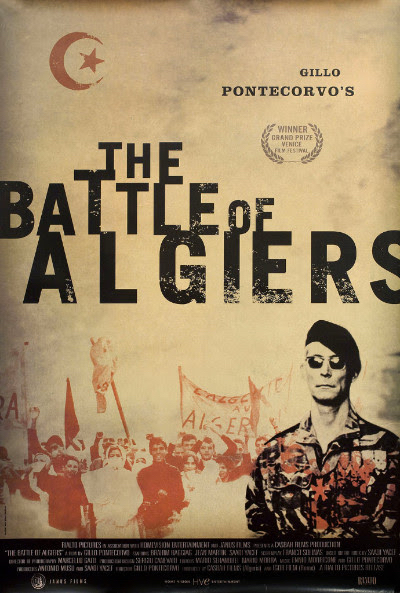
Before I get to Roger’s note, I have seen the film and, while it was released in 1967, the issues portrayed in the film are pertinent today. With a feel of direct cinema and cinema verite’, The Battle of Algiers is engaging and delivers a closeup view of terror, tactics and strategy. Highly recommended!

Dear Cinephiles,

50 years ago, Italian filmmaker Gillo Pontecorvo released one of the greatest movies ever made – THE BATTLE OF ALGIERS. The film is a big-screen recreation of the bloody mid 1950s Algerian uprising against French rule. The film was shot on a low budget and used non-actors from Algiers. The fact that the point of view is from those colonized rattled the French government enough to ban the film. It went on to get three Oscar nominations including Best Director. The film is a masterpiece, and it has been restored in a gorgeous digital print. This film is so influential – and political thrillers filmed today borrow from Pontecorvo’s style.

THE BATTLE OF ALGIERS is as urgent and immediate as it was 50 years ago. Below find a wonderful essay by Justin Chang from the LA Times on the film’s importance. It plays tonight at 5:00pm and tomorrow at 7:30pm at the Riviera Theatre. I will highly encourage you to see this landmark film.

See you at the movies!

Roger Durling

Get tickets here.

algiers1

Once banned, ‘Battle of Algiers” smart, compassionate take on terror and rebellion resonates today
By Justin Chang – LA Times

For those who have seen “The Battle of Algiers,” Gillo Pontecorvo’s masterful 1966 panorama of political insurrection and urban anxiety, the title alone can summon forth indelible images of Algerian resistance. Three women sneak through the crowded casbah to plant bombs in public places. A revolutionary leader named Ali La Pointe (Brahim Haggiag) waits quietly in the darkness as he’s surrounded by police. A triumphant throng of men and women shout and cheer amid a rising cloud of smoke as their hard-fought dream of independence has finally come to pass.

Buried amid all these defining moments is a calm, pivotal scene in which a French military chief named Col. Mathieu (Jean Martin) trains his soldiers to root out members of Algeria’s National Liberation Front, cautioning them to be discriminating in their search. “Are they all our enemies? We know they’re not,” he says of the Algerian locals. “But a small minority holds sway by means of terror and violence. We must deal with this minority in order to isolate and destroy it.”

It is difficult to read those words in isolation, divorced from their political and cinematic context, and not hear a shivery echo of recent headlines. You may have heard someone express a similar sentiment when parsing the Israeli-Palestinian conflict, or differentiating between Muslims and Islamists. However chilling Mathieu’s sentiments may be, they may strike you as a model of sensitivity compared with Donald Trump’s infamous remarks about the Muslim world — or, for that matter, his son Donald Jr.’s recent comparison of the Syrian refugee population to a bowl of selectively tainted Skittles.

Closer to home, the notion of a dangerous sub-minority feels painfully relevant to the ongoing clashes between police officers and unarmed black men in America. The latest fatalities in El Cajon, Calif.; Tulsa, Okla.; and Charlotte, N.C., suggest that when it comes to this cycle of senseless violence, too many cops — however vehemently they might deny it — still view great swaths of the African American population as a criminal menace by default. (Reviewing Pontecorvo’s film in 1967, then-New York Times critic Bosley Crowther wrote, “One may sense a relation in what goes on in this picture to what has happened in the Negro ghettos of some of our American cities more recently.”)

All of which is a roundabout way of saying that there has perhaps never been a better time to experience or re-experience “The Battle of Algiers,” which is commemorating its 50th anniversary with a digital 4K restoration that will appear in select theaters on Oct. 7 courtesy of Rialto Pictures. Then again, as history is always at pains to remind us, there has never been an inappropriate moment for a picture that so completely collapses the distance between now and then.

The movie’s tremendous dramatic urgency and sociopolitical currency can be attributed, in no small part, to its still-electrifying alchemy of form and content. Mimicking the jagged, caught-on-the-fly syntax of a ’50s black-and-white newsreel even as it moves with the propulsive sweep of a thriller, the movie seems to be everywhere at once, the camera capturing pockets of anxiety and unease even in broad daylight.

A dangerous armed movement rises from the shadows, yet with an insistently human face. Soldiers bound up the steps of the casbah, their footfalls echoed by the up-and-down rattlings of Ennio Morricone’s score. The omniscience of the film’s perspective and the fluidity of the editing ease us into the narrative yet slowly divest us of our moral bearings. The film is not just a relentlessly gripping entertainment but also a cinematic Rorschach blot, a moral miasma that tosses our sympathies this way and that.

Feared, loathed and loved over the last half-century, “The Battle of Algiers” won the Golden Lion at the 1966 Venice Film Festival and was later nominated for three Academy Awards (director, original screenplay and foreign-language film). It was deemed so incendiary in France that it was banned there for five years, and even afterward it has remained a magnet for controversy, often derided as an apologia or a blueprint for terrorism, rather than a call for common understanding.

It’s worth recalling that the last time “The Battle of Algiers” showed theatrically here was in 2004, during the U.S. invasion of Iraq. A few months earlier, in 2003, the Pentagon hosted a private screening, advertised by a flier that touted the picture’s relevance: “How to win a battle against terrorism and lose the war of ideas. Children shoot soldiers at point-blank range. Women plant bombs in cafes. Soon the entire Arab population builds to a mad fervor. Sound familiar? The French have a plan. It succeeds tactically, but fails strategically. To understand why, come to a rare showing of this film.”

Whatever viewers at the time might have learned about how a Western imperialist power should or should not deal with a rapidly mounting, many-sided insurgency, those lessons seem positively quaint in light of the geopolitical crisis that looms before us at present, following the rise of Islamic State and the subsequent deadly attacks in Europe and the U.S. What might have once seemed a far-flung, local concern has spread far beyond Iraq to consume what feels like the world entire. Meanwhile, on a very different yet simultaneous front, the struggle for black justice at home continues, and for some Americans, its roots and motivations — and the cycles of brutality and unrest that emerge in its wake — are no less difficult to grasp.

Who is safe? Who is innocent? Why must they riot? Where will the next attack occur? Was that shooting or bombing the work of a terrorist, or just an unhinged mind? (And in the end, does it matter?) “The Battle of Algiers” offers no reassuring answers to these questions, but to watch the film, with its startlingly evenhanded treatment of both sides, is to experience the sort of mature intelligence and tough-minded compassion that makes you long to believe hope is still possible.

The film’s greatness was hardly preordained. In his essay for the 2004 Criterion Collection DVD release, British film lecturer and critic Peter Matthews recalls how “The Battle of Algiers” was originally conceived along more Hollywood-friendly lines, complete with a journalist hero (set to be played by Paul Newman) who would serve as an entry point for Western audiences. Fortunately, heeding the influence of their country’s neorealist masters, Pontecorvo and screenwriter Franco Solinas refused to make the Algerians a secondary presence in their own story. As Matthews writes, the filmmakers “knew that every artistic decision is simultaneously an ethical one.”

If the perspective of “The Battle of Algiers” still feels radically diffuse, its aesthetic choices have been more readily absorbed into the mainstream. A war film shot with bristling handheld urgency — like, say, Paul Greengrass’ “Bloody Sunday” and “Green Zone,” or Alfonso Cuarón’s “Children of Men” — is no longer compared to documentaries or newsreels; hyperkinetic Steadicam is simply par for the course. The use of untrained performers (Martin was the sole professional actor cast in Pontecorvo’s film) is no longer a novelty, even if most American films still rely on big-name stars and strong, relatable protagonists to lure audiences toward difficult subject matter.

The spirit of Pontecorvo’s filmmaking can be felt even in pictures with markedly different stylistic DNA. Picking up where “The Battle of Algiers” left off, Kathryn Bigelow’s excellent post-9/11 thrillers address the ground-level pressures of dealing with an insurgency (“The Hurt Locker”) and the morality of torture (“Zero Dark Thirty”). Clint Eastwood’s World War II drama “Letters From Iwo Jima,” though done in a much more classical register, feels no less powerful in its willingness to penetrate the mind-set of a side that we typically perceive as the enemy.

Ken Loach, who has long cited Pontecorvo’s influence, made perhaps his most “Algiers”-like effort with 2006’s “The Wind That Shakes the Barley,” which also chronicled the tensions that flare between the occupiers (the British) and the occupied (the Irish). When Loach received the Palme d’Or at Cannes for the film, the words he spoke might as well have been a permanent epitaph for “The Battle of Algiers,” if “epitaph” is the right word for a film that refuses to die: “Maybe if we tell the truth about the past, we tell the truth about the present.”

showcasesbiffshowcasesbiff


FILM REVIEW: GIGOLA (CHARPENTIER, 2011)

Reviewed by Larry Gleeson. Viewed at the Santa Barbara International Film Festival 2011.

Gigola, directed by Laure Charpentier, is a French film with subtitles set in the early 1960’s Paris containing themes of adult sexuality and gender issues. The film made it’s debut at the Cannes Film Festival. From there Gigola was shown at the Hamburg Film Festival in Germany and finished out the year at the Paris Gay & Lesbian Film Festival, in Paris, France. The mise-en-scene is in Gigola is remarkable. The costumes, make-up, and lighting are spectacular conveying images reminiscent of That’s Entertainment (1974), and Moulon Rouge (2001).

The film opens with a teenage school girl named George, played by Lou Dillion, as a  young and slender coming of age debutante, and her teacher, an attractive mid 30ish woman. Playful background music provides energy for a highly sexually charged, sensual transaction between George and her teacher.

Charpentier jumps ahead to 1963 Paris nightlife scene. George’s boy friend has committed suicide. George has decided to withdraw from school and announces to the night-time partiers that she has flunked out of medical school seemingly intentionally.

Next time we see George she is in a Parisian bistro and we are introduced to a Carol Channing like character. George has reinvented herself.

A comment is made  to George, “You look like a gigolo.”

George coolly replies, “Gigola.”

We now see George as Gigola, the name she has given her new self. A well-to-do matron comes to the bistro and Gigola is into action. Dressed in a black tuxedo, Gigola escorts the matron onto the dance floor for a spin. Soon the pair leave the bistro together and head to the matron’s estate. With grace, elegance and a touch of class Gigola seduces the matron in an erotic bedroom scene with a snake-headed cane and white gloves.

Gigola, if nothing else, knows what she wants and she goes after it. She threatens to leave her new found matron unless she receives more money. The matron has already given Gigola a signet ring and a red MG convertible. The matron capitulates handing over to Gigola a large cache of currency. We now witness Gigola expanding her “business” with new girls working under her discretion.

Meanwhile, Gigola’s father, an opium addict, is squandering away the family’s estate as he cogently leads the life of a Parisian gentlemen. Eventually Gigola confronts her father brandishing a loaded revolver after repeatedly warning her father to stay away and, in turn, pleading with her mother to cut him off.

After an attempted suicide, Gigola finds herself under the care of a psychiatrist who bears a striking resemblance to her former teacher. She suggests having a baby to Gigola. Gigola is less than optimistic but the psychiatrist is able to connect with Gigola. Never one to miss an opportunity, Gigola deftly makes clear her intentions to the attractive psychiatrist. When the psychiatrist makes a “house call” Charpentier uses a wrestling take down move to portray the mixed emotions the psychiatrist has – she is attracted to Gigola but she is married and lives according to her principles as a married woman – a defining characteristic of the times. The psychiatrist cares about Gigola and they have dinner together where she tells Gigola that Gigola needs to let go.

Again without missing a beat Gigola moves deeper into the nightclub scene in Paris meeting a Mr. Tony Pasquale, a Sicilian. The two gain a mutual respect for each other and Tony ends up impregnating Gigola. Gigola has the baby and it seems as though Gigola has accepted normalcy and is conforming to societal norms. Gigola has left and George has come back.

However, before a sigh of relief can be expressed, in tromps the cast from the bistro. A raucous scene ensues in the hospital room with Gigola consenting to have her locks cut – a symbol of Gigola’s re-emergence.

The film closes with Gigola adhering to her somewhat circular, misguided idealism. She has turned over the care of her child to her mother and she is shown in tuxedo walking down a Parisian cobblestone alley way with her back back to the camera just before sunrise.

Amazing Friday night film for the right audience. Gigola is currently available on Amazon Prime.

SBIFF The Showcase – The Battle of Algiers

NEW RESTORATION OF THE 1967 ITALIAN FILM MASTERPIECE!

THE BATTLE OF ALGIERS
Directed by Gillo Pontecorvo
Written by Franco Solinas, Gillo Pontecorvo
Starring Brahim Haggiag, Jean Martin, Saadi Yacef
Country of Origin: Algeria/Italy
Running Time: 123 min
Subtitled

 algiers

New restoration of one of the most influential political films in history, The Battle of Algiers (1966), vividly re-creates a key year in the tumultuous Algerian struggle for independence from the occupying French in the 1950s. As violence escalates on both sides, children shoot soldiers at point-blank range, women plant bombs in cafés, and French soldiers resort to torture to break the will of the insurgents. Shot on the streets of Algiers in documentary style, the film is a case study in modern warfare, with its terrorist attacks and the brutal techniques used to combat them. Pontecorvo’s tour de force has astonishing relevance today.

 Here’s what other leading critics are saying:

“ASTONISHING! A political thriller of unmatched realism!”
A.O. Scott, The New York Times

“A GREAT FILM…Everything about this film says it’s real, it’s happening now, it’s important.”
Kenneth Turan, Los Angeles Times

“PULSES WITH ENERGY! As urgent, intense, prescient as ever!”
Ann Hornady, The Washington Post

Screening:
Sunday October 23 @ 2:00pm
Monday October 24 @ 7:30pm
Tuesday October 25 @ 5:00pm
Wednesday October 26 @ 7:30pm
at the Riviera Theatre
2044 Alameda Padre Serra

riviera

See you at the movies!

santa-barbara-riviera-theater1

(Source:sbiff.org release)