Tag Archives: Technology

FILM REVIEW: Charlie Victor Romeo (Berger, Daniels, Michelson, 2013): USA

Reviewed by Larry Gleeson. Viewed during the AFI Filmfest 2013.

Interestingly, the film Charlie Victor Romeo, evolved from an award-winning play created in 1999 by Daniels, Berger and Gregory. The play captured two Drama Desk Awards for Outstanding Unique Theatrical Experience and Outstanding Sound Design and received recognition from Time Magazine in 2004 as Best Theatre Top Ten plays. The 1999 theatre version eventually was videotaped and the Smithsonian Aviation Museum reviewed it. Shortly thereafter, the aviation community picked it up and incorporated it into its repetoire of training tools for its pilots’ Crew Resource Management. After its 1999 opening at Collective:Unconscious in New York City, the played toured internationally and nationally until 2008.

The film version of  Charlie Victor Romeo, is a collaborative effort between Collective:Unconscious and 3LD Art & Technology Center. The production was filmed at 3LD Art & Technology Center as part of its new 3LD/3D+ program, a cross-platform for distribution and production of experimental work and made its West Coast premiere on Saturday, November 9th, at the AFI Filmfest 2013. Following the second viewing at the Filmfest on November 11th, the cast of Patrick Daniels, Irving Gregory, Noel Dinneen, Sam Zuckerman, Debbie Troche and Nora Woolley hosted a Q & A. Producer Catarina Bartha was also in the house to support her cast.

Berger, when asked what was the motivation behind the project, conveyed that it wasn’t anything political that it was simply trying to make something of interest to an audience.

In its most basic sense, Charlie Victor Romeo, dramatizes the human intensity that surfaces during the distressed descents of six airline crashes culled from dialogs taken from the surviving black box transcripts. In introducing the affected flights overlay schematics display the failed mechanical parts of the air crafts.

The team of screenwriters, Berger, Daniels and Gregory, scoured the typed transcripts of scores of airline emergencies and crashes, finally settling on the six presented. The criteria used in choosing which emergencies to dramatize the team wanted scenarios with enough emotional intensity that they could perform the scenes dramatically. They also wanted situations that illuminated the aviation perspective. And, finally, they wanted material that allowed their performances to create a bridge for the audience between professional aviation and their art in portraying  the human aspect of handling an aviation emergency while in inflight when things go horribly wrong. All the flights selected had issues due to mechanical failures.

Charlie Victor Romeo, creates a spell-binding, psychologically thrilling techno experience within a tension-filled cockpit as the flight crews provide testament to the ability to live life to the very last second while deftly providing insight into who the people are that we entrust our lives to during airline flights and what they do when things go horribly wrong. Furthermore, the conscious decision to use 3D technology enabled the troupe to help bring the reality of being in the cockpit directly to the audience consciousness during the catastrophic experience as the pilots fight to save their passengers and themselves from an impending disaster.

In my opinion, Charlie Victor Romeo, pushes boundaries proving stereoscopic lensing is no longer the exclusive d0main of the epic major studios productions. But more than that, Charlie Victor Romeo, takes real-life aviation emergencies and brings them into the mainstream consciousness in a very humanistic way. Recommended


Note from Roger – Tower

Dear Cinephiles,

TOWER is flat out brilliant.  One of the best documentaries of the year.    And it’s also the most visually immersive unique visual experience.

I cannot recommend this spellbinding film more.  I’m attaching the NY Times review below which was a Critic’s Pick.

It plays tonight at 7:30pm at the Riviera Theatre.

See you at the movies!
Roger Durling

Click here for tickets

tower

‘Tower,’ About 1966, Before Mass Shootings Became Routine
By Manohla Dargis – The New York Times

The haunting documentary Tower revisits a 1966 mass shooting at the University of Texas at Austin that shocked the country. It may be difficult to comprehend the reaction to the horror of Charles Whitman, a 25-year-old student who shot more than a dozen dead, wounding more than twice as many. A cover story in Life magazine suggested just how alien the carnage seemed at the time, noting that during the rampage Whitman’s actions were “so outrageous, so hard to grasp, that people could not believe it.” Many more mass shootings later, it’s now tragically easy to believe.

You get a sense of just how brutal and absolutely foreign that violence must once have seemed in Tower. Directed by Keith Maitland, the movie is partly based on “96 Minutes,” an article by Pamela Colloff that ran in Texas Monthly in 2006, the 40th anniversary of the shooting. Most of the article was an oral history based on interviews that she skillfully pieced together for a mosaiclike remembrance. Mr. Maitland borrows this approach, drawing on first-person accounts, as well as archival and original sources. He’s also turned much of this material into walking, talking animations with the help of actors, an ingenious stroke that — at least at first — helps create some needed critical distance.

Whitman was one of the year’s big news stories alongside Vietnam. Time magazine put him on its cover, running a banner (“The Psychotic & Society”) across a photo of him — just another smiling guy in glasses — reading a newspaper, with a small dog at his side. In time, he was transformed into a popular culture touchstone in Peter Bogdanovich’s Targets, a 1968 thriller that drew on the incident; “The Ballad of Charles Whitman,” Kinky Friedman’s 1973 satirical song that frames the blood bath as an all-American story; and “The Deadly Tower,” a 1975 made-for-TV drama. By important contrast, Tower isn’t about Whitman; he isn’t its subject, star or selling point.

Tower also isn’t about why Whitman committed his atrocities or even how. There’s little information on him — his background, beliefs, history or health — in the documentary. His name is barely mentioned. He’s there throughout, though, represented as the unknown shooter in the frightened recordings of people phoning in reports; in police dispatch calls; in intermittent gunfire; and in the eerie puffs of gun smoke emanating from the university tower where he took position. He is a question mark, a lethal void whose immateriality makes an agonizing contrast to the men and women he shot, those who died as well as those who suffered and survived.

This shift in focus — from the perpetrator to the victims — doesn’t read as especially American or cinematic. (One of Hollywood’s most durable genres is the gangster movie, after all, not the victim picture.) And while there may be all sorts of sociopolitical and psychological explanations for why movies are so violent, it’s also just an easy way to keep people nervously waiting and watching. Mr. Maitland put in time as an assistant director on the TV series “Law & Order” and he understands how to narratively string out violence. The movie begins with Neal Spelce (Monty Muir), a journalist gutsily reporting from the scene while driving closer to it, an opener that creates instant tension.

The scene then shifts to Claire Wilson James (Violett Beane), a heavily pregnant freshman who is just finishing a coffee break with her boyfriend, Tom Eckman (Cole Bee Wilson). As they’re walking across campus, they are both hit. Claire goes down first, followed by Tom. They remain where they fall for an unbearably long time, creating a ghastly spectacle that becomes an emblematic tableau that Mr. Maitland returns to again and again, at times using news footage. He soon adds other victims and voices, including that of Aleck Hernandez Jr. (Aldo Ordoñez), a teenager on his paper route riding past the campus, his cousin perched on his bike.

The expressive animation was done via rotoscoping, a technique that involves tracing moving images by hand (as in Disney’s Snow White) or through software (as in Richard Linklater’s Waking Life). The results in Tower are extremely liquid, with each line incessantly ebbing and flowing, creating a vivid sense of life. The animation gives Mr. Maitland a lot of creative freedom, allowing him to take Expressionistic leaps. When Ms. James and Mr. Eckman are shot, their bodies briefly transform into wrenching, twisting white silhouettes while the backdrop becomes a blast of bright red. You are spared the blood, even as the horror creeps in and then floods you.

In her article, Ms. Colloff noted that, surprisingly, perhaps, outside of some bullet holes, there were no physical reminders of the shooting at the University of Texas until 1999, when the school created a memorial garden. “No plaques had ever been displayed, no list of names read, no memorial services held,” she wrote. In 2007, the school finally installed a plaque observing the shooting, and this Aug. 1, the 50th anniversary, it dedicated a new memorial. Using a limited frame, Mr. Maitland does his own commemorating, inherently raising questions about terror, the nature of heroism and what it means to really survive. He also does something even more necessary: He turns names on a plaque into people.

Girls und Panzer Film Opens in U.S. on November 18 With San Francisco Premiere

Film distribution company Eleven Arts confirmed on Thursday that it will release the English dub of Girls und Panzer der Film in theaters on November 18. The company will hold the official premiere at the New People Cinema in San Francisco at 7:00 p.m. that day. The event will include a Q&A with the English dub‘s director after the film’s screening. Eleven Arts will announce more screenings in other theaters on Friday.

Sentai Filmworks licensed the film and previously announced plans to release the film in theaters in November. Sentai Filmworks also plans to reveal more details on “distribution, release date, and streaming offerings” at a later date.

The Girls und Panzer film is director Tsutomu Mizushima’s follow-up to his 2012 Girls und Panzer television anime about schoolgirls who learn to battle in tanks with other teams nationwide.

(Source: http://www.animenewsnetwork.com)

29th Tokyo International Film Festival Unveils Full Lineup

The Tokyo International Film Festival (TIFF) held a press conference to announce lineups in the all sections, jury members, and this year’s topics and highlights at Toranomon Hills Forum in Tokyo.

screen-shot-2016-10-03-at-5-09-19-pm

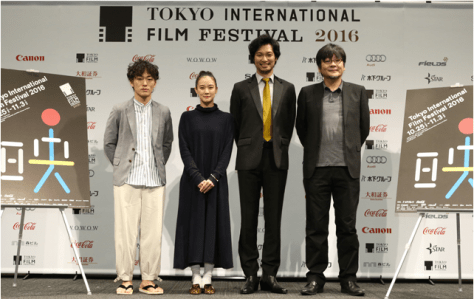
From left: Daigo MATSUI, Yu AOI, Munetaka AOKI, and Mamoru HOSODA ©2016 TIFF

Yasushi SHIINA, Director General of TIFF & TIFFCOM, made opening remarks and announced that the festival muse for this year is Haru KUROKI, one of the most accomplished actresses in Japan. TIFF’s programing directors then took the stage to introduce the lineup for each section of the 29th edition, as well as to reiterate the prior announcements of the Opening film, Stephen Frears’ Florence Foster Jenkins and the Closing film, Yoshitaka MORI’s Satoshi: A Move for Tomorrow.

In the Competition section, 16 films were selected from among 1,502 titles from 98 countries and regions. Representing the two Japanese titles in this main competitive section, director Daigo MATSUI and actress Yu AOI from Japanese Girls Never Die, and actor Munetaka AOKI from Snow Woman were welcomed on the stage and made remarks.

Click here for the Full Competition Lineup.

Acclaimed director Mamoru HOSODA, who is being honored this year with “The World of Mamoru Hosoda” in the Animation Focus section, greeted the audience after the retrospective lineup was announced. He will appear for stage talks during TIFF with such special guests as director Hirokazu KORE-EDA and filmmaker Daisuke “Dice” TSUTSUMI.

This year’s International Competition Jury members were also announced. French director/writer/producer Jean-Jacques BEINEIX will serve as President, working with director Hideyuki HIRAYAMA, actor Valerio MASTANDREA, producer Nicole ROCKLIN, and director Mabel CHEUNG.

During the 10-day celebration, more than 200 films will be screened and there will be unique film-related events every day at the festival venues, including stage appearances, Q&A sessions and symposia featuring celebrated guests from around the world.

The 29th TIFF will take place October 25 to November 3, 2016 at Roppongi Hills, EX Theater Roppongi (Minato City) and other theaters, halls and facilities in Tokyo Metropolitan Area.

(Source:www.tiff-jp.net)


Hosoda hopes to surpass anime legend Miyazaki

Posted by Larry Gleeson

By Olivier Fabre

screen-shot-2016-09-29-at-5-01-37-pmTOKYO —

Mamoru Hosoda, one of Japan’s young anime directors hoping to lead the industry after the retirement of legendary animator Hayao Miyazaki, says he hopes to surpass his boyhood hero one day, but don’t look for Miyazaki in his movies.

“That won’t happen. It is only right that different directors create totally different works,” Hosoda, 49, told Reuters TV ahead of the Tokyo International Film Festival next month where a retrospective of his work will be shown.

“I think there are movies that only I can create and movies that only I know how to make people enjoy them,” he said.

Hosoda’s rise to fame culminated with his 2015 box office hit “Boy and the Beast”, which grossed over 5.8 billion yen ($57 million) to become the second most watched movie in Japanese theatres that year.

His movies are colorful and vibrant and appear to follow in Oscar-winning Miyazaki’s footsteps. However, Hosoda regularly chooses themes related to family and identity, which disappoint some fans who seek the more immersive fantasy provided by works out of Miyazaki’s Studio Ghibli.

“The Boy and the Beast” explores the relationship between a paternal beast-father figure and a run-away child. His previous film, “Wolf Children”, centered on a single mother raising children fathered by a werewolf.

Hosoda said his deeper exploration of the meaning of self-identity in an extremely homogeneous nation are often lost on viewers.

“I think there are possibly people in the audience here who were not able to understand that. And that, in a way, is representative of Japan today,” he said.

Hosoda is hopeful for the future of Japan’s animation industry despite the fact that more and more animators rely on computer graphics to polish their work.

“There are, or should be, multiple correct ways to express oneself in animation,” he said.

“If you start saying that only Disney or Pixar animations are the right kind of animations, that just becomes very boring. If everything needs to have computer graphics,then you lose a lot of the richness in expression available in animations,” he added.

“The World Of Mamoru Hosoda” retrospective runs from October 25 to November 3 at the Tokyo International Film Festival and will include movies such as the critically acclaimed “Summer Wars”.

(c) Copyright Thomson Reuters 2016.

(Source: http://www.japantoday.com)

ZERO DAYS: Opening Night Gala @AFIDOCS

North American Premiere

ZERO DAYS, directed by Alex Gibney is slated for Opening Night Film for the 2016 American Film Institute’s AFI DOCS. The film will be making its North American Premiere on Wednesday, June 22, 2016, 7:30 P.M., at the Newseum in Washington, D.C.

unnamed

When independent Internet technicians discovered a chillingly powerful computer virus unlike anything they’d seen before, signs pointed not merely to recreational or criminal hackers, but to a high-stakes game of cyber warfare between nations. Academy Award®-winning filmmaker Alex Gibney returns to the festival with ZERO DAYS, a fascinating exposé of American and Israeli covert operations aimed at Iran’s nuclear program. Gibney (TAXI TO THE DARK SIDE, GOING CLEAR: SCIENTOLOGY AND THE PRISON OF BELIEF) is a master of investigative documentary filmmaking, shining a light on institutions as diverse as WikiLeaks, the Church of Scientology, Apple Inc., Enron and the U.S. military. His latest work poses compelling and critically important questions about the role of technology in war and foreign policy, and its worldwide implications. — Mimi Brody

For more details click here.