Tag Archives: david Lynch

World Premiere of Focus Features’ SONG SUNG BLUE to Close 2025 AFI FEST, October 26th.

Posted by Larry Gleeson


WORLD PREMIERE OF SONG SUNG BLUE TO CLOSE AFI FEST 2025 PRESENTED BY CANVA

PASSES NOW ON SALE

FOR IMMEDIATE RELEASE – Los Angeles, CA, September 10, 2025 — Today, the American Film Institute (AFI) announced that the World Premiere of Focus Features’ SONG SUNG BLUE, written and directed by Craig Brewer, will close the 39th edition of AFI FEST presented by Canva on Sunday, October 26.

Based on a true story, the film follows two down-on-their-luck musicians, played by Hugh Jackman and Kate Hudson, who form a joyous Neil Diamond tribute band, proving it’s never too late to find love and follow your dreams. The film is produced by John Davis (p.g.a.), John Fox (p.g.a.) and Craig Brewer (p.g.a.) and features Michael Imperioli, Ella Anderson, King Princess, Mustafa Shakir, Hudson Hensley, with Fisher Stevens, and Jim Belushi.


Bob Gazzale, AFI President and CEO

“AFI FEST is proud to close our annual celebration of excellence and artistry with the World Premiere of SONG SUNG BLUE – a timely film about love and resilience – music and magic,” said Bob Gazzale, AFI President and CEO. “Audiences will leave the theater chanting the refrain of “Sweet Caroline” – so good, so good, so good!”


The festival will take place October 22–26 at the TCL Chinese Theatres in the heart of Hollywood and feature a curated selection of Red Carpet Premieres, Special Screenings, World Cinema, Documentaries and Short Films.

As previously announced, Academy Award®-winning filmmaker Guillermo del Toro will serve as the Guest Artistic Director for this year’s festival, and the festival will open with SPRINGSTEEN: DELIVER ME FROM NOWHERE, starring Jeremy Allen White and written for the screen and directed by Scott Cooper.

Passes to AFI FEST 2025 are now available for purchase online at FEST.AFI.com. Festivalgoers have the opportunity to purchase a Star Pass or upgrade to a Patron Pass. The AFI FEST Star Pass is a five-day pass with access to all screenings (excluding Red Carpet Premieres), early screening selection before individual tickets go on sale, priority theater access, entry to the festival lounge, invitation to the festival mixer to mingle with filmmakers and guests, a complimentary AFI FEST tote and free Rush Line access to all screenings. The AFI FEST Patron Pass features all the benefits of the Star Pass plus two tickets to all of the star-studded Red Carpet Premieres held at the historic TCL Chinese Theatre and priority screening selection before Star passholders.

The full festival lineup will be unveiled on September 30. Individual tickets will be available on October 6.

AFI FEST is recognized by the Academy of Motion Picture Arts and Sciences as a qualifying festival for the Live Action, Animated and Documentary Short Film categories for the annual Academy Awards®. AFI FEST is also a qualifying festival for consideration for the British Short Film categories of both the BAFTA Film Awards and the British Independent Film Awards (BIFA).

AFI is a nonprofit, donor-powered organization. Join AFI’s Premiere Circle to support the American Film Institute and enjoy access to exclusive one-of-a-kind opportunities at AFI events, including AFI FEST. To learn more, email Advancement@AFI.com.

Canva, the all-in-one visual communication and collaboration platform, returns as the exclusive Presenting Sponsor of AFI FEST 2025. Designed to empower entertainment professionals to visualize their ideas into impactful film and TV projects, Canva will be integrated throughout AFI FEST including hosting industry networking events, hands-on training workshops for filmmakers, and powering the festival’s digital and printed materials. Entertainment professionals can explore resources to pitch projects, plan shoots, and bring creative visions to life at canva.com/entertainment.

About the American Film Institute (AFI)

The American Film Institute (AFI) is a nonprofit organization with a mandate to champion the moving image as an art form. Established in 1967, AFI launched the first comprehensive history of American film and sparked the movement for film preservation in the United States. In 1969, AFI opened the doors of the AFI Conservatory, a graduate-level program to train narrative filmmakers. The Conservatory, which counts Deniese Davis, Affonso Gonçalves, Susannah Grant, Matthew Libatique, David Lynch, Melina Matsoukas and Rachel Morrison as Alumni, is ranked as one of the top film schools in America. AFI’s enduring traditions include the AFI Life Achievement Award, which honors the masters for work that has stood the test of time; AFI AWARDS, which celebrates the creative ensembles of the most outstanding screen stories of the year; and scholarly efforts such as the AFI Catalog of Feature Films and the AFI Archive that preserve film history for future generations. AFI exhibition programs include AFI FEST Presented by Canva and year-round exhibition at the AFI Silver Theatre and Cultural Center in Maryland. AFI Movie Club is a destination for movie lovers from around the world to celebrate and engage with the art form every day. Other pioneering programs include workshops aimed at elevating emerging storytellers and technology, including AFI DWW+ and the AFI Cinematography Intensive Workshop. Read about all of these programs and more at AFI.com and follow us on social media at Facebook.com/AmericanFilmInstitute, YouTube.com/AFI, X.com/AmericanFilm, TikTok.com/@americanfilminstitute and Instagram.com/AmericanFilmInstitute.

About AFI FEST
Now in its 39th year, AFI FEST is a world-class event, showcasing the best films from across the globe. This year’s edition takes place in Los Angeles from October 22-26, 2025. With an innovative slate of programming, the five-day festival presents screenings, panels and conversations, featuring both master filmmakers and new cinematic voices. AFI FEST includes high-profile films with Q&As featuring the films’ cast and crew and a robust lineup of fiction and nonfiction features and shorts, providing a one-of-a-kind experience for movie fans. Additional information is available at FEST.AFI.com. Connect with AFI’s film festival at Facebook.com/AFIFEST, Twitter.com/AFIFEST, Instagram/AmericanFilmInstitute, TikTok/@AmericanFilmInstitute and YouTube.com/AFI.

About Canva
Launched in 2013, Canva is the world’s leading all-in-one platform for visual communication and collaboration. Built to empower everyone to design, the company serves the creative and design needs of enterprises, small businesses, consumers, and students in more than 190 countries worldwide. Whether you’re a novice taking your first steps in design, or a creative professional seeking powerful tools, Canva ensures users have what they need to transform an idea into something beautiful. Underpinned by the world’s most comprehensive library of designer-made content, Canva is powered by a suite of products and proprietary AI tools which elevate how individuals and teams create, collaborate, and communicate with ease.

Press contact:

American Film Institute: Shari Mesulam, shari@themesulamgroup.com

David Lynch and Johnny Depp are helping a teenager with stage four cancer make a gory zombie film

Posted by Larry Gleeson

By Olivia Waring

Horror fan Anthony Conti has stage four kidney cancer, but thanks to the Make A Film Foundation, his short film The Black Ghiandola, starring Depp, Lynch, Laura Dern and JK Simmons, is in post-production.

It was also co-directed by three massive Hollywood names — Evil Dead director Sam Raimi, Twilight director Catherine Hardwicke and St Vincent director Ted Melfi — during the five-day shoot.

screen-shot-2016-12-08-at-1-24-56-am

The synopsis of the film, which Conti wrote himself, reads: ‘The Black Ghiandola centers on a young man, played by Anthony Conti, who risks his life to save the girl he loves, after his family is wiped out during a zombie apocalypse.’

Conti, who lives in Hollywood, already had experience making his own comedy/sci-fi YouTube series, The Satanic Zucchini Show.

He later managed to get this new project off the ground after contacting Make A Film Foundation to get hold of a copy of one of their other movies.

Writing The Black Ghiandola apparently helped Conti fight his cancer, and stars involved in the project have paid tribute to the ‘courageous’ youngster in touching a video from the foundation.

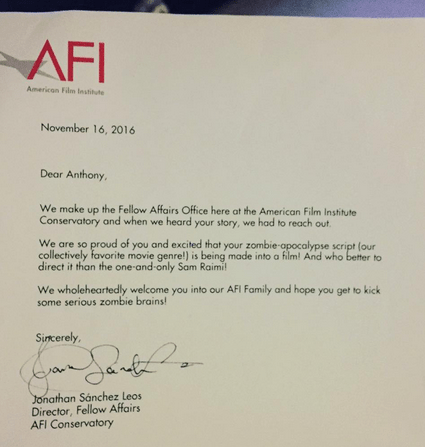
The teen also uploaded a shot of the letter he received from the American Film Institute telling him Sam Raimi would be directing his movie, which must have been a huge moment for him.

screen-shot-2016-12-08-at-1-27-36-am

Conti, who is undergoing chemotherapy, received financial help from dozens of Hollywood businesses, including channel AMC who make his fave show The Walking Dead, plus family members and online supporters.

Snaps from the set of the film show just how much fun all those taking part had, and how much fake blood was deployed, too.

screen-shot-2016-12-08-at-1-29-07-am

Depp appears to be playing a doctor who gets attacked by flesh-eating zombies, a role he no doubt relished.

screen-shot-2016-12-08-at-1-30-40-am

*Photos from @ThatOneAnt22 Instagram

(Source: http://metro.co.uk)

The AFI FEST Interview: KILL ME PLEASE Director Anita Rocha da Silveira

This debut film follows 15-year-old Bia and her friends as they grow up in the West Zone of Rio de Janeiro. As the girls try to navigate the usual pitfalls of puberty, a wave of murders sweeps the city and bodies begin to appear in the group’s usual stomping grounds. What starts as morbid curiosity slowly starts to infect their young lives, and after an encounter with death, Bia will do anything to stay alive. This audacious vision announces filmmaker Anita Rocha da Silveira as a rising talent whose mastery of dark subject matter is strikingly bold and altogether entertaining. The production, packed with killer performances from its young cast and brilliant music, is a giallo-tinged take on puberty and the experience of living in a girl’s body. As it reaches its tense conclusion, the  alchemy of styles creates something fiercely original.

AFI spoke to the director about the film, which screens as part of AFI FEST 2016’s Newscreen-shot-2016-10-27-at-6-25-40-pm Auteurs section.

AFI: Your film plays cleverly with horror film references. What inspired you?

Anita Rocha da Silveira: I’m particularly fond of David Lynch. The TWIN PEAKS pilot and BLUE VELVET were very important references. He inspired me to create an alternative universe where I could exaggerate the tones. Most importantly, however, I like the way he portrays flaming desire within a society that’s doomed to fail. I think mostly in characters such as Donna Hayward [on TWIN PEAKS], who feel everything so intensely that they seem just about to faint.

I’m also a fan of Dario Argento and got some inspiration from films like THE STENDHAL SYNDROME. Other essential references are Brian De Palma’s CARRIE, Jacques Tourneur’s CAT PEOPLE and Claire Denis’s TROUBLE EVERY DAY. Some might not consider TROUBLE EVERY DAY a genre piece but, for me, it’s one of the greatest films of the 21st century and an amazing modern vampire tale.

AFI: Your lead actor Valentina Herszage is an incredible discovery and a real-life high-schooler. Talk about your collaboration.

ARDS: It was very important to be able to work with teens of the same age as the characters. I didn’t want a 20-year-old playing a 15-year-old girl. I wanted to find teens who were going through similar dilemmas, [and had] faces that carried the marks of a stage in our lives when our bodies are constantly changing.

We knew we needed to find new talents, so we announced the casting call in drama classes and on Facebook. We saw around 300 girls in our first audition, then I picked 50 for a more specific activity. I finally came down to 13 for one last audition, from which I chose the leading role and the supporting characters.

screen-shot-2016-10-27-at-6-26-40-pm

Valentina was 15 years old during the shoot, and she fascinated me because of her love for horror movies — her favorite is THE SHINING. Other actresses were more prepared but she was fearless and that kind of energy was fundamental to the character. Together, we talked about sexuality, desires, experiences with death, violent impulses. She was always completely committed. 


AFI: Did the themes of religion come from your own personal upbringing, or did they erupt from the setting of the film?

ARDS: In Brazil, we’ve been seeing evangelical churches grow at an exponential rate. It’s the fastest growing religion in the country. Every election year we see the evangelical bench in congress increase, as well as the rise of conservative thought, along with the daily attack on women’s and LGBT rights.

We have several evangelical churches here, following different trends. For KILL ME PLEASE, I took my inspiration from a real church, with a big temple in the area where I shot, which targets a younger public. This church has teenage pastors, uses surf boards as altars and also pop music to attract followers. For me it was important to show the church because it’s part of the lives of many Brazilian youths, and also a counterpoint to [lead character] Bia’s desires and wishes. It represents a conservative discourse I’m fed up with, mostly about how a woman is supposed to behave.

Free tickets for KILL ME PLEASE will be available on AFI.com beginning November 1.

afi_logo_official

(Source: http://www.blog.afi.com)

FILM REVIEW: Eraserhead (David Lynch, 1976): USA

Reviewed by Larry Gleeson. Viewed at the Egyptian Theatre, AFI film festival, Hollywood, Calif.

screen-shot-2016-10-24-at-4-47-43-pmEraserhead, directed by David Lynch, the 2010 AFIfest’s guest director, continues to mesmerize audiences with its stark portrayal of the many all too human desires. As NY Times’ Manohla Dargis so eloquently writes “The black-and-white world of Eraserhead disturbs, seduces and even shocks with images that are alternately discomforting, even physically off-putting. It also amuses with scenes of preposterous, macabre comedy, among them a memorable family dinner involving a cooked bird that wiggles obscenely on its plate while it gushes forth a menacing dark liquid.” Consequently, Henry Spencer, played by John Nance is informed that he has fathered a child with girlfriend Mary X, played by Charlotte Stewart. However, the child is born as a mutated fetus. The doctors aren’t even sure the baby is human any longer. The baby appears with shuffling eyes and a bulbous wet head that looks like a skinned lamb and just lies on a table, cackling and cooing – more an emblem of dread than a bundle of joy. Henry and Mary move into Henry’s single-room apartment where the baby’s constant crying keeps them awake at night. Their existence is dominated by the overwhelming banality of Henry’s single apartment and its outlook onto a brick wall. Eventually, Mary walks out, leaving Henry with sole charge of the baby. Henry is left with what is some men’s greatest nightmare – of being left with the sole responsibility for  raising an unwanted child.

Throughout Eraserhead, Lynch plays with a good deal of sexual imagery and sexual energy which seems to be the through action of the film. In the opening moments, we see Henry floating through space dreaming and what look like sperm emerging from his mouth. When domestic life with the baby starts going wrong, Henry is seen pulling sperm out of the sleeping Mary’s mouth as though trying to symbolically reverse the pregnancy. The sex in the film seems tinged with disgust – Henry’s future mother-in-law questions Henry about whether he and Mary have had sexual intercourse and proceeds to come onto Henry by slobbering on his check and neck. Later  Henry hooks up with the seductive, attractive woman from across the hallway. However,  Henry’s bed turns into a glowing swamp. Henry’s pick up attempt comes full circle as he sees the woman seducing another man. She teasingly turns to Henry and laughs at him somewhat menacingly. The only happiness Henry seems to find is in his radiator dream-land where a girl with puffy pock-cheeked cabaret-style dancer  nervously sings and moves on stage as sperm drop on her. Perhaps as Richard Schieb suggests “this latter seems to be arguing that masturbation is the only safe form of sex – certainly, this would seem to be the case at the climax of the film, which sees Henry going off to join the pure and innocent puff-cheeked girl in radiator dream-land in a blaze of white light that may be the hereafter.” And who is the mysterious man depicted at the beginning and at the end of the film? He appears to be “the man behind the curtain” pulling the lever that controls Henry’s fate. Moreover, he quite possibly may represent Henry’s bloodline with his disfigured appearance shadowed by the flying sperm-like images. Or, maybe he represents a higher duality of fear and omniscience as Henry, in the opening scene, is seen confessing a wrongdoing and receiving forgiveness. This first scene sets the tone for Eraserhead. It is open to your interpretation.

Eraserhead certainly defies any type of classification. Lynch literally seems to have tapped into his subconscious. He uses dreams and dream-like imagery. Overall, Eraserhead  seems to symbolize industrial dehumanization to a post-holocaust nuclear proliferation era with powerful sexual overtones. Henry lives in the midst of an industrial wasteland. The only views we get of the outside world are of cold, dirty factories. The only greenery we see is in Henry’s room consisting of two piles of dirt, one on his dresser and one on his bedside table where branches have sprouted. And, as Scheib so poignantly asks, “What do the pencil erasers represent – do they, as some pedantic academic suggested, symbolically represent the mind’s ability to repress or ‘erase’ matter?” Indeed.

Eraserhead was produced by the American Film Institute (AFI). AFI is known for its Lifetime Achievement Awards and for its production of over 250 short films.  Eraserhead appeared at the 1976 Chicago International Film Festival, at the Filmex Film Festival in 1977 and at the 1978 Avoriaz Fantastic Film Festival garnering the Antennae II Award. In 2004, The USA National Film Preservation Board named Eraserhead to the National Film Registry. It took Mr. Lynch five years to complete it. Other notable films by Mr. Lynch include Mulholland Drive (2001), Blue Velvet (1986), Twin Peaks: Firewalk with Me (1992). Recommended.