Tag Archives: Actor

Lipstick Under My Burkha to be screened at 29th Tokyo International Film Festival

Posted by Larry Gleeson

By Suparno Sarkar

The movie Lipstick Under My Burkha will have its World Premiere at the 29th Tokyo International Film Festival to be held from Octoer 25 to November 3. Directed by Alankrita Shrivastava and produced by Prakash Jha, the film is set in the crowded lanes of a small town and chronicles the secret lives of four women in search of freedom.

Lipstick Under My Burkha features Konkona Sen Sharma, Ratna Pathak Shah, Aahana Kumra and Plabita Borthakur, among others.

Expressing her excitement about the movie being screened at the Tokyo Film Festival, the director said in a statement: “The landscape of small town India is rapidly changing, and women are finding the courage to think about what they truly want. Their secret dreams and veiled desires – just on the verge of breaking out. It is this point of transition that Lipstick Under My Burkha explores. Though locally rooted, it is a story with universal resonance. And I am delighted to begin the film’s journey at the esteemed Tokyo International Film Festival.”

Meanwhile, Konkona Sen Sharma is also delighted about the event. “It is truly an honour to have our film premiere at the Tokyo International Film Festival. I’m particularly excited because it is in a competitive section at such a prestigious festival,” she said.

screen-shot-2016-09-27-at-10-54-58-am
A still photo of Ratna Pathak from Lipstick Under My Burkha (Photo courtesy of PR Handout)


Ratna Pathak Shah added: “I am thrilled to be a part of this brave film that explores desire in the context of a changing India. And I am delighted that our film will premiere at the Tokyo IFF. It is wonderful news.”

(Source: http://www.ibtimes.co.in)

FILM REVIEW: La La Land (Chazelle, 2016): USA

Viewed by Larry Gleeson at Venice Film Festival.

Film Director Damien Chazelle’s La La Land comes on the heels of his Oscar nominated screenplay adaptation for 2015’s Whiplash, where a highly intense music teacher molds a young, dedicated student. J.K. Simmons performance as the teacher garnered him an Oscar for Best Performance by an Actor in a Supporting Role.

Chazelle, an avid music lover, had wanted to do a musical spectacle in the manner of Jacques Demy’s The Young Girls of Rochefort and The Umbrellas of Chambourg  while mixing in a splash of Gene Kelly and Stanley Donen’s Singing in the Rain. Moreover, Chazelle wanted a realism mixed into the story. Having resided in Los Angeles for the last ten years and having had a love affair with the city, Chazelle chose the City of Angels to set his Hollywood success-seeker film.

The film opens without much fanfare in a typical Los Angeles morning traffic jam. A young woman, Mia, played by Emma Stone, in a white Prius, is having an issue with her phone and misses an opportunity to move forward as the traffic jam has freed up somewhat. The young man behind her in a late 1980’s maroon-colored, Buick Riviera convertible, Sebastian, played by Ryan Gosling, lets her know with a blare of his horn and a not-so-friendly “good morning to you” gesture. Soon traffic slows again. This time, however, as radio are being dialed in, drivers begin exiting their vehicles and break into to an energetic, six-minute song and dance number, “Another Day of Sun,” staged on the 110 freeway overlooking downtown Los Angeles. As the song concludes, the title is flashed across the screen and the film is off and running with a start reminiscent of Elvis Presley and Ann-Margret in Viva Las Vegas.

La La Land is more about relationship and the life-changing experience two young lovers gain from each other. Mia is an aspiring actress mired in her real job as a barista juxtaposed against a series of failed acting auditions where she is continually interrupted. Sebastian, on the other hand, is a coarse, die-hard classical jazz pianist who doesn’t believe in compromising his convictions for anything or anyone. As their paths begin to cross Sebastian brushes off Mia as someone who will never understand his plight – until she does. When their paths finally converge, the harsh realities of life begin to set in and the two unknowingly turn to each other in raw emotional exchanges and thereby find the strength each needs to reach the stars.

In a powerful denouement in the city full of optimism and broken dreams, the story concludes with a Mick Jagger and Rolling Stones truism echoed faintly at first only to be finished with an exclamation point:

“You can’t always get what you want

But if you try sometime you find

You get what you need!”

And if the story isn’t enough in itself, the catchy musical numbers credited to Chazelle’s long-time friend and co-collaborator, Justin Hurwitz, will keep almost any music aficionado’s attention. If not, then the roving camera movement of cinematographer Linus Sandgren is bound to keep eyes in the scene. And, if that’s not enough, then the supercharged production numbers from choreographer Mandy Moore will keep you riveted as they sync in timing with Sandgren’s camera movement allowing the actors seemingly the ability to levitate. And in vein with Chazelle’s vision and outright homage to the musicals of the 50’s and 60’s, Production Designer David Wasco keeps the screen illuminated with a bright vision of reds, yellows, pinks, pastel greens and sky blues, aided wonderfully by Mary Zophres’ costuming, while the filming locations could very well serve as a Los Angeles pop culture tour.

If there’s only one film you can see this year – make it La La Land! Highest recommendation.

Which movies are in the running for the 2017 Oscars?


screen-shot-2016-09-26-at-11-40-47-am
La La Land with Ryan Gossling and Emma Stone is already a favorite to win the 2017 Oscar for Best Picture. (Photo courtesy of SND)

LOS ANGELES, Sept 25 ― What were the films and who were the actors who stood out at the latest film festivals? In the wake of the Venice, Toronto and Telluride festivals, here is an update on the movies and players potentially in the running for the 2017 Oscars.

In the period from September to December, the pace of superhero epic and action blockbuster releases slows down to make way for potential Oscar-winning works. This year is no exception with studios and distributors preparing to launch the movies they feel stand the best chance in the 89th Academy Awards at a time when they will still be fresh in the minds of the 2017 jury. What are the movies that will benefit from this Hollywood marketing strategy?

Top favourite ‘La La Land’

Having won the People’s Choice Award at the Toronto Film Festival, La La Land is now a serious contender for the 2017 Oscar for Best Picture. The Canadian accolade should not be overlooked. In fact it is a more than reliable indicator for the likely winner of a much-coveted gold statuette, having been awarded to such previous Oscar winners as Twelve Years a Slave, The King’s Speech, Slumdog Millionaire and American Beauty.

But it would be unwise to bet on the musical comedy which features Emma Stone and Ryan Gosling without evaluating the chances of some of the other movies that have come to light in the latest festivals: notably Manchester by the Sea, which is buoyed by a remarkable performance by Casey Affleck, Jeff Nichols’ Loving, Denis Villeneuve’s Arrival, Nocturnal Animals by Tom Ford, which won the Silver Lion at the 73rd Venice Mostra, and the biopic of Jackie Kennedy, Jackie, which could harvest a second Oscar for Natalie Portman.

However, competition for Best Actress in a Leading Role looks set to be fierce this year. Having garnered an award in Venice, Emma Stone has every chance of gaining a nomination. Ruth Negga (Loving), Amy Adams (Arrival), Viola Davis (Fences) and Taraji P. Henson (Hidden Figures) are other likely contenders, as is French actress Isabelle Huppert for her much-noted performance in Paul Verhoeven’s Elle. As for Best Actor in a Leading Role, Casey Affleck (Manchester by the Sea), Joel Edgerton (Loving), Jake Gyllenhaal (Nocturnal Animals), Denzel Washington (Fences), Dev Patel (Lion) and Tom Hanks (Sully) could all be in the running.

A more diverse Oscars?

Several films that stand to be selected could also turn the page on the controversy surrounding the 2016 Oscars which was judged to be too “white.” Even if The Birth of a Nation does not currently look to be a competitor, the film which tells the story of a slave revolt may nonetheless be nominated. Other films that look likely to garner nominations include Moonlight, which premiered at the Telluride Film Festival. The story of an African-American growing up in a Miami neighbourhood has already been hailed as major work of independent cinema.

Hidden Figures which casts Octavia Spencer and Taraji P. Henson as mathematicians who, in spite of being overshadowed by their male colleagues, contributed to the success of the Apollo space program, and Denzel Washington’s Fences, which features Viola Davis, have also been tipped for Oscar nominations.

However, we will still have to wait close to five months to see which way the jury votes in the 2017 Academy Awards which will be held on February 26 in Los Angeles. The nominations for the Oscars will be announced on January 24. ― AFP-Relaxnews

(Source: http://www.themalaymailonline.com)

FILM REVIEW: Nocturnal Animals (Ford, 2016): USA

Viewed by Larry Gleeson at Venice Film Festival.


Fashion Designer and Film Director Tom premiered his new film, Nocturnal Animals, at the Sala Grande Theater during the 73rd Venice International Film Festival. Nocturnal Animals received the Silver Lion – Grand Jury Prize (generally considered runner-up to the Golden Lion – Best Film). This was Ford’s second feature film. His first film was the critically acclaimed, A Single Man (2009) starring Colin Firth. Firth receiving an Oscar nomination for Best Performance by an Actor in a Leading Role for his efforts.


Nocturnal Animals, is a tale of redemption, revenge, love and cruelty. Ford opens the film with a strong musical score to reveal rotund, morbidly obese girls dancing topless upon pedestals seemingly pretending to be debutantes. Adding to the fanfare special effect confetti drops down and through the frame. All-American girls showcasing their goods and talents. Bordering on the macabre, the tone for the film has been set.


Hollywood, A-lister Amy Adams plays a real-life West Texas debutante, Susan Morrow, who lives an unfulfilling life of daunting privilege with her handsome husband, Hutton Morrow, played by Armie Hammer. As Hutton prepares for yet another last-minute weekend high-finance business meeting in New York relationship fissures widen. A pensive Susan reflects on the state of her union with Hutton after a ‘not-so-discreet’ phone conversation from Hutton’s elevator arriving at a penthouse suite amid feminine gaiety as she opens a plain, white, mail shipping box. Susan opens the box to a black and white manuscript titled, “Nocturnal Animals,” by Edward Sheffield, Susan’s former husband and first true love.


In dramatic fashion, Ford begins a journey into the past yet grounded in the present as the manuscript opens up a world fictional, yet etched within Susan’s consciousness. Using parallel storylines, present and fictional coupled with flashbacks to when Edward and Susan first met and the ensuing courtship and short-lived marriage. Laura Linney, plays Susan’s West Texas Republican mother, and delivers some of the film’s more memorable lines during a martini lunch where she unleashes her verbal diatribe lambasting Susan for even considering a marriage to “weak’ Edward. Notwithstanding, however, the real storytelling takes place within the pages of the manuscript. Self-reflective and dramatic the narrative is full of conflict and escalating tensions as a husband and wife, Tony and Laura Hastings, played respectively by Jake Gyllenhaal and Isla Fisher, travel at night across rural West Texas with their teenage daughter, India, played by Ellie Bamber. Without even as much as a lit billboard, out of a pitch dark blackness a vehicle approaches the family’s suburban mid-sized car at a high-rate of speed. The car is driven erratically and its occupants are behaving wildly as they pass. Not too much to worry about until they decide to force the Hastings car off the road. Mayhem ensues as the hellions carjack the Hastings vehicle with the women inside leaving Tony on the side of the road in the dark by his lonesome. Soon a vehicle returns to pick up Tony. He’s informed he gang leader wants to make amends and that Laura and India want Tony brought to where they are being held hostage. Fearing the worst Tony manages to escape and eventually makes his way to a law enforcement office to make an abduction/missing persons report to lawman Bobby Andes, played by Michael Shannon. Susan is shocked and awed at the power of Edward’s writing and the visceral strength of Edward’s character, Tony. By the end of the manuscript, Susan’s life perspective has shifted as she and Edward make plans to meet.

Unquestionably, Ford delivers an emotional and psychological thriller with Nocturnal Animals. Superb acting, exquisite production values and strong storytelling are the film’s hallmarks. Shane Valentino (Straight Outta Compton) handled the film’s production design. Seamus McGarvey (Godzilla, Atonement, The Avengers) provided the cinematography. Costuming was assembled by Arianne Phillips (Kingsman: The Secret Service, Walk The Line, 3:10 To Yuma). Abel Korzeniowski (A Single Man, We) orchestrated the music. Along with directing Ford takes a screenplay writing credit along with Austin Wright, the author of “Tony and Susan,”  for writing the novel the film is based on. Nevertheless, the Casting Director, Francine Maisler (The Revenant, Birdman, The Big Short, 12 Years a Slave) and performances by the actors are above and beyond. This is a Don’t Miss film waiting for Academy of Motion Pictures Arts and Sciences nominations. The Oscars.

Dorothy Dandridge, Ida Lupino and Anna May Wong Honored at AFI FEST 2016

In celebration of the 30th edition of AFI FEST presented by Audi, a trio of diverse female trailblazers will adorn the festival’s 2016 key art and be featured in its programming lineup. AFI FEST will spotlight Dorothy Dandridge, the first African American nominated for a Best Actress Academy Award®; Ida Lupino, a pioneering director, writer, producer and actress who became the first woman to direct a film noir; and Anna May Wong, the first Chinese-American actress to rise to international prominence.

AFI FEST will screen three films featuring each artist in its expanded Cinema’s Legacy section that celebrates motion picture heritage and presents recent restorations of film classics and films about the history of cinema: Otto Preminger’s CARMEN JONES (1954) starring Dandridge; the Lupino-directed THE HITCH-HIKER (1953); and E.A. Dupont’s PICCADILLY (1929) starring Wong.

Art

screen-shot-2016-09-24-at-3-54-58-pm

Dorothy Dandridge (1922-1965) rose to prominence alongside her sister Vivian and jazz singer Etta Jones as part of the song-and-dance trio the Dandridge Sisters, before becoming a solo artist who starred in Hollywood musicals. With CARMEN JONES (1954), she became the first black woman to receive an Academy Award® nomination for Best Actress.

screen-shot-2016-09-24-at-3-55-30-pm

London-born Ida Lupino (1918-1995) was a pioneering actress, director and producer. Her acting credits include THEY DRIVE BY NIGHT (1940) and HIGH SIERRA (1941) opposite Humphrey Bogart. She made her writing/directing debut with NEVER FEAR (1949) before THE HITCH-HIKER (1953) made her the first woman to direct a film noir.

screen-shot-2016-09-24-at-3-56-24-pm

Anna May Wong (1905-1961) was the first Chinese-American movie star, having achieved stardom in the Technicolor THE TOLL OF THE SEA (1922). Among her collaborators were Douglas Fairbanks, Josef von Sternberg and Raoul Walsh, with credits including THE THIEF OF BAGDAD (1924), PICCADILLY (1929) and SHANGHAI EXPRESS (1932).

(Source: http://www.blog.afi.com)

FILM REVIEW: Paradise (Konchalovsky, 2016): Russia

Posted by Larry Gleeson

Russian Director Andrei Konchalovsky premiered his latest work, Paradise, at the Sala Grande Theater during the 73rd Venice International Film Festival.


roof-paradise_5
Olga and Helmut enjoying a summer moment before the atrocities of war interrupt their passionate relationship in Andrei Konchalovsky’s Paradise. (Photo courtesy of ASAC Images/Biennale Cinema di Venezia)

Paradise tells the story of three individuals, Olga, Helmut and Jules as their paths cross amidst the trials and tribulations of WWII during the Hitler regime. Olga, played by Yulia Vysotskaya the real-life wife of Director Konchalovsky, is an aristocratic Russian woman and a member of the French Resistance arrested for hiding Jewish children during a surprise Nazi police raid. As part of her punishment she is sent to jail where her path crosses with Jules, a French-Nazi investigator, played by Phillipe Duquesne, who has been assigned to investigate her case. Olga pumps up her feminine wiles with what appears to be some success to get Jules to lighten her punishment. However, events take an unexpected turn and Olga is sent off to a dark, dirty hellish concentration camp. While managing to survive and stay alive, Olga catches the eye of Helmut, played by Christian Clauss, a high-ranking German SS officer, played by Christian Clauss, who oversees the camp’s operations with an auditor’s acumen. Helmut had previously fallen madly in love with the upper-class Olga and still felt the yearnings of love. Slowly and with the utmost care initially, the two embark on a tumultuous and destructive relationship leading to a conscious break in Olga’s mental state of what constitutes Paradise with the impending Nazi defeat looming.


Konchalovsky takes the viewer on a compelling journey into the past utilizing what appears to be archival footage and documentary style interviews from the three main characters. He sets the film in 1942 early with the use of a text overlay during the film’s prologue and quickly introduces the audience to the world of Olga as a high-class, fashion editor for Vogue magazine. With the blink of an eye, the tone of the film is changed irrevocably as Olga is shown being grilled all night long about why she would hide Jewish children and lie to the police about it. And, Konchalovsky doesn’t stop there. He enters into power relationships via sexual manipulation, eavesdropping, concentration camp internment and the visceral art of kapo survival.

In the end the paradise unveiled falls into a similar vein to the spiritual realities of war and the fight for what is right displayed in Laszlo Nemes’ Academy Award nominated Son Of Saul. Also, like Son Of Saul, Konchalovsky’s Paradise has gotten the nod to be Russia’s entry for Best Foreign Language film. This comes on the heels of Konchalovsky garnering a Silver Lion for Best Director at the 73rd Venice International Film Festival.


Along the way Konchalovsky pays tribute to Russian cinema history with Paradise, shown in black and white with reflexive characteristics of film reels unwinding on the big screen harkening back to the days of Dziga Vertov’s Man With the Movie Camera. Paradise editor Ekaterina Vesheva poured through scores of newsreels in search of the film’s soul while keeping an authenticity to resonate within documentary sensibilities.

In line with achieving further authenticity, Konchalovsky wanted unknown actors audiences wouldn’t recognize from well-known projects. Not an easy task for a casting director to find three actors with Russian, German and French language abilities who could carry out the characters monologues with maximum believability. Consequently, casting was carried out simultaneously in three countries with Elina Ternyaeva as the Russian Casting Director, Uwe Bunker was in Germany and Constance Demontoy worked in France.

Such attention to detail continued with copious research into character development and environmental factors of female camp internment. Purportedly, Konchalovsky handed a compulsory list of 40 books for Clauss to read in preparation for his role as Helmut. A triangle of trust was being created between director, actor and audience. Julia Vysotskaya, a prominent television presenter and stage actress shaved her head, lost significant body weight and endured the rigors of the film’s highly intense, emotional scene work. Furthering the look and feel of the 1940’s war era with authentic costuming and set objects were Costume Designer, Dmitry Andreev, and Production Designer, Irina Ochina.


olga-paradise_2
Yulia Yvotskaya and Philippe Duquesne square off as Olga and Jules in sexually charged scene from Andrei Konchalovsky’s Paradise. (Photo courtesy of ASAC Images/Biennale Cinema di Venezia)

While the list of Holocaust films continues to grow, Konchalovsky submits a rare twist with an exquisite aura and an emotional delicacy.  Artistic, informative and transcendent, Paradise, permeates more than one metaphysical level. Highly recommended.


4 questions about Konchalovsky’s ‘Paradise’

What is the film about?

The action takes place in France during World War II. Russian émigré and Resistance member Olga Kamenskaya is detained by the police for trying to save two Jewish children. Jules, a French policeman and a Nazi collaborator, is willing to make concessions for her, but Olga winds up in a concentration camp where she meets S.S. officer Helmut, a Chekhov admirer who joined the S.S. in hopes of creating a paradise on Earth.

The scenes in the film alternate with interviews with the protagonists in which each talks about his or her childhood, family life, profession and the reasons they chose to support one side or the other.

Who stars in the film?

Olga is played by actress Yulia Vysotskaya, who is also director Konchalovsky’s wife. Helmut is portrayed by Christian Claus, and Jules, by Philippe Duquesne. Other actors include: Jakob Diehl, Peter Kurth, Viktor Sukhorukov and Vera Voronkova.

Olga-Paradise_2.jpg
Olga, played by actress Yulia Vyotskaya, who is also director Konchalovsky’s wife, plays up her feminine wiles with Jules, played by Phillip Duquesne, a French-Nazi collaborator assigned to investigate her case. (Photo courtesy of ASAC Images/Biennale Cinema di Venezia)

Which awards has the film received?

The film premiered on Sept. 8, 2016 at the Venice Film Festival and won the Silver Lion for Best Director.

silver_lion_for_best_director_-_andrei_konchalovsky_-_la_biennale_di_venezia_-_foto_asac

In the last 10 years, Russian films and directors had received five prizes in Venice: Nikita Mikhalkov (Special Lion, 2007), Alexei German, Jr. (Silver Lion for the film The Paper Soldier, 2008), Mikhail Krichman (Golden Osella for Best Cinematography for Silent Souls, 2010), Alexander Sokurov (Golden Lion for Faust, 2011) and Konchalovsky himself (Silver Lion for The Postman’s White Nights, 2014).

roof-paradise_5
Rooftop scene from Andrei Konchalovsky’s Paradise. (Photo courtesy of ASAC Images/Biennale Cinema di Venezia)

*Featured image: Paradise director Andrei Konchalovsky . Photo courtesy of ASAC Images/Biennale Cinema di Venezia.

(Source: http://www.rbth.com)

Note from Roger Durling – Fatima

Post by Larry Gleeson

Dear Cinephiles,

FATIMA was the “small miracle of a film” that won the Best Picture at this year’s Cesars – France’s equivalent of the Oscars.  It’s such a profoundly enriching experience watching this tale about mothers and daughters and immigrants in France.

It plays tonight at 7:30pm at the Riviera Theatre.

See you at the movies!
Roger Durling


Review: In ‘Fatima,’ a Muslim Mother Working in France Hits Her Limit
fatima

By Stephen Holden –  The New York Times

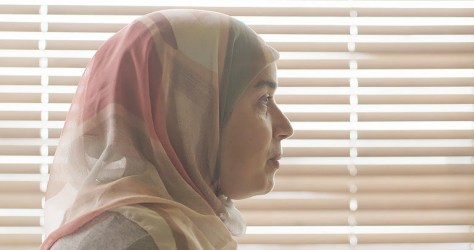
“If my daughter is a success, my happiness is complete,” declares the title character of “Fatima,” a small miracle of a film from the French director Philippe Faucon.

Divorced from her husband, whom she followed to France and with whom she is still friendly, Fatima (Soria Zeroual) is a 44-year-old North African woman raising two teenage girls in Lyon. The oldest, Nesrine (Zita Hanrot), 18, is a first-year medical student, and the younger, Souad (Kenza-Noah Aïche), is a sullen, sexy 15-year-old rebel ashamed of her mother for working as a housecleaner.

Souad sneers that Fatima is “a useless she-donkey” and “a living rag.” But her mother, however stung, endures the abuse and chooses her words carefully when firing back. Fatima loves her daughter despite her insolence. Steeped in North African Muslim culture, Fatima has traditional notions of what she calls “respectable” female behavior that don’t apply in France, and she is upset when Souad insists on baring her shoulders.

If the movie, loosely based on two books by Fatima Elayoubi, tells a familiar story of immigrants struggling to make something of themselves in an alien culture (Fatima speaks some French but reads only Arabic), it does so in a tone that is kindhearted but clearheaded, and the performances are low-key and believable. (Mr. Faucon picked Ms. Zeroual, a nonprofessional actress, to play Fatima.) It makes you feel the intense pressures facing Fatima and her family from all sides. When a young man flirts with Nesrine on a train, she politely but with a tinge of regret explains that she has to study.

Some of those pressures come from gossipy female neighbors who are envious, and judgmental. One Moroccan woman fumes that Nesrine didn’t greet her at a bus stop, an incident that Nesrine, lost in her thoughts of school, doesn’t recall. While on the job 12 or more hours a day, Fatima is treated with barely disguised contempt by female employers who brusquely order her around and who, she rightly senses, suspect her of petty theft.

Nesrine nearly cracks under the strain of her studies, which require her to absorb complex medical terminology. She worries most about not disappointing Fatima, who is sacrificing everything to pay for her schooling. Nesrine simply can’t afford to fail.

Eventually Fatima, exhausted, falls down stairs with her cleaning equipment and takes a paid five-month medical leave. But when the time is used up, she complains of continuing shoulder pains, although tests indicate she has recovered. She has simply reached her limit.

To bolster her morale, Fatima has been keeping a bedside journal, written in Arabic. As she reads aloud from it to a sympathetic doctor, her reflections on hardship, sacrifice and life’s unfairness have the tone of a humble manifesto.

“Be proud of all the Fatimas who clean working women’s houses,” she reads, and her words resound with the determination and quiet nobility of a woman who, however downtrodden, knows her own worth.

Fatima” is not rated. It is in French and Arabic, with English subtitles. Running time: 1 hour 19 minutes.

unnamed(11)


(Source: http://www.sbiff.org)

Andrei Konchalovsky’s Paradise nominated as Russia’s Oscar candidate

Andrei Konchalovsky’s film Paradise has been selected as Russia’s entry for Best Foreign Film at the 89th Academy Awards. The Russian Oscar Committee, chaired by actor and director Vladimir Menshov, made the decision on Sept. 19, the Committee’s TASS correspondent reported.

The film had its premiere on Sept. 8 at the Venice Film Festival, where it won a Silver Lion. Source: Kinopoisk.Ru

“Well, colleagues, thank you, it has somehow all passed me by – well, alright, I had better agree with you,” said Konchalovsky, expressing his gratitude to the Committee for their decision.

Paradise weaves together the fate of three people during World War II: Russian émigré Olga, an aristocrat and member of the Resistance; Jules, a French policeman and Nazi collaborator; and Helmut, a high-ranking officer in the S.S. Actress Yulia Vysotskaya, Konchalovsky’s wife, stars as Olga, alongside Viktor Sukhorukhov, Philippe Duquesne, Christian Clauss, and Peter Kurth.

The Russian Oscar Committee, chaired by actor and director Vladimir Menshov, made the decision on Sept. 19. Source: Kinopoisk.Ru


The film had its premiere on Sept. 8 at the Venice Film Festival, where it won a Silver Lion.

The 89th Academy Awards are scheduled to take place in Los Angeles on Feb. 26, 2017.

(Sources: http://www.rbth.com, http://www.tass.ru.com)

Warren Beatty to Receive SBIFF’s Kirk Douglas Award for Excellence in Film

Academy Award® winner Warren Beatty will be honored with the eleventh annual Kirk Douglas Award for Excellence in Film. Known for his iconic roles in BONNIE AND CLYDE, REDS, and DICK TRACY, Beatty will next be seen as Howard Hughes in 20th Century Fox’s RULES DON’T APPLY, which he also wrote and directed. The award will be presented at Bacara Resort & Spa in Santa Barbara on December 1, 2016 with all funds raised supporting SBIFF’s free year round educational programs.

Since 2006, the annual Kirk Douglas Award for Excellence in Film, which this year coincides with Douglas’s 100th birthday, has been awarded to a lifelong contributor to cinema through their work in front of the camera, behind, or both. Past honorees include Jane Fonda, Jessica Lange, Forest Whitaker, Robert DeNiro, Michael Douglas, Harrison Ford, Quentin Tarantino, Ed Harris, and John Travolta.

“Warren Beatty upholds the highest artistic standards of the film industry,” says Kirk Douglas, original award recipient. “His choice of material has entertained us as well as made us think more deeply about the world we live in. I’m delighted he is accepting this recognition of his extraordinary talent.”

The event starts off with an outdoor cocktail reception where attendees mingle with each other and watch the honoree and other special guests walk the red carpet. Following the reception, attendees are seated for an extravagant dinner and tribute in an intimate setting. Following the three-course meal, special guests will take the stage to recognize the honoree’s complete body of work with various montages and clips. The evening culminates with the honoree being presented with the award and addressing the attendees. These events are truly a once in a lifetime experience and will be remembered by its attendees for many years to come.

Tickets are available here.

The 32nd Santa Barbara International Film Festival s scheduled to run February 1-11, 2017.

sbiff3


(Source: http://www.sbiff.org)