Note from Roger – Command and Control

Dear Cinephiles,

Yes, COMMAND AND CONTROL is a documentary, yes it plays like a thriller – and I assure you will be at the edge of your seat.  It is also a history lesson of nuclear weapons from WWII through the Cold War and today.  It’s an extremely timely documentary – essential viewing.

Below is a review from LA Times.  It plays tonight at 5:00pm and tomorrow at 7:30pm at the Riviera Theatre.

See you at the movies!
Roger Durling

Click here for tickets.

command-and-control1

The thin line between safety and Armageddon is at the center of ‘Command and Control’ documentary
By Kenneth Turan – LA Times

Lots of documentaries these days will tell you to be afraid, to be very afraid, but few will scare you as coolly and as convincingly as “Command and Control.”

Directed by Robert Kenner, who co-wrote with book author Eric Schlosser (a key on-screen presence), “Command and Control” focuses on a Sept. 18, 1980, accident at a Titan II missile silo in Damascus, Ark., that came terrifyingly close to causing a nuclear explosion that would have devastated the entire East Coast.

But Kenner and Schlosser, who last collaborated on Kenner’s Oscar-nominated “Food, Inc.,” are also telling a larger story about the inherent dangers nuclear weapons pose not just for our enemies but for ourselves. No weapons advocate ever thought one of these behemoths might detonate right here at home, but the inevitable conclusion on seeing this film is that one very well might.

As Schlosser says quietly, harkening back to the first Trinity site nuclear test in New Mexico in 1945, “from the beginning there was the sense of this immense power just being on the verge of slipping out of our control.”

Though this kind of subject matter is by nature incendiary, Kenner and Schlosser have understood that handling the material as dispassionately as possible is the best way to make it completely unnerving.

Yet, paradoxically, the key people who lived through that 1980 event (almost all of whom are interviewed here) are, even nearly 40 years after the fact, nothing if not emotional about their memories, not surprising when you remember they thought a world-changing nuclear catastrophe was imminent.

Director Kenner has also been helped enormously by the existence, in Green Valley, Ariz., of the Titan Missile Museum, which is in essence an almost exact replica of the Titan missile silo in Arkansas where the accident and the drama took place.

The discreet re-creations of events Kenner and cinematographers Paul Goldsmith and Jay Redmond have filmed are essential in giving us an exact idea of how chilling the space in question was, how unnerving the looming presence of the enormous missile topped by a nine megaton thermonuclear warhead, three times as powerful as all the bombs detonated in World War II, nuclear weapons included.

“Command and Control” begins dramatically, with the deadly accident. It is 6:25 p.m. on that day, and a re-creation shows two members of the Air Force’s Propellant Transfer System team, nearing the end of their 12-hour shift, suiting up to service the behemoth.

“You’re counting on everything to work perfectly all the time,” says Jeffrey L. Plumb, who was 19 at the time. “And things just don’t work perfectly all the time.”

So it was that Plumb’s coworker David Powell used a ratchet instead of a torque wrench to remove a gasket, only to watch in horror (so much so that he didn’t tell his superiors the full story for half an hour) as the gasket fell and hit the side of the rocket, causing an immediate fuel leak that was a real threat to explode and perhaps detonate the warhead.

At this point “Command and Control” goes back and forth between the Air Force’s attempts to deal with this crisis and other past nuclear weapons accidents. The Air Force says there have been 32 of these, which is scary enough, but the film claims there have been more than one thousand.

Most terrifying of all, and gone into in some detail, was a 1961 event when a B-52 bomber broke apart in flight over Goldsboro, N.C. The resulting centripetal force actually armed the hydrogen bomb on board and when the weapon hit the ground, only one tiny switch prevented it from going off.

Off-site, Air Force higher-ups soon took over command of the Arkansas situation, but that didn’t stop the response from becoming chaotic and seat of the pants.

As related by the participants, the story became one of heroism and foolishness, of individual people who responded well and systems that did not. A nuclear explosion did not take place, but terrible things did happen, so embarrassing to the Air Force that even the people who acted heroically were shunned.

As terrifying as this particular event was, the back story is equally scary, including the realization that the United States and the Soviet Union at one time had between them close to 70,000 of these frightening weapons.

And it is very disturbing to hear the people who were in charge of using them, like Lt. Allan D. Childers, say that in the name of deterrence they were perfectly ready to push the launch button. “I had to be prepared to destroy an entire civilization,” he says, “and I had no problem with that.”

Most troubling of all, however, is the idea that nuclear weapons are machines, and every machine ever made has broken down at some point.

“It will happen,” says Sandia Laboratories engineer Bob Peurifoy, a former weapons builder. “Maybe tomorrow, maybe a million years from now, but it will happen.”

As I said, be very afraid.

(Source:www.sbiff.org)

Tom Hanks to be Honored with the Hollywood Actor Award

Hollywood, CA, (October 11, 2016) – dick clark productions announced today that Academy Award-winning actor Tom Hanks will be honored with the “Hollywood Actor Award” for his performance in critically acclaimed “Sully at the 20th Annual “Hollywood Film Awards.

“Tom Hanks delivered another amazing performance in a career filled with amazing performances. We are thrilled to honor him,” said Allen Shapiro, CEO of dick clark productions.

The awards ceremony, celebrating its 20th anniversary as the official launch of the awards season®, will be hosted by actor and comedian James Corden, and will take place at the Beverly Hilton Hotel in Beverly Hills, on November 6, 2016. The Hollywood Film Awards honors some of the most acclaimed films and actors, as well as artists in Cinematography, Visual Effects, Film Composing, Costume Design, Editing, Production Design, Sound and Makeup & Hairstyling. Its honorees over the past 20 years have included the world’s biggest stars and more than 110 have gone on to garner Oscar nominations and/or wins.

Tom Hanks is an award-winning actor, producer and director. One of only two actors in history to win back-to-back Best Actor Academy Awards®, he won his first Oscar® in 1994 for his moving portrayal of AIDS-stricken lawyer Andrew Beckett in Jonathan Demme’s “Philadelphia.” The following year, he took home his second Oscar® for his unforgettable performance in the title role of Robert Zemeckis’ “Forrest Gump.”  He also won Golden Globe Awards for both films, as well as a Screen Actors Guild (SAG) Award® for the latter. Hanks was most recently seen in “Captain Phillips,” Stephen Spielberg’s “Bridge of Spies” and Clint Eastwood’s “Sully.”

About Sully

On January 15, 2009, the world witnessed the “Miracle on the Hudson” when Captain “Sully” Sullenberger glided his commercial airliner onto the frigid waters of the Hudson River, saving the lives of all 155 passengers and crew aboard.  However, even as Sully was being heralded worldwide for his unprecedented feat of aviation skill, an investigation was unfolding that threatened to destroy his reputation and his career.

The film is directed by Clint Eastwood with a screenplay by Todd Komarnicki based on the book Highest Duty by Chelsey “Sully” Sullenberger and Jeffrey Zaslow.

The film is produced by Eastwood, Frank Marshall, Allyn Stewart and Tim Moore.  The film stars Tom Hanks, Aaron Eckhart and Laura Linney.  Eastwood’s below-the-line collaborators include director of photography Tom Stern, A.F.C., A.S.C., production designer James J. Murakami, editor Blu Murray, costume designer Deborah Hopper, casting by Geoffrey Miclat, C.S.A., visual effects supervisor Michael Owens and music by Christian Jacob and The Tierney Sutton Band.

Previously announced honorees for this year’s show include: “Hollywood Career Achievement Award,” Eddie Murphy; “Hollywood Blockbuster Award,” “The Jungle Book”; “Hollywood Animation Award,” “Zootopia”; “Hollywood Cinematography Award,” Linus Sandgren; “Hollywood Film Composer Award,” Mychael Danna; “Hollywood Editor Award,” John Gilbert; “Hollywood Visual Effects Award,” Stephane Ceretti and Richard Bluff; “Hollywood Sound Award,” Christopher Boyes and Frank Eulner; “Hollywood Costume Design Award,” Albert Wolsky; “Hollywood Make Up & Hair Styling Award,” Shane Thomas, Angela Conte, Bec Taylor and Noriko Waztanabe; and “Hollywood Production Design Award,” Wynn Thomas

Additional honorees for this year’s event will be announced at a later date.

About dick clark productions

dick clark productions (dcp) is the world’s largest producer and proprietor of televised live event entertainment programming, with the “Academy of Country Music Awards,” “American Country Countdown Awards,” “American Music Awards,” “Billboard Music Awards,” “Dick Clark’s New Year’s Rockin’ Eve with Ryan Seacrest,” “Golden Globe Awards,” “Hollywood Film Awards” and the “Streamy Awards.” Weekly television programming includes “So You Think You Can Dance,” from 19 Entertainment, a division of CORE Media Group and dcp. dcp also owns one of the world’s most unique and extensive entertainment archive libraries, with more than 55 years of award-winning shows, historic programs, specials, performances and legendary programming. For additional information, visit http://www.dickclark.com.  

About The Hollywood Film Awards®

The Hollywood Film Awards®, founded in 1997, were created to celebrate Hollywood and launch the awards season. The recipients of the awards are selected by an Advisory Team for their body of work and/or a film(s) that is to be released during the calendar year. For additional information, visit www.hollywoodawards.com.


PR Contacts:

Slate PR

Andy Gelb: 310-461-0111, andy@slate-pr.com

Elyse Weissman: 310-461-0114, elyse@slate-pr.com


dick clark productions

(Source:  www.hollywoodawards.com)

Chicago Film Festival Marks 52nd Year

Posted by Larry Gleeson

By Lisa Fielding

The Chicago International Film Festival is America’s longest running competitive film festival, and organizers are promising something for everyone this year.

michael-kutza-by-emily-oscarson-copy
Michael Kutza, Founder and Director, Chicago International Film Festival. (Photo credit: Emily Oscarson)

“Young people films like ‘Trolls’ in 3D for kids, up to musicals like ‘La La Land,’ which is a big, Oscar potential, and we have a whole section on musicals. But really the festival is based on discovering new directors and honoring some of the old ones who’ve been here over the years,” says Michael Kutza, Founder and Artistic Director.

Kutza founded the CIFF in 1964 and has been bringing independent and foreign films to the masses for years.

“We do a mix of independent and Hollywood. We close with a big Hollywood film to tempt you to come see some of our foreign films. It’s a tough town, but we want to get you to see the world, and so we tempt you with Hollywood,” he says.

Kutza says not only does the festival educate fans about films they would never have seen otherwise, but the 15-day festival offers hundreds of feature films. It’s an opportunity to see many features before they are released.

“You want the best films, you want the winner of the Cannes Film Festival, Venice, Sundance, then you start with that. We go all over the world to find what’s best and bring it to film fans here in Chicago,” he says.

There will also be documentaries, films by first-time filmmakers, short-subject films, educational films, big name directors and actors along with films submitted for the Academy Awards.

There’s even a new section this year, an International Musical section.

04_zfr_mimi_plauche_pic
Programming Director Mimi Plauche, Chicago International Film Festival (Photo from http://www.tiff.ro.com)

“We found everything from an Israeli-Palestinian hip-hop musical. Three different Polish musicals were made this year, and we have two of them. It’s really kind of fun looking for and finding a whole new genre of films from around the world,” says Mimi Plauche, programming director.

This year’s main competition jury president is actress Geraldine Chaplin, daughter of Charlie Chaplin. She will join Kutza for a conversation about her career and the 23 days her famous father spent at Chicago’s Essanay Studios in 1915.

event_geraldinechaplin_tribute
Actress Geraldine Chaplin, daughter of Charlie Chaplin, will serve as the main competition jury president for the 52nd Chicago Film Festival. (Photo courtesy of Chicago International Film Festival)

“I was just in Cuba and spent ten days on a jury with Geraldine. I asked her if she’d ever been to Chicago and she said no. I told her to come and take part and we can honor you and you talk about your life and your dad’s films,” Kutza says.

bog-mcqueen
Directors Peter Bogdonovich, left, and Steve McQueen will be honored at the 52nd Chicago International Film Festival. (Photo credit: http://www.chicago.cbslocal.com)

This year, directors Peter Bogdonovich and Steve McQueen will be honored. The film fest opens on Thursday and runs through Oct. 27. For more information, click here.

(Source: http://www.chicago.cbslocal.com)

LA FILM CRITICS ASSOCIATION HONORS SHIRLEY MacLAINE WITH CAREER ACHIEVEMENT AWARD

The Los Angeles Film Critics Association (LAFCA), comprised of professional film critics working in the Los Angeles print and electronic media, has announced it will Shirley MacLaine with its Career Achievement Award on January 17th, 2017 in Century City, California at the Intercontinental Hotel.

Ms. MacLaine, one of Hollywood’s legendary leading ladies, has an extensive body of work beginning with her breakthrough performance in The Apartment (1960)  and includes strong performances in Sweet Charity, Irma LaDouce and Terms of Endearment.  MacLaine won an Oscar with Terms of Endearment for Best Actress in a Leading Role for her performance as Aurora Greenway. More recently MacLaine played Marjorie Nugent alongside Jack Black in the dark dramedy, Bernie (2011). Her next role in The Last Word can be seen starting in the spring of 2017.  MacLaine is also a prolific writer having authored several books.

The 35th Annual Los Angeles Film Critics Association Awards - Inside
Pictured above is Claudia Puig, LAFCA President (Photo credit: lacfa.net)

LAFCA President Claudia Puig lauded MacLaine by saying,


“We are very excited to be giving the award to someone who has had such an illustrious, versatile acting career, and who has contributed so much to our collective enjoyment of movies.”


MacLaine responded saying, “I’m thrilled with the honor by the Los Angeles Film Critics Association, the recognition and the encouragement.”

Here’s a brief snippet from Shirley on criticism and Billy Wilder:

According to LAFCA’s website other top awards will be decided by the membership on Sunday, Dec. 4, 2016, and those honorees will join MacLaine at the January dinner.

This year’s awards ceremony is dedicated to director Curtis Hanson (L.A. Confidential, Wonder Boys), who died on Sept. 20.

(Sources: http://www.lafca.net, HollywoodGlee archives)

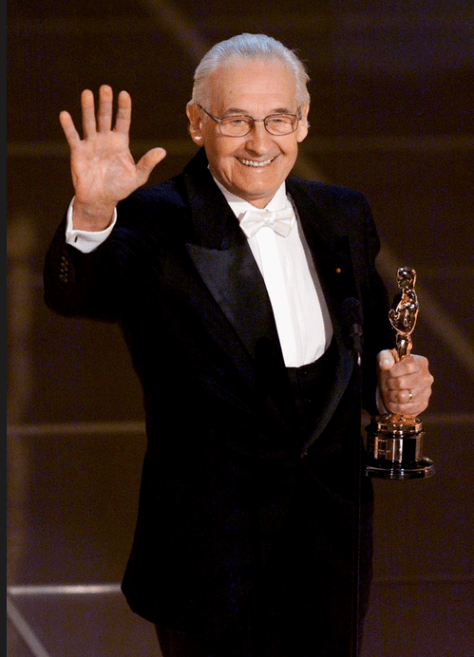
Acclaimed Polish film director Andrzej Wajda dies aged 90


Andrzej Wajda the acclaimed Polish director whose films reflected his country’s turbulent history, has died at the age of 90.

Reports in Poland said he died in hospital of lung failure after being put into a medically induced coma in recent days.

Director of films including Kanał, Katyń and the Palme d’Or-winning Man of Iron, Wajda was also awarded an Oscar for lifetime achievement

screen-shot-2016-10-10-at-11-09-13-am
Wajda after receiving his honorary Oscar in 2000 (Photo credit: Gary Hershorn/Reuters)

Wajda, who was awarded an Oscar for lifetime achievement in 2000, became a filmmaker only after being rejected by the army in 1939.

He attended Poland’s renowned Łódź film school after the second world war. His career took flight after winning the jury special prize at the Cannes film festival in 1957 for Kanał (Canal), about the doomed 1944 Warsaw uprising by Polish partisans against the Nazis.

screen-shot-2016-10-10-at-11-13-42-am

A still from Wajda’s 1957 film, Kanał. (Photo: Allstar/Kingsley-Int)

The award allowed Wajda to make his next film, Popiół i Diament (Ashes and Diamonds) in 1958 and cemented his position in Polish film.

In the 1970s Wajda turned to Polish literature for inspiration for Brzezina (Birch Wood, 1970), Wesele (The Wedding) two years later and Ziemia Obiecana (The Promised Land) in 1974.

At the 1977 Cannes festival, he screened Człowiek z marmuru (Man of Marble), a film critical of communist Poland.

It was followed three years later by Człowiek z żelaza (Man of Iron), focused on the rise of Poland’s anti-communist Solidarity trade union. That film won the Palme d’Or at Cannes in 1981, even as Poland’s then-communist regime cracked down on Solidarity and imposed martial law.

“The day of the Palme was a very important day in my life, of course. But I was aware that this prize wasn’t just for me. It was also a prize for the Solidarity union,” Wajda said in an interview in 2007.

The filmmaker donated the prestigious award to a Kraków museum, where it remains on display next to his other prizes, including the lifetime achievement Oscar.

Screen Shot 2016-10-10 at 11.17.07 AM.png

The 1981 Palme d’Or saved Wajda from being jailed by the communist regime – a fate that befell many of the director’s friends and colleagues – including Solidarity’s leader, Lech Wałęsa.


Wajda’s opposition to the regime of Poland’s communist leader, general Wojciech Jaruzelski, led him to make films abroad, including Danton (1983) in France, starring Gérard Depardieu.

Eine Liebe in Deutschland (A Love in Germany, 1986) followed in Germany and Wajda’s interpretation of Dostoyevsky’s The Possessed (1998) was shot in France.

After the collapse of communism in Poland in 1989, Wajda returned to the country’s wartime history, focusing on stories suppressed by the communists. Korczak (1990) details the fate of Janusz Korczak, a pre-war Polish-Jewish children’s author and physician who died in the Holocaust.

With Pierścionek z orłem w koronie (The Crowned-Eagle Ring, 1993), Wajda once again turned to the 1944 Warsaw uprising. Wielki Tydzień (Holy Week, 1995) examined the 1943 Warsaw ghetto uprising – the doomed rebellion against the Nazis by Jewish partisans.

One of his last films, Katyń – nominated for an Oscar in 2008 – tells the story of his father, Jakub Wajda, who was one of 22,500 Polish officers killed by the Soviets in 1940 in the Katyn forest. Last year he directed Powidoki, which is Poland’s official entry for this year’s Academy Awards.

(Source: http://www.theguardian.com)

FILM REVIEW: Arrival (Villenueve, 2016):USA

Viewed by Larry Gleeson during the Venice Film Festival.

Canadian Director Denis Villenueve’s (Sicario, Prisoners, Incendies) new science fiction drama, Arrival, is based on Ted Chiang’s “Story of Your Life.” Alien ships have landed across the globe without explanation communicating only a Sanskrit word for war.

The film opens in a reflective voice-over coupled with powerful sound effects and strong camera work to create a feeling of pandemonium. Supersonic jets blaze across the screen as 12 unidentified flying objects descend from the sky and land across the globe. The aliens attempt to communicate with written words and phrases in a never seen before language.  Dr. Louise Banks, a linguist played by Amy Adams (Man of Steel, American Hustle, The Fighter), is charged with communicating with the alien intelligence. Artist Martine Bertrand designed the aliens written language. The Sanskrit word for war is delivered to Louise at her university teaching office for translation. At first she balks. However, the opportunity to put to use all she has learned in a lifetime of study and academia and the mourning she’s gone through over the loss of her daughter provides her the impetus to join the effort.

Initially, Dr. Banks appears anxious. However, she quickly is brought up to speed by the US military. Captain Marks, played by Mark O’Brien, informs the team on what is known about the alien landings. One of the first translations the group deciphers is “language is weapon.” Soon however, the process is stalled. Intelligence about the alien space ship reveals that their doors open every 18 hours granting an opportunity to board the craft. After dialogue and heated conversation, Dr. Banks is granted clearance to board the craft with the team. With the team in position to board the craft, Villenueve amps up the sound effects and music including some very heaving breathing from Dr. Banks as the team waits, attired in Cybex hazmat suits, for the alien ship to position itself to allow boarding. With the ship’s entry encapsulated in smoke combined with some abstract visuals and the surreal effect of slow motion the team boards the alien vessel.

In the end, Dr. Banks proves she’s up for the task and begins the communication process with the aliens but not without difficulty. An interesting reference is made to the Sapir-Whorf theory that once a person starts to learn a language the person will start to dream and think in it. However, when the aliens begin writing a thought one hand begins the thought while the other hand ends it simultaneously. Louise’s mind has difficulty comprehending this and she begins to experience highly vivid, visual flashbacks of her daughter. She begins to wonder why. Once the team members managed to board the ship and attempted to understand and communicate with the aliens they were enlightened with insight into their own human nature. In the end this appears to help Louise move on with her life finding closure to the cancer that took her daughter’s life.

Seemingly, a large part of the film’s aesthetics is augmented and carried out by sounds. Dave Whitehead created the whirrs and clicks of the alien language while Supervising Sound Editor Sylvain Bellemare created the sounds the ships made when moving. Composer Johann Johannsson created the film’s musical score.

Jeremy Renner (The Hurt Locker, The Bourne Legacy, American Hustle) plays Ian Donnelly, a physicist who attempts to solve the alien communication through mathematics. And is the sidekick to Adams Louise. Donnelly comes across as highly intelligent, energetic scientist who adds warmth and light to the team’s dynamic. Forest Whitaker (The Last King of Scotland, Lee Daniels’ The Butler) plays Colonel Weber, Military Intelligence, who’s responsible for coordinating the communication process. Weber needs Louise and Ian to succeed and it’s his job to see that they do. Weber pushes the two to do more and to get more from the aliens. Michael Stuhlbarg (Boardwalk Empire, Men in Black III) plays CIA Agent Halpern who’s responsible for reporting to the government the team’s actions.

Arrival is a well-constructed film with a stellar cast and talented crew. Notably, Amy Adams is superb as Dr. Louise Banks. The costuming provided by Costume Designer Renee April and the production design provided by Patrice Vermette were excellent as were Carlos Huante’s alien visual effects. In addition, the sound design and musical score brilliantly augmented and sophisticatedly created the atmospheric for the film’s mis-en-scene.  Executive producer and screenwriter Eric Heisserer adapted the short story to screenplay. 21 Laps and Film Nation received production company credits along with producers Shawn Levy, Dan Cohen, Dan Levine and Aaron Ryder. Bradford Young served as Cinematographer capturing delicate moments with sensuality along with the massive “rainy day” science fiction scenes.

Arrival is a must-see story about life and death and the reality between the two. It also speaks volumes on humility within the parameters high stakes, foreign communication . Highly recommended.

(Featured photo courtesy of ASAC Images/Biennale Cinema di Venezia)

All about European film

Posted by Larry Gleeson

Giulia Privitelli interviews Sarah Chircop about her experience on the jury that was in charge of selecting the winner of the Venice Days Award, part of the historic Venice Film Festival.

Last year, I had the opportunity to take part in the 72nd edition of the Venice Film Festival as a 28 Times Cinema jury member – an initiative supported by the European Parliament. This initiative is now in its seventh year, and this year’s Maltese representative was Sarah Chircop. In this interview, she shares her experience as this year’s 28 Times Cinema and Lux Film Prize Maltese ambassador.

What is the 28 Times Cinema initiative and how did you come to know about it?

This is a EU-funded initiative where 28 young people from every European country screen-shot-2016-10-09-at-5-13-59-pmbetween the ages of 18 and 25 are selected and invited to Venice to experience the oldest film festival in Europe.

The 28 members essentially form part of a unique jury who are in charge of selecting the winner of the Venice Days Award. With each year, the initiative demonstrates a consistent interest in arthouse cinema and independent film by the younger generation.

I remember that you yourself had mentioned this initiative a while back, and encouraged me to apply through Spazju Kreattiv. In turn, I encourage every young cinephile who happens to be reading this to the same next year.

What was it like being part of this year’s jury?

Well, the beauty of this jury is its versatility and diversity. We were 28 different people sharing different thoughts and ideas, different academic backgrounds and of course cultures.

And, the more time spent together and discussed as a jury, the more our differences were revealed, as well as our similarities. But all in all, I tried to keep an open and inquisitive mind, questioning as much as possible even though the days were long and tiring making it quite difficult at times.

But did you meet any other actors or directors as a 28 Times jury member? I remember exchanging a word or two with Elit Iscan from Mustang and Ondina Quadri from Arianna , as well as the director of Mediterranea, Jonas Carpignano at the Villa degli Autori…

The red carpet was always rolling on star after star. I attended the premiere of The Bleeder, starring Liev Schreiber who was awarded the Persol Tribute to Visionary Talent Award 2016, which was cool.

But honestly, I was much more moved to sit in the same room as the directors of The War Show, this year’s winner of the Venice Days Award, and to later meet the producers too. A personal favourite director, Luca Guadagnino, was also there with a film called Ombre dal Fondo and we did get to have the director of a film called Boys in Trees DJ at our closing party, which was crazy fun.

Apart from all the film-watching, naturally, celebrity-snooping and the parties, what other activities were you involved in throughout the two weeks of the festival?

Honestly, there were times you’d be at a panel and all you can think of is whether Cate Blanchett would be gracing the red carpet at some point. She didn’t, much to my disappointment.

Besides all the film watching and jury debating, we also had to select and attend a Screen Shot 2016-10-09 at 5.14.56 PM.pngworkshop. I chose the Active Cinemagoers Workshop, led by Irene Angel, where we learnt what it takes to be an active cinemagoer and what is involved in organising a film festival through discussing renowned case studies and then working together to imagine our own festival.

Other workshops included Film Criticism, Radio Film Journalism, Seeing and Translating Cinema and Social Networks & Film Festivals. Besides these workshops, we also attended various panels on the European Parliament, Virtual Reality, Biennale College Films, War on Screen and The Selection Process in Film Festivals. There was also the Miu Miu Women’s Tales, where female filmmakers and actors discussed their work and experiences. Guests included actresses Juno Temple and Dakota Fanning.

Sounds like you had plenty to keep you busy! In fact, in a nutshell, what was a typical day for a 28 Times jury member like?

My day would always start with… you guessed it… an espresso. The hours of sleep I managed to rack up determined the number of these said espressos. But I loved waking up early to a hungover Lido and go about searching for a different bar to properly come to my senses. The croissant was as important, might I add.

Once the caffeine was in my system I would usually meet up with some of the group to get tickets for a film we wished to see out of the Venice Days selection then head to our first ‘compulsory’ screening of the day. Lunch was either a quick bite at the Lion’s Bar right in the heart of the festival area before heading off to a workshop, panel discussion or another film but sometimes there was also time for a sit down meal before resuming more movie-watching.

Once our compulsory activities were done for the day, we’d usually try to catch even more films, watch the celebrities gracing the red carpet and maybe even manage an Aperol spritz – and most of the time we did. The day almost always ended, at least for me, with an ice cream.

screen-shot-2016-10-09-at-5-15-48-pm

Back to your role as jury member. What was the Venice Days selection like this year? Was there a unifying theme?

This year, 12 feature films were selected as part of the Venice Days programme; these were our priority and responsibility to watch and think about for jury discussions presided by Canadian artist, Bruce la Bruce.

As with each year, Venice Days aims to focus on the rich variety of different cultures and nations, to look both to the future and the past and allow for a young and curious audience to play an active role. The Mississippi Mermaid was the star of this year’s posters, stressing the achievements of women in the film industry today, while also presenting, and I quote: “an emblem of an ever-changing cinema that stirs our emotions and fears instead of soothing us.”

The jury selected the Syrian film The War Show by Andreas Dalsgaard and Obaidah Zytoon as the winner of the award for this year. What was the jury’s statement, yours included, for choosing this film?

The War Show. Yes. Well, it was clear to most of us from the start that there was no real contender against this film. It provoked an impassioned response, to say the least, from the Jury. It presented sensitive and violent content in such an effective way yet it was not solely through its content that it won our vote but the way in which it was presented; through a series of powerful images portraying life and death.

Although some deliberated on whether it belonged alongside the rest of the Venice Days selection, which was comprised of narrative fiction features, it was ultimately recognised as an outstanding crafted piece of cinema. It succeeds in painting a truthful picture of the political and societal portrait of Syria and of “a war which is defining a conflict of time”. It is with sadness that I urge all of you to experience The War Show, yet I fear the necessity of making another a film like this.

Political and social content is also central to the films presented for the Lux Film Prize which, I am to understand, you are also representing this year.

Yes. Toni Erdmann, As I Open My Eyes and Ma Vie de Courgette are the three finalists vying for the Lux Prize this year – all brilliant films in their own right. As a Lux Film ambassador, my role actually started once I returned to Malta.

Having represented Spazju Kreattiv, which manages Malta’s only specialised art-house cinema in St James Cavalier, I am to promote these European films locally, while also contributing to bringing Europe’s cinematic soul closer to Europeans. The films are subtitled with the 24 official EU languages, enabling them to travel and be screened in more than 50 cities and 20 festivals across Europe.

screen-shot-2016-10-09-at-5-16-33-pm

You speak of European film – how would you define such a film, if you could?

Through this experience, I have come to understand European Film as an art form which essentially tries to unite Europe by telling European stories, a form of cinema that focuses on cultural values and intercultural dialogue.

However, I feel that it is actually quite hard to rightly define European cinema and perhaps its nature is something free from the constraints of a technical description, but is rather something which should be left to be whatever it needs to be.

Would you say European cinema is sufficiently represented in Malta?

Spazju Kreattiv is part of the Europa Cinemas network and has recently launched their new cinema programme which includes quite a varied selection of films, including the screening of Lux Prize nominated films such as L’Avenir which was actually one of the 10 shortlisted films for this year’s Lux Prize.

This year, Spazju Kreattiv will also be participating in the first edition of European Art Cinema Day taking place today. There is also the Kinemastik Short Film Festival which promotes European Cinema and, of course, the Valletta Film Festival which debuted its second edition last June with a large selection of European as well as international films. I see this festival fast becoming one of the most attractive in the Mediterranean region.

Any final words to potential future Maltese 28 Times Cinema and Lux Film Ambassadors out there?

Just go for it. It’s an experience that will truly stimulate your mind, enter your heart, and settle permanently into that cosy little home called memory. Let’s keep cinema alive and let’s keep European cinema the place to carry on recognising and celebrating different cultures.

(Source: http://www.timesofmalta.com)

Alibaba Pictures, Amblin to co-produce films for global, Chinese audiences

Posted by Larry Gleeson

Reporting by Ryan Woo; Editing by Paul Tait and Clelia Oziel

BEIJING: Steven Spielberg’s Amblin Partners and Alibaba Pictures Group Ltd, the film unit of Chinese billionaire Jack Ma’s Alibaba Group Holding Ltd, said on Sunday they will co-produce and finance films for global and Chinese audiences.

They will also collaborate on the marketing, distribution and merchandising of Amblin Partner films in China, the companies said in a joint statement.

Amblin Partners creates film, television and digital content under the Amblin Entertainment, DreamWorks Pictures and Participant Media brands.

Big Chinese companies including Dalian Wanda Group Co are looking to bring more Western films and movie-making prowess into China even as they seek to expand their footprint in Hollywood.

China’s masses have the ability to keep Hollywood movies afloat, industry watchers say. They expect China to soon surpass the United States as the world’s biggest movie market.

This year’s ‘Warcraft’, which was a box office flop in the United States, raked in hundreds of millions of dollars in China, making it one of the country’s highest-grossing films of the year.

“Some of the stories I’m hoping Jack and I can tell in this new partnership between Amblin Partners and Alibaba Pictures will be able to bring Chinese-themed stories to the American audience, and we can do co-productions between our company and your company,” Spielberg said at a briefing in Beijing.

“And we can bring more of China to America, and bring some more of America to China.”

Hong Kong-listed Alibaba Pictures has yet to release any films, although the company formerly known as ChinaVision Media Group Ltd has several projects in production.

Alibaba Pictures began investing in Hollywood films in 2015 with its stake in ‘Mission: Impossible – Rogue Nation’. It was an investor in this year’s blockbusters ‘Star Trek Beyond’ and ‘Teenage Mutant Ninja Turtles: Out of the Shadows’.

Chinese e-commerce giant Alibaba Group paid about US$800 million for a controlling stake in ChinaVision Media in 2014.

Under the terms of the partnership, Alibaba Pictures will also acquire a minority stake in Amblin Partners, which is chaired by Spielberg, the award-winning U.S. movie director and producer.

Dalian Wanda, the conglomerate controlled by China’s richest man Wang Jianlin, is partnering with Sony Pictures under which Wanda will market Sony Pictures’ films and co-finance some upcoming movie releases of Sony Corp’s film unit in China.

In January, Wanda paid US$3.5 billion for a controlling stake in U.S. film studio Legendary Entertainment. The group has also since said it would start co-investing in global blockbusters next year.

“I heard a lot of people say the movie industries are dead. I think that’s a lack of imagination,” Ma said at the briefing. “All the cinemas in the future are going to be changed because of technology. So people will definitely have all kinds of experiences watching movies.” – Reuters

(Source: http://www.channelnewsasia.com)

Cinema, Society and Democracy Questions and Answers

With Indian films earning accolades at the recent Toronto International Film Festival, three-city tour of the Indo-European Film Festival and no dearth of cine lovers, Indian film makers are spearheading the need for adequate representation for an international audience while the country continues to inspire international film-makers, both in terms of stories and a keen ground for showcasing their films, but not without challenges.

Posted by Larry Gleeson

By Anisha Mandal

screen-shot-2016-10-09-at-10-11-43-amAdoor Gopalakrishnan, a veteran Indian film director, scriptwriter, producer and a revolutionary figure for Malayalam cinema, just had his film Pinneyum, literally ‘Once Again’, left the Toronto International Film Festival (TIFF 2016) in awe. As someone who has headed the National Film Awards.

In India, he was asked if Indian films getting selected in film festivals outside the country sends a message in the favour of sustainable content in Indian cinema, to which he said, “Generally, festivals are US-Europe centric. Most of the Indian films being made are neither erotic nor exotic. This is a big handicap in catching the attention of the usual festival selectors. Some important films in the Indian context simply do not get selected because the selectors are hardly familiar with life and goings on in India.”

This year, TIFF showcased 12 Indian films and films centred around the country, comprising Deepa Mehta’s Anatomy of Violence, Adoor Gopalakrishnan’s Pinneyum and Buddhadeb Dasgupta’s Bait. The documentary section saw young filmmakers, Shirley Abraham and Amit Madheshiya’s Cinema Travellers which spelled poetry on screen with its showcase of the gypsy-distributors of films who took the art far and wide as well as Khushboo Ranka and Vinay Shukla’s An Insignificant Man, an important film for the democracy that is India. Ranka’s gift to the country in the form of the first virtual reality film, Right to Pray, was also showcased during the festival. Despite the slow footing that Indian filmmakers are gradually finding, it was imperative to ask Gopalakrishnan if in his opinion India is failing to make a mark in international film festivals. He echoed the sentiment of independent filmmakers in the country by stating, “There is no conscious effort on the part of the Indian nation to support and promote the production of a cinema of excellence. The so- called film industry also makes it difficult for new voices to be heard.”

André Ceuterick, Director, Festival International du Film D’Amour de mons, suggests that more face-to-face interactions are required between India and the world for prospects to be explored, owing to which he came down to conduct a Masterclass on filmmaking at Satyajit Ray Film and Television Institute (SRFTI), a reputed film institution in Kolkata. “It’s about meeting the right people, going to the right places, and wanting to show your films,” said Ceuterick, when asked about how independent filmmakers can overcome the obvious challenges of the commercial viability of the films that they make and the subjects that intrigue them to make their films.

Both Andre Ceuterick and Adoor Gopalakrishnan had very interesting takes on censorship as a factor that hinders the scope for filmmakers. Gopalakrishnan noted, “Censorship is an archaic concept suitable for dictatorships, not democracies. Unfortunately, the official view is that the viewer is immature and he/she should be protected from bad influences. While the censors look for explicit scenes of sex to cut, terrible sequences of violence get through unhurt.” Also, passing a remark on the censor boards even in film festivals, Ceuterick said, “I was once surprised in an Arab country where people in the audience were openly watching porn on their phones, but an artist’s vision of inculcating nudity as a motif was banned in form of not allowing such films being screened at the festivals there.”

screen-shot-2016-10-09-at-10-12-55-amIt is safe to concur that the increasing exposure to international funds and finding a way to showcase films at international film festivals is indeed creating new avenues for filmmakers in the country. It is however a source of despair for all to not be able to garner adequate encouragement and support in the country itself. It, perhaps, reminds one of what Bob Dylan once famously said, “Look, when I started out, mainstream culture was Sinatra, Perry Como, Andy Williams, Sound of Music. There was no fitting into it then and of course, there’s no fitting into it now.”

(Source: http://www.mediaindia.eu)


Academy Museum Now in Production

The Academy of Motion Picture Arts and Sciences is building the world’s premier movie museum in the heart of Los Angeles.  Located in the historic Wilshire May Company building at Wilshire and Fairfax, the Academy Museum will explore the history and magic of what happens on screen as well as behind it. In keeping with this mission, the Academy Museum announced Katharine DeShaw as its Managing Director, Advancement and External Relations.

screen-shot-2016-10-08-at-3-32-50-pm
Katherine DeShaw (pictured above) was appointed Managing Director, Advancement and External Relations for the Academy Museum of Motion Pictures Arts and Sciences on October 6, 2016.

DeShaw said, “I can’t imagine any opportunity more exciting than helping to bring the Academy Museum to the public in Los Angeles and movie fans around the world. The new facility will be extraordinary, the exhibitions and programs under development are remarkable and the base of support is strong. I can’t wait to begin fundraising for the remaining third of the $388 million campaign.”

Recognized nationally as a leader in the arts and philanthropy, DeShaw has led record-breaking fundraising campaigns for the Los Angeles County Museum of Art, the Walker Art Center in Minneapolis, the New York City Chapter of the Multiple Sclerosis Society and Gay Men’s Health Crisis in New York City. She most recently led the consulting firm Philanthropology, which focuses on best practices in philanthropy for clients in a variety of areas, including the arts, culture, the environment, health and social justice. Ms. DeShaw serves on the faculty of the Getty Leadership Institute, an executive management program for international museum directors, and designed its fundraising curriculum.
screen-shot-2016-10-08-at-3-47-27-pm
Academy Museum Director Kerry Brougher
“As we forge ahead toward our opening, Katharine brings not just expertise but also superb leadership, born of nearly three decades of success in philanthropy and the arts,” said Kerry Brougher, Director of the Academy Museum.  “She has the skills, the vision and, above all, the talent to help us create the great movie museum that the film capital of the world expects and deserves.”
Beginning on November 1, DeShaw will direct all aspects of fundraising, including completion of the $388 million capital campaign to support the new Museum, now under construction. She will play a key leadership role in expanding external relations efforts, including community and civic outreach, while supporting publicity and marketing initiatives for the Museum.
(Source: Press release oscars.org)