October 2, 2016 – Today’s White House Student Film Festival in Washington, DC, marked AFI’s third annual collaboration on the event, which inspires and celebrates young filmmakers from around the nation. AFI welcomed aspiring K–12 filmmakers to the White House to premiere their work for an audience of special guests and film artists from in front of and behind the camera, including Ty Burrell, Alfre Woodard and STRANGER THINGS creators Matt Duffer and Ross Duffer and star Millie Bobby Brown.
AFI is a founding partner of the festival, which took place this year preceding South by South Lawn, an elaborate outdoor event celebrating the arts to be held on Monday, October 3. As part of AFI’s ongoing mission to educate today’s audiences and tomorrow’s storytellers — a mandate that began when AFI was born in the White House Rose Garden in 1965 — participating filmmakers will continue to learn about the art form after the festival by working closely with AFI Conservatory alumni as mentors.
Open to K–12 student filmmakers, storytellers were encouraged to submit their short film based on this year’s festival theme, “The World I Want to Live In.” Thirteen finalist films were screened at the event, followed by a meet-and-greet with festival attendees. In line with this year’s theme of looking toward the future, and the festival’s annual spirit of innovation, Virtual Reality stations were also part of the experience for guests, filmmakers and their families.
Since the White House Student Film Festival inception in 2014, AFI has worked on President Barack Obama’s program as an advisor and producer, reviewing submissions and creating a celebration that includes educational opportunities for the selected young filmmakers. This year, that partnership continued as the White House Student Film Festival highlighted both the Administration’s commitment to public service and AFI’s ongoing mission to nurture the next generation of storytellers.
The Tokyo International Film Festival (TIFF) held a press conference to announce lineups in the all sections, jury members, and this year’s topics and highlights at Toranomon Hills Forum in Tokyo.
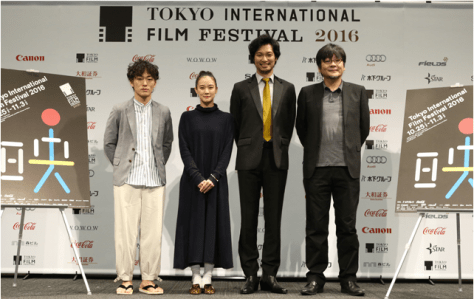
In the Competition section, 16 films were selected from among 1,502 titles from 98 countries and regions. Representing the two Japanese titles in this main competitive section, director Daigo MATSUI and actress Yu AOI from Japanese Girls Never Die, and actor Munetaka AOKI from Snow Woman were welcomed on the stage and made remarks.
Acclaimed director Mamoru HOSODA, who is being honored this year with “The World of Mamoru Hosoda” in the Animation Focus section, greeted the audience after the retrospective lineup was announced. He will appear for stage talks during TIFF with such special guests as director Hirokazu KORE-EDA and filmmaker Daisuke “Dice” TSUTSUMI.
This year’s International Competition Jury members were also announced. French director/writer/producer Jean-Jacques BEINEIX will serve as President, working with director Hideyuki HIRAYAMA, actor Valerio MASTANDREA, producer Nicole ROCKLIN, and director Mabel CHEUNG.
During the 10-day celebration, more than 200 films will be screened and there will be unique film-related events every day at the festival venues, including stage appearances, Q&A sessions and symposia featuring celebrated guests from around the world.
The 29th TIFF will take place October 25 to November 3, 2016 at Roppongi Hills, EX Theater Roppongi (Minato City) and other theaters, halls and facilities in Tokyo Metropolitan Area.
Nate Parker talks quickly, in grandly eloquent phrases, about slavery, injustice, about his Art (with a capital A), about how he became imbued with the revolutionary spirit and the obstacles he has faced.
He talks in lengthy and complex diatribes, not only about his controversial movie, The Birth of a Nation, which he co-wrote, directed and stars in, but digresses on to other subjects: religion, family, racism.
But what he doesn’t talk about and refuses to address is the 17-year-old rape case in which he was acquitted and why he has not apologised to the woman concerned and her family.
In interviews, at press conferences and on the red carpet at the Toronto Film Festival in September, he consistently dodged questions about the sexual abuse allegations at Penn State University in which he and a fellow student athlete were accused of rape. They claimed the sex was consensual.
Parker was acquitted in a 2001 trial and his roommate, Jean McGianni Celestin, who co-wrote The Birth of a Nation, was convicted but he appealed the verdict and was granted a new trial; the alleged victim would not testify again. She committed suicide in 2012 after two previous attempts.
Speaking to CBS television’s 60 Minutes show for a forthcoming interview, Parker addresses the court case but stops short of an apology: “I was falsely accused,” he tells host Anderson Cooper. “I went to court, I was vindicated. I feel terrible that this woman isn’t here. Her family had to deal with that, but as I sit here, an apology is — no.”
Parker admits to Cooper that what happened that night was “morally wrong” when viewed through his faith: “As a Christian man . . . just being in that situation, yeah, sure. I am 36 years old right now. My faith is very important to me, so looking back through that lens . . . it’s not the lens I had when I was 19 years old.” But when asked if he felt any guilt at all, his answer is unequivocal: “I don’t feel guilty.”
Parker’s film tells the story of Nat Turner (Parker), a slave who led a bloody rebellion in Virginia in 1831; among the many violent scenes is a brutal depiction of Turner’s wife being raped. Although it received a standing ovation at the Sundance Film Festival and rave reviews in January and won two awards there, the American Film Institute later refused to screen it amid concerns from the students about the resurfaced sexual allegations.
Nate Parker in Birth of a Nation
The initial Oscar buzz died down after The Hollywood Reporter quoted members of the Academy who admitted that the controversy had made them less likely to vote for the film – or even watch it. Almost overnight, one of Hollywood’s most promising new film-makers had become damaged goods, and his eagerly anticipated film was suddenly a PR nightmare.
Parker’s case hasn’t been helped by an essay written by his accuser’s sister, Sharon Loeffler. “In the years that followed, Nate Parker became a well-known actor,” she wrote in Variety. “It tormented my sister to see him thrive while she was still struggling… As her sister, the thing that pains me most of all is that in retelling the story of the Nat Turner slave revolt, they invented a rape scene. The rape of Turner’s wife is used as a reason to justify Turner’s rebellion.” Loeffler goes on to call the scene “creepy and perverse”.
When The Birth of a Nation premiered at Toronto it was reasonably well received with plenty of applause. Tellingly, though, it received no end-of-festival awards and critics have suggested that Parker’s history and present adamant refusal to address the issue will have an adverse affect on the movie’s performance. It is due to be released in the UK on January 20 next year.
There was some doubt as to whether Parker would even attend the Toronto festival and if he did, whether he would give press conferences and interviews. But for four days during the festival Parker was in the spotlight, always evading questions about the rape scandal with convoluted diversions into the subject matter of the movie, saying: “This is a forum for the film. I don’t want to hijack this with my personal life.”
Nate Parker with his wife Sarah DiSanto (Photo credit: Getty Images)
When we talked at the Fairmont Royal York Hotel, I asked whether he thought the rape case would damage the movie’s performance at the box office and how he felt when details of the allegations resurfaced he replied: “I am 36 years old, there are so many obstacles in my life so many obstacles getting this film off the ground. I go to God with my thoughts and my prayers for support and getting through any of the obstacles that have presented themselves in my life.”
Will it have any affect on the movie’s chances for awards?
“I try not to think of awards. I don’t make movies for awards, I make movies for people. I am an artist and not a politician.”
But how have the recent events affected him and how will it affect the movie?
“I am going to speak first to the rape scene in the movie… I made this film without any reflection of anything that did or didn’t happen in my life. As a black man, as a father, as a husband my last 36 years have been many obstacles that have led me to this moment and the way I have continued to get through them all is in prayer and petitioning to the God that I believe in.”
Nate Parker was born in Norfolk, Virginia, 40 miles east of where Turner’s rebellion occurred. His parents never married although his mother later married an Air Force officer.
“I grew up with nine of us in a three-bedroom apartment and it was very hard in the sense that we had very little,” he recalls. “But as a kid you don’t understand what you don’t have until you turn on the television and then you are able to contextualise your position in society.
“So in seeing the different ways people that look like me were represented in the media it affected me greatly and I grew up with a very heavy and dense chip on my shoulder, like I am sure many others do, and I had very few ways of dealing with it because there were so many closed doors for people who look like me.”
However, he went to Pennsylvania State University where he became a nationally ranked wrestler and met his future wife, Sarah, who is white. The couple have four daughters in addition to another daughter Parker had from a previous relationship. Parker has also adopted his sister’s son.
Nate Parker at the Toronto Film Festival in September (Photo credit: Reuters/Jack Thornhill)
His Hollywood career began when he was spotted by a talent manager while attending a modelling convention in Texas. He moved to Los Angeles and made his screen debut in the TV series “Cold Case,” before being cast by Denzel Washington in the historical drama The Great Debaters, which Washington directed. He went on to appear in The Secret Life of Bees, Red Tails and Arbitrage.
He was in his 20s when he learned of Nat Turner, an educated slave and preacher whose rebellion is now seen as a turning point in the fight for liberation. “It made me feel a bit more whole, like I knew more about the contributions of people that looked like me to the country that everyone said was so great,” he says. “I thought more people needed to know about it.
“So when I became an artist I said I wanted to present this to the world and to be honest, I didn’t know if I was going to direct. I just knew it needed to be told. I don’t think this story is important just for black people; I think it’s important for all of us. It’s something necessary and worthy of our attention.”
In 2014 he began work on the script and on raising the £7 million budget for the movie he called The Birth of a Nation. He ironically used the same title as D.W. Griffith’s 1915 movie which was notorious for its virulently racist views of blacks and which historians see as a major impetus for the rebirth of the Ku Klux Klan and a rise in lynching and other racist violence.
“I reclaimed the title and re-purposed it as a tool to challenge racism and white supremacy in America,” says Parker.
In his version of Turner’s story, a brutal sexual assault by white men on Turner’s wife feeds a rage that sets the rebellion in motion. History, however, shows that Turner never acknowledged having a wife and his rebellion was, according to his own writings, based on spiritual visions.
The film was shot in 27 days and first screened at the Sundance Film Festival where Fox Searchlight £14 million for the worldwide distribution rights, the biggest deal in the festival’s history.
“When I made this film I had no idea… I would never have guessed in a million years that I would be sitting here today,” says Parker. “I just made a movie and kept going forward and tried to finish it.”
As for the violent and bloody rebellion in which Turner and his followers hack and murder white men, he says: “We have to give our audiences credit to think that they won’t reduce the entire film to being about black people killing white people. If you watch the film and are honest with yourself you can see past the skin colour and recognise it was literally the oppressed against the oppressor.
This film is about so many things that are bigger than me.”
The Birth of a Nation will screen at the London Film Festival in October followed by a January UK release.
Terry Gilliam‘s longtime passion projectThe Man Who Killed Don Quixote has been delayed again. The writer-director was going to start shooting the film (for the second time) next week, but another unexpected curveball has been thrown in this troubled project’s direction. Gilliam called the most recent delay of his fantastical adaptation of Miguel de Cervantes’ novel “slight.”
What’s preventing Don Quixote from going before cameras this time? Money.
While speaking with Jonathan Ross on the BBC Radio 2 talk show (via Indiewire), Gilliam explained the delay:
“I was supposed to start to be shooting it starting next Monday. It’s been slightly delayed. I had this producer, a Portuguese chap, who claimed he’d get all the money together in time. And a few weeks ago, he proved that he didn’t have the money. So we are still marching forward. It is not dead. I will be dead before the film is.”
Back in March, it was reported Gilliam would begin principal photography on October 4th. The film, which will star Adam Driver and Michael Palin– (Monty Python), was said to have an $18 million budget. The Man Who Killed Don Quixote started to appear genuinely close to happening, but that still sounds like the case, despite the new delay. As Gilliam said, they’re marching forward.
A few months ago, the director’s plan was to have the film finished in time for next year’s Cannes Film Festival. He told reporters at this year’s fest he’s ready to get this movie out of his head and into the world (Source: Indiewire):
“We should be here in Cannes next year with the finished film, and then you can ask me why I made such a mess of it or why I made such a wonderful film. I think it’s going to be great…It’s one of those dream nightmares that never leave you until you finish the thing. I want to get this film out of my life so that I can get on with the rest of my life.”
If this recent delay is only momentary, Gilliam can probably still reach that 2017 Cannes premiere he wants. The last we saw of the filmmaker he was scouting locations for The Man Who Killed Don Quixote, which is set to co-star Olga Kurylenko, Stellan Skarsgård, and Joana Ribeiro. After 20 years of waiting, Terry Gilliam will, sadly, just have to wait a little bit longer complete The Man Who Killed Don Quixote.
The Love Witch is the second feature film from Anna Biller and it recently received distribution from Oscilloscope Laboratories. Oscilloscope Laboratories is scheduled to release The Love Witch in 35mm in Los Angeles at the Landmark Nuart on November 11th and in New York on November 18th, with additional screenings in select theaters across the country.
Biller’s first feature was Viva(2007), a dramedy musical about two Los Angeles suburbanites who experiment with drugs, sex and bohemia in the 1970’s. Both films are shot in 35mm. Biller wrote, directed and produced The Love Witch and also made many of the props and paintings and is credited with Costuming and Production Design. Biller also devoted time and efforts to the film’s musical score and composition and has quickly become known for using classic and outdated film genres to communicate the feminine role within contemporary culture. Interestingly, with The Love Witch Biller creates a visual style that pays tribute to the Technicolor thrillers of the 1960’s while exploring aspects of female fantasy along with the repercussions of pathological narcissism.
In the film’s opening, blood-red, gothic text provides introductory credits. Soon we see the film’s protagonist Elaine, a stunningly, good-looking young witch, played by the svelte Samantha Robinson, driving in a mint-condition, red mustang convertible from the mid-to-late 1960’s. An inner voice-over narration informs the viewer Elaine is leaving the city (San Francisco) driving into the redwoods where no one will know her. A flashback to the scene of her former husband Jerry’s death and more voice-over indicate Elaine suffered a nervous breakdown after he “left her” and she’s under suspicion.
As Elaine is driving the Mustang convertible in the first scene Biller appears to pay homage to Hitchcock’s Psycho with some nice camera work from cinematographer M. David Mullen with a police cruiser appearing in the rear view mirror coupled with a closeup of an eyeball. Other closeups are provided in this sequence of a Tarot deck and a heart card with swords through it as well as an opened pack of cigarettes. It becomes quite clear Elaine is hell-bent on having a man to love her.
Without much adieu, Elaine moves into a small-town (presumably in or near Eureka, California) and holes up in a three-story, royal purple Victorian home. Her friend Barbara, another witch, played by Jennifer Ingrum, has made available an apartment space within. The apartment décor seemed rather peculiar to the interior decorator, Trish, played by Laura Waddell, who welcomed Elaine and showed her the place. Trish commented she had decorated the apartment with the peculiar color scheme from a soft tarot deck while Barbara and “her students” provided the occult paintings and other similarly styled wiccan décor adornments.
The Love Witch 05/19/15
Biller makes an interesting choice with her filmmaking in the next scene as she makes a leap, or jump cut, to a lavish Victorian Tea Room for Ladies Only after Elaine said she’d only need a moment to freshen up. The costuming and visual colors are alluring and highly feminine complete with a golden-haired harpist maiden and large pastel-colored hats. Here Elaine reveals she has fairy princess fantasies and that all women are just little girls underneath with dreams of a prince carrying them off on a white horse. Trish agrees she has those fantasies too – commenting about how ridiculous it all is. After a slight pause Elaine confides she doesn’t think she’s found her Prince Charming yet. However, she believes she’s discovered the formula as she’s been studying parapsychology and now knows everything there is to know about men.
Her “formula” are spells and potions she conjures up in her apartment. She then proceeds to pick up her unsuspecting male victims, seduce them and leaves them forlorn and hapless. Finally, she at last meets her Prince Charming. However, her overriding and desperate need to be loved drives her to the edge of insanity and to murder.
The Love Witch is a beautifully lush film with its lavish, fetish costuming and meticulous set designs. It also has a 1960’s look and feel despite its contemporary setting and it makes extensive use of high-key lighting as it delves into female culturally defined roles with entrancing scene work. These filmmaking techniques and production design attributes allow Biller to encode feminist ideas within the frames of cinematic aesthetics and visual pleasure. And even though Biller was making a film for women, I can tell you after seeing this film, it’s a film made for men, too, with what could arguably have the longest running female tampon joke. The Love Witch is wholeheartedly recommended and dare I say…. “a film to die for.” It’s intriguing and, in my opinion, it’s fun!
Again, the film will be screening in Los Angeles at the Landmark Nuart on November 11th and in New York on November 18th, with additional screenings in select theaters across the country. Hope to see you there.
(Press materials provided courtesy of Marina Bailey PR)
This year’s Tokyo International Film Festival is set to take place in less than a month, and two Chinese-language films are in the final competition for the top Tokyo Grand Prix.
The two films are Mr. No Problem by mainland director Mei Feng and Shed Skin Papa by Hong Kong director Roy Szeto. Mr. No Problem, shot in stylish black-and-white, is a three-act fable set in wartime Chongqing. It focuses on the indifferent rich, the head clerk on a farm, and some young intruders. Based on a 1943 short story, the film is screenwriter Mei Feng’s directorial debut and stars well known comedian and actor Fan Wei.
Still from Mr. No Problem, by Chinese film director Mei Feng. (Photo courtesy of Tokyo International Film Festival)
Comedy Shed Skin Papa calls to mind the tale of Benjamin Button. As a frustrated director faces debt and a divorce, his elderly father suddenly regains his youth. Elements of history and romance then unfold. Adapted from a play by Norihiko Tsukuda, the film stars Hong Kong actors Francis Ng and Louis Koo.
Still from Shed Skin Papa by Hong Kong film director, Roy Szeto. (Photo courtesy of Tokyo International Film Festival)
A total of sixteen films have been selected to compete for the highest honors in Tokyo. They also include Italy-France-Switzerland co-production Seven Minutes and After You’re Gone from Russia.
Established in 1995, the Tokyo International Film Festival is among the most competitive film festivals in Asia. This year’s event will open on October 25th and feature more than 200 films from around the world.
Manila (CNN Philippines Life) — Three years ago, Quezon City launched its first independent film festival, QCinema, as a platform for young and emerging filmmakers and, according to Mayor Herbert Bautista, to establish the city as a film capital like Bangkok and Hong Kong. The festival opened with three competition films, awarded with ₱500,000 post-production grants each. Over the years, it has expanded into a sprawling international film festival, not only producing some of the most memorable Filipino films in recent years, but opening its slate to Philippine premieres of international films from prestigious film festivals around the world such as Cannes, Locarno, and Berlin.
This year, the lineup includes diverse picks from around the world and a new competition program, “Asian New Wave,” featuring films from young filmmakers around the region.
Martin Del Rosario stars as Nico in Prime Cruz’z Ang Manananggal sa Unit 23B (Photo credit: Ang Manananggal sa Unit 23B/Facebook)
The main competition slate features seven films from Filipino directors:
Ang Manananggal sa Unit 23B by Prime Cruz stars Ryza Cenon and Martin Del Rosario. The film is about a manananggal who falls in love with a brokenhearted boy.
Baboy Halas: Wailings in the Forest by Davao-based filmmaker Bagane Fiola features a Mindanaoan cast. It tackles the life of one of the last old Manobo families in the mountains of Mindanao and how they cope with some unusual changes in their environment.
Best. Partee. Ever. by first-time filmmaker Howard “HF” Yambao stars JC De Vera as a discreet gay man who spends five years in jail for drug pushing.
Hinulid by Kristian Sendon Cordero stars Nora Aunor as a woman who returns home in Cagbunga, Camarines Sur to bury her son in their village that is watched over by the Tolong Hinulid (Three Dead Christs). The cast is all Bikol.
Patay na si Hesus by Victor Kaiba Villanueva is a Cebuano comedy-drama which stars Jaclyn Jose as Isay, a single mother of a dysfunctional family who learns that her ex-husband, Hesus, has died.
Purgatoryo by Roderick Cabrido is about the death of Ilyong who is killed by the police after he was caught stealing. This sets a chain of events involving the complex relationship of gambling lord, a policeman, a funeral parlor owner, and her two helpers. The film stars Bernardo Bernardo and Arnold Reyes.
Women of the Weeping River by Sheron Dayoc is about Satra, a widow living in Southern Mindanao who befriends an aging woman in the village to help her hold peace talks with a rival family.
The short film competition has eight entries:
Hondo by Aedrian Araojo
If You Leave by Eduardo Dayao
Kung Saan May Naiwan by Joshua Joven and Kaj Palanca
Nang Lumipad ang Batang Agila by Mihk Vergara
Padating by Gabrielle Tayag
Papa’s Shadow by Inshallah Montero
Sayaw sa Butal by Victor Nierva
Viva Viva Escolta by Janus Victoria
The new competition program “Asian Next Wave” features six entries from filmmakers from China, Indonesia, Malaysia, Philippines, Singapore, and Thailand.
Aside from the competition films, the festival is also screening acclaimed films from international film festivals such as Ken Loach’s Palme D’Or winner I, Daniel Blake, João Pedro Rodrigues’s Locarno winner, The Ornithologist, and the animated film companion to Train to Busan, Seoul Station. Park Chan-wook’s Cannes shocker, The Handmaiden opens the film festival.A focus on acclaimed director Mike De Leon will feature his restored classics, Kakabakaba Ka Ba?,Kung Mangarap Ka’t Magising, and Hindi Nahahati ng Langit. Newly restored films Laurice Guillen’s Kasal? (1980) and Butch Perez’s Haplos (1982) will also premiere.
A screening of the Three Colors trilogy, Red, White, and Blue, will also be held on the 20th death anniversary of the Polish filmmaker Krzysztof Kieślowski.
The QCinema International Film Festival will be held on October 13 to 22.
*Featured image: Nora Aunor stars in Kristian Sendon Cordero’s Hinulid, a Circle Competition entry in this year’s QCinema International Film Festival. (Photo credit Hinulid Facebook page)
Mamoru Hosoda, one of Japan’s young anime directors hoping to lead the industry after the retirement of legendary animator Hayao Miyazaki, says he hopes to surpass his boyhood hero one day, but don’t look for Miyazaki in his movies.
“That won’t happen. It is only right that different directors create totally different works,” Hosoda, 49, told Reuters TV ahead of the Tokyo International Film Festival next month where a retrospective of his work will be shown.
“I think there are movies that only I can create and movies that only I know how to make people enjoy them,” he said.
Hosoda’s rise to fame culminated with his 2015 box office hit “Boy and the Beast”, which grossed over 5.8 billion yen ($57 million) to become the second most watched movie in Japanese theatres that year.
His movies are colorful and vibrant and appear to follow in Oscar-winning Miyazaki’s footsteps. However, Hosoda regularly chooses themes related to family and identity, which disappoint some fans who seek the more immersive fantasy provided by works out of Miyazaki’s Studio Ghibli.
“The Boy and the Beast” explores the relationship between a paternal beast-father figure and a run-away child. His previous film, “Wolf Children”, centered on a single mother raising children fathered by a werewolf.
Hosoda said his deeper exploration of the meaning of self-identity in an extremely homogeneous nation are often lost on viewers.
“I think there are possibly people in the audience here who were not able to understand that. And that, in a way, is representative of Japan today,” he said.
Hosoda is hopeful for the future of Japan’s animation industry despite the fact that more and more animators rely on computer graphics to polish their work.
“There are, or should be, multiple correct ways to express oneself in animation,” he said.
“If you start saying that only Disney or Pixar animations are the right kind of animations, that just becomes very boring. If everything needs to have computer graphics,then you lose a lot of the richness in expression available in animations,” he added.
“The World Of Mamoru Hosoda” retrospective runs from October 25 to November 3 at the Tokyo International Film Festival and will include movies such as the critically acclaimed “Summer Wars”.
The Taos Shortz Film Fest prides itself on innovative, creative programming and many opportunities for networking…2017 is no exception.
The Taos Shortz Film Fest is looking for films that surpass the normal standard. Exceptional storytelling, films that transport cinemites to an alternative world and culture, creative camera shots and impeccable production. We strive to bring our audience the best of short filmmaking.
Documentaries, animations and experimental films are encouraged.
Films directed and produced by Native Americans are encouraged.
One shot films are encouraged.
Films with a TRT of between 3 and 15 minutes are ideal.
Jack Reacher (Tom Cruise) returns with his particular brand of justice in the highly anticipated sequel JACK REACHER: NEVER GO BACK. When Army Major Susan Turner (Cobie Smulders), who heads Reacher’s old investigative unit, is arrested for Treason, Reacher will stop at nothing to prove her innocence and to uncover the truth behind a major government conspiracy involving soldiers who are being killed. Based upon JACK REACHER: NEVER GO BACK, author Lee Child’s 18th novel in the best-selling Jack Reacher series, that has seen 100 million books sold worldwide.
Paramount Pictures and Skydance Present
A Tom Cruise Production An Edward Zwick Film
“Jack Reacher: Never Go Back”
Executive Producers Paula Wagner Herb Gains David Ellison Dana Goldberg
Produced by Tom Cruise, p.g.a. Don Granger, p.g.a. Christopher McQuarrie
Based on the book “Never Go Back” by Lee Child
Screenplay by Richard Wenk and Edward Zwick & Marshall Hershkovitz
Directed by Edward Zwick
Cast: Tom Cruise, Cobie Smulders, Aldis Hodge, Danika Yarosh, Patrick Heusinger, Holt McCallany, Robert Knepper
Scheduled Release: October 21, 2016
(Source: Paramount Studios press materials courtesy of Casey Spiegel)




 TOKYO —

