Category Archives: #BIFF

UPDATED: Berlinale FILM CAPSULE: On Body and Soul (Enyedi, 2017): Hungary

By Larry Gleeson

On Body and Soul (Testről és lélekről) from Budapest Writer/Director Ildikó Enyedi captured the hearts and minds of the audience early this morning at the spacious Berlinale Palast Theater.

screen-shot-2017-02-10-at-4-19-13-pm
Director lldiko Enyedi on set during On Body and Soul. (Photo courtesy of Berlinale.de)

Director Enyedi manages to weave together a narrative with parallel story lines for the first half of the film. Beautifully shot, Enyedi’s On Body and Soul showcases a stunning mise-en-scen with the woods setting. The other setting is a slaughterhouse. No details are left out. Everything from immobilizing cattle for fattening to gutting the animals with their entrails and blood pouring from their opened undersides. These, however, are just the details. The real story takes place in the moments in between.

Two co-workers, Maria and Endre, have a thing for each other. Neither one can seem to find the right words or make an appropriate move. Endre is the company’s Director of Finance and acts more like a site general manger. Maria, on the other hand, is relatively new, and operates as a quality control inspector. She is referred throughout as Doctor. She’s smart like an idiot savant and manages to portray aspects of an awkwardness somewhere between addled and autistic. She’s also obsessive compulsive.

One day, a burglary has taken place and a large amount of mating powder has been lifted. The ensuing investigation borders on the macabre. Without credible physical evidence, a annual mental health assessment is ordered to begin immediately. A shapely, auburn woman with a rather sassy hair style conducts interviews with all the employees. Most of the questions revolve around sexual and reproduction issues and histories. Based on the responses, she makes a conclusion about who the thief probably is. One aspect of the study, however, is skewered, and sets in motion a lovely sequence bringing the two awkward co-workers into relationship.

Filled with subtle humor and adult idiosyncrasies, On Body and Soul, is making an early case for the Golden Bear at the Berlin Film Festival. Stay tuned for more. In the meantime, I’ll see you at the cinema!

*UPDATE: On Body and Soul received the 2017 Berlin International Film Festival’s Golden Bear, the festival’s top prize for a film.

FILM REVIEW: Django (Comar, 2017): France

Reviewed by Larry Gleeson as part of the 67th Berlin International Film Festival.

Django, showing in Competition, from French helmer, Etienne Comar, was the Opening Night Film for the 67th Berlinale, more commonly referred to as the Berlin International Film Festival, tells the story of legendary musician/composer and gypsy-swing jazzman Django Reinhardt. Django is set in France during the German occupation in the years from 1943 to 1945 and backed by strong research. Director Comar delivers an authentic portrait of the artist.

The film opens with a suspenseful rolling of the tiles in blood red accompanied by non-diagetic music. After the titles roll, the gypsy swing music continues as the opening scene reveals a forested, snow-flurried backdrop somewhere in the German Andennes region where a band of gypsies has set up camp. The men are gathered strumming their instruments in a soulful celebration of life. How quickly life changes as the Nazi’s raid the Roma camp. The scene fades as the eldest member of the troop has taken a lethal bullet to the forehead. Two adolescent brothers escaped the gunfire.

screen-shot-2017-02-10-at-3-58-24-am
Pictured left to right; Beata Palya, Bim Bam Merstein and Reda Kated from the French film, Django, by Etienne Comar. (Photo credit: Roger Arpajou)

Comar  forwards to Paris where preparations are being made for a concert performance. However, the lead musician has gone missing. The manager is sent to find and retrieve him. Without much effort, the manager finds a man fishing along a river bank. The man is Django Reinhardt, the film’s protagonist, played delicately by French actor, Reda Kateb, and the manger is his brother. As the brother tries to hurry Django, Django slows the tempo pretending to have a greater interest in the 4 ½ inch juvenile catfish he caught. Nevertheless, Django is whisked back to the theater where his mother, played compellingly by Bim Bam Merstein, awaits admonishing her soon for his tardiness. Django hasn’t a care in the world. He’s above such pettiness. And he goes out on stage and captivates the theater audience with his exquisite and complex musicianship.

The situation, however, quickly changes as the Nazis are using the Paris as the “whorehouse for their army.” Django has a blossoming reputation and the Nazis want a German tour to raise the country’s morale. Yet, they dictate “no more nigger music, dancing in the aisles, no tapping of the feet and no solos longer than five seconds.” Naturally, Django refuses to go on tour, is consequently arrested and spends the rest of the film trying to get he and his family to Switzerland with the help of an admirer, played by the lovely Cecile de France (The Young Pope).

screen-shot-2017-02-10-at-3-55-18-am
Left, Cecile de France as Louise de Klerk in a vital moment from Django. (Photo credit: Roger Arpajou)

Up to hearing Django Reinhardt for the first time I considered myself fairly astute when it came to jazz. Myself being an avid Django Reinhardt music fan from my first listen when had to ask who was playing the lush syncopated rhythms, I was told by a bewildered Santa Barbara City College Photography Instructor, Seantel Sanders, it was Django Reinhardt. Noticing this film about Reinhardt was opening the Berlin Film Festival, I was on a mission to see it. I sat raptured as Comar makes, in many respects, a period piece with spot-on costuming, made by Pascalene Chavanne, tight production design incorporated by Oliver Radot and smooth cinematography provided by Christoph Beaucarne. Warren Ellis handled the music.

Coming in at a surprisingly quick 117 minutes, Django is an exceptional film illuminating a gifted artist struggling with his sensibility regarding the use of his music for political purposes. Underneath, the narrative is a powerful look at the treatment of the Roma camps and their survivability as the German Army closes in. Working off archival materials, Comar delivers a timely piece on gypsy culture and the improvisational skill and unique sounds that emerged and captivated the Parisian club scene during WWII. Highly recommended.

Berlin Film Fest International Jury Press Conference

Posted by Larry Gleeson

The 67th Berlin International Film Festival International Jury held its  opening press conference Thursday, February 9th, at the Berlin Grand Hyatt Hotel to introduce this year’s  Berlinale festival goers to its panel. As previously announced, Director and Screenwriter, Paul Verhoeven is serving as this year’s  Jury President. Other members of the Jury include; producer Dora Bouchoucha Fourati (Tunisia), artist Olafur Eliasson (Denmark), actress Maggie Gyllenhaal (USA), actress Julia Jentsch (Germany), actor and director Diego Luna (Mexico), and director and screenwriter Wang Quan’an (People’s Republic of China). After a warm Berlinale welcome and very brief introductions, the panel opened for questions from the floor.

Interestingly, a Kurdistan/Iraq news agency reporter popped the first question with all the zeal of a U.S. White House Press Briefing first informing the press conference her agency would be reporting live for ten days. From there, she set the tone for her question stating “traditionally the Berlinale is quite political with its selection of films. What political message do you want to transmit with this year’s festival?” Verhoeven coolly replied as the International Jury President his focus is on a film’s qualitative nature rather than any specific ideological or political message.

Quickly, the Boston Herald took the floor next delivering a two-pronged inquiry for Ms.Gyllenhaal and Verhoeven into the courageous nature of creating film roles and insider casting details of Elle.

Taking the lead, Verhoeven affirmed the Herald’s line of questioning telling the room he and the Elle producers tried to make Elle a Hollywood film with a profit motive. However, after several unsuccessful pitches to A-listers, the Elle team returned to France moving forward with a French film production. French starlet Isabelle Humbert had made it known through various channels she was very interested in the film. She thoroughly studied the characters from Phillipe Dijan’s novel “Oh…” With hat-in-hand, Verhoeven offered to Humbert. She accepted. And she delivered according to Verhoeven with a courageous performance.

jury-1-of-1
American Actress Maggie Gyllenhaal, third from left, at the 67th Berlin Film Festival International Jury Press Conference on Thursday, February 9, 2017. (Photo credit: Larry Gleeson/HollywoodGlee)

Gyllenhaal interjected “Isabelle was meant to play that role and was very courageous.” Continuing Gyllenhaal remarked most often actors choose roles they can identify with as a person versus as an actor and when a collaboration between a director such as Verhoebven and Humbert works together something special is created.

A handful more of questions came forth ranging from why Russian films weren’t in the festival to Luna’s feelings about a  border wall to what does the jury expect from the festival. In reverse order, the jury has high hopes of learning more about film, while Luna artfully and quite diplomatically said he is still investigating the wall issue. However, he plans to be a part of the solution as he has several love stories with the United States and to sever such beauty makes no sense. Verhoeven reminded the audience, the jury does not select films.

Coming full circle, the press conference concluded with how Gyllenhaal was introduced as the brother of Jake Gyllenhaal. Jake served on the jury five years ago. As inquiring minds want to know, Maggie was asked if she called Jake to ask about being on the jury. She did and Jake told her it was an amazing experience seeing films from all over the world from filmmakers he didn’t know existed. Wrapping up and putting the finishing touch on the morning, “What an amazing time to be an American at an international film festival,” said Ms. Gyllenhaal. Without further adieu, the 2017 Berlin Film Festivals’s International Jury Press Conference concluded.

The festival runs through February 19th.


Last minute preps for Berlinale Opening

Posted by Larry Gleeson

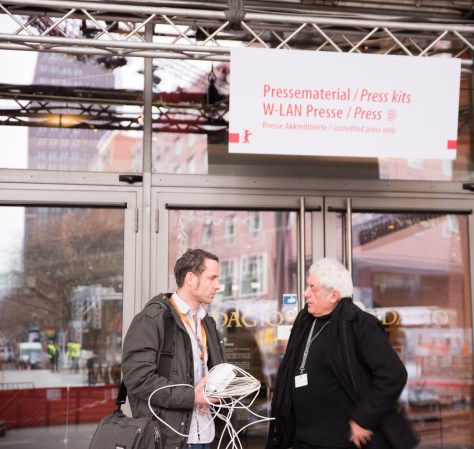
Workers outside the Potsdamer Platz Theater/Berlinale Palast are ramping up with last minute preparatory efforts for the 2017 Berlin International Film Festival Glamorous Opening for the Race of the Bears 2017. 

prep-4-of-1
(Photo credit: Larry Gleeson/HollywoodGlee)
prep-3-of-1
(Photo credit: Larry Gleeson/HollywoodGlee)

Press and media room personnel were also discussing the configuring  of the W-LAN for the Berlinale’s  well-known and highly respected world-class media coverage.

The World Premiere of Etienne Comar’s  French film, Django, the story of famous European composer/guitarist and gypsy swing, jazz man, Django Reinhardt, is the Opening Night Film for the 67th Berlinale.  The festival will run February 9th through February 19th.

GLAMOROUS OPENING OF THE RACE FOR THE BEARS 2017

Posted by Larry Gleeson

Minister of State and Federal Government Commissioner for Culture and the Media Prof. Monika Grütters, the Mayor of Berlin Michael Müller, Jury President Paul Verhoeven and Festival Director Dieter Kosslick will open the 67th Berlin International Film Festival at the Berlinale Palast at 7.30 pm on February 9.

During the Opening Gala, the International Jury will be introduced. In addition to Paul Verhoeven (director, screenwriter, The Netherlands), Dora Bouchoucha Fourati (producer, Tunisia), Olafur Eliasson (artist, Iceland), Maggie Gyllenhaal (actress, USA), Julia Jentsch (actress, Germany), Diego Luna (actor, director, Mexico) und Wang Quan’an (director, screenwriter, People’s Republic of China) will also be introduced. Anke Engelke will host the evening. The event will be broadcasted live on television by ZDF/3sat and via www.berlinale.de.

Following the Opening Gala Django by Etienne Comar will have its world premiere. The director and his film team, including the actors Alex Brendemühl, Cécile de France, Reda Kateb, Bim Bam Merstein, Beáta Palya and Jan Henrik Stahlberg will present the film in the Berlinale Palast.

The members of the International Jury and the GWFF Best First Feature Award Jury, director Jayro Bustamante (Guatemala), French actress Clotilde Courau and director and producer Mahmoud Sabbagh (Saudi Arabia) are all expected on the Red Carpet. Also the Jury members of the Glashütte Original Dokumentarfilmpeis, Daniela Michel (Mexico), Laura Poitras (USA) und Samir (Iraq / Swiss), will be there. A number of prominent German politicians and ambassadors have also announced their attendance.

Other international and national guests are also anticipated: Mario Adorf, Fatih Akin, Thomas Arslan, Hartmut Becker, Iris Berben, Senta Berger, Anne Zohra Berrached, Sebastian Blomberg, Can Dündar, August Diehl, Maria-Victoria Dragus, Andreas Dresen, Katja Eichinger, Alexander Fehling, Veronica Ferres, Inka Friedrich, Liv Lisa Fries, Maria Furtwängler, Martina Gedeck, Jan Ole Gerster, Michael Gwisdek, Jella Haase, Fritzi Haberlandt, Monika Hansen-Sander, Corinna Harfouch, Leander Haußmann, André M. Hennicke, Hannah Herzsprung, Jutta Hoffmann, Oliver Hirschbiegel, Louis Hofmann, Henry Hübchen, Sandra Hüller, Hannes Jaenicke, Christian Jankowski, Odine Johne, Sibel Kekilli, Friederike Kempter, Burghart Klaußner, Herbert Knaup, Hanno Koffler, Juliane Köhler, Wolfgang Kohlhaase, Thomas Kretschmann, David Kross, Frederick Lau, Alina Levshin, Enrico Lo Verso, Heike Makatsch, Jacob Matschenz, Ulrich Matthes, Wotan Wilke Möhring, Ursela Monn, Antoine Monot, Armin Mueller-Stahl, Nele Mueller-Stöfen, Wanja Mues, Jannis Niewöhner, Ulrich Noethen, Christiane Paul, Christian Petzold, Max Riemelt, Oskar Roehler, Andrea Sawatzki, James Schamus, Clemens Schick, Tom Schilling, Jenny Schily, Sebastian Schipper, Volker Schlöndorff, Maria Schrader, Emilia Schüle, Jannik Schümann, Marie-Lou Sellem, Robert Stadlober, Lilith Stangenberg, Jasmin Tabatabai, Aylin Tezel, Anna Thalbach, Rosalie Thomass, Antje Traue, Ludwig Trepte, Jördis Triebel, Elisabeth Trissenaar, Tom Tykwer, Justus von Dohnányi, Rosa von Praunheim, Nora von Waldstätten, Franziska Weisz, Wim Wenders, Lavinia Wilson, Ai Weiwei, Johanna Wokalek, Tang Yan, Roland Zehrfeld, as well as many others.

Logo-Berlinale-Facebook

(Source: Berlinale Press Office)

APPLAUSE FOR THE OFFICIAL PARTNERS OF THE 67TH BERLIN INTERNATIONAL FILM FESTIVAL

Posted by Larry Gleeson

Besides having four Principal Partners – Audi, Glashütte Original, L’Oréal Paris, and ZDF – the Berlinale is supported by more than 30 national and international enterprises. The Festival’s Co-Partners are Mastercard and Tesiro.


Berlinale_Director“We would sincerely like to thank Prof. Monika Grütters for the unflagging support of the federal government. We are also extremely indebted to all our Official Partners. Along with backing us financially, they contribute indispensably to the festival experience by offering diverse services and funding various initiatives. The Berlinale, as we know and love it, would not be possible without this fantastic support,” says Festival Director Dieter Kosslick.

Principal Partners

Audi

As official automobile partner, Audi is providing the Berlinale with about 300 vehicles which bring the stars to the Red Carpet. At the Audi Berlinale Lounge directly in front of the Berlinale Palast, the automobile manufacturer will also give exciting insights into the world of cinema. Here the Berlinale Open House Programme will offer movie fans a chance to experience the important personalities of this year’s Berlinale films up close.
Audi has supported short film directors at the Berlinale with the Audi Short Film Award since 2015. Endowed with € 20,000, this award for innovative artistic filmmaking will be presented during the official Award Ceremony by the International Short Film Jury (Christian Jankowski, Kimberly Drew, Carlos Núñez).
In 2017, under the newly created umbrella of “EFM Horizon presented by Audi”, the European Film Market (EFM) will be offering a variety of different initiatives focussing on the film industry of the future.
Audi is also supporting the Berlinale Social Hub and has again been responsible for the production of the Berlinale’s popular festival bag. Once more there will be an official Berlinale box office for advanced ticket sales at Audi City Berlin (Kurfürstendamm 195).


Glashütte Original

This year, Glashütte Original – a watch manufacturer rich in tradition – will sponsor for the first time the Glashütte Original Documentary Award. Endowed with € 50,000, it will be presented during the official Award Ceremony. The prize money will be split between the director and the producer of a documentary film from the Competition, Berlinale Special, Panorama, Generation, Perspektive Deutsches Kino or Forum section. The jury members in 2017 are Daniela Michel (Mexico), Laura Poitras (USA), and Samir (Iraq/Switzerland). In addition to the prize money, Glashütte Original will also provide the statuette, which will be crafted in the company’s manufactory in Saxony.

As Principal Partner, Glashütte Original is official host of the Golden Bear Lounge in the Hotel Grand Hyatt Berlin, which will be the central meeting place for film teams in the official programme as well as other eminent festival guests.

L’Oréal Paris

With its professional make-up team, the Berlinale’s official cosmetic specialist will again provide the stars with the perfect Red Carpet look. The fact that the world of film is closely related to the world of beauty is embodied by film icons such as Julianne Moore, Susan Sarandon, Jane Fonda, Eva Longoria, and Iris Berben. Festival-goers will also have a chance to get the latest “Berlinale look”, free of charge, at the L’Oréal Paris Make-up-Studio at Potsdamer Platz.
On the occasion of the Berlinale, L‘Oréal Paris will for the first time present “The Atelier” in Berlin: a creative location that will allow people to actually experience the brand known as L‘Oréal Paris. Lena Meyer-Landrut and Miss Fame, both brand ambassadors, are expected at the opening of “The Atelier” and on the Berlinale’s Red Carpet.

ZDF

As the Principal Media Partner of the Berlinale, the ZDF/3sat television network is producing and broadcasting all the stage events at the Berlinale Palast – from the Opening Gala to the Shooting Stars Awards, from the presentation of the Honorary Golden Bear to the Award Ceremony of the International Jury. As pool leader, ZDF is also in charge of providing TV footage to countless national and international broadcasters covering the Festival.

At 7.20 pm on February 9, 2017, the Opening Gala of the Berlinale will be broadcast live by 3sat, ZDF’s partner station, during the programme “Kulturzeit extra”. On February 18, 2017, 3sat will also televise the final highlight of the Festival in a special live broadcast: the awarding of the Golden and Silver Bears by the International Jury.
Industry get-togethers will be held daily at the ZDF Lounge in the “mesa” restaurant of the Grand Hyatt Berlin.

Co-Partners

Mastercard

Mastercard, a leading international technology company for payment solutions, builds on emotionality and exclusivity. This makes its partnership with the Berlinale a significant component of its branding strategy.

In partnering with the Berlinale, Mastercard is again setting up an exclusive ticket counter in the Potsdamer Platz Arkaden mall. Here Mastercard holders can secure tickets to highly-coveted film premieres. In addition, all sorts of “priceless surprises” await visitors during the festival.

Tesiro

Each year since 2009, Tesiro has presented an exclusive Berlinale jewelery collection that illustrious guests may adorn to crown their appearances on the Red Carpet. Tesiro is not only continuing its long-standing co-partnership with the Berlinale, but also its support as principal partner of the European Shooting Stars initiative. The presentation of the Shooting Stars Awards will take place in the Berlinale Palast on February 13, 2017. Tesiro is also bringing a large number of representatives of the Chinese press to Berlin for media coverage about the festival.

Initiative Partners in 2017: ARRI and Nespresso (Co-Partners of Berlinale Talents).

Third Partners in 2017: ARRI, Colt Technology Services, Dell EMC, Dolby, GWFF, rbb TV station, TV Movie.

The “Gesellschaft zur Verwertung von Film- und Fernsehrechten (GWFF)”, a society for safeguarding film and television rights, is funding the GWFF Best First Feature Award endowed with € 50,000. This year’s jury members are Jayro Bustamante (Guatemala), Clotilde Courau (France), and Mahmoud Sabbagh (Saudi Arabia).

Suppliers in 2017: Akkumat, Aspera (an IBM company), Barco, Canon, ChariTea, CineStar, Cup Concept, Deutsches Weininstitut (DWI), Haus Rabenhorst, Nespresso, Rohde & Schwarz, Potsdamer Platz – Brookfield, Sony Center at the Potsdamer Platz, TOP-IX, Viva con Agua, Vranken Pommery, Wall.

For editorial coverage, the website of the Berlinale offers more details and contact information.

Logo-Berlinale-Facebook

(Source: Berlinale Press Office)


Berlinale Goes Kiez: The Festival in Neighbourhood Cinemas

Posted by Larry Gleeson

Once again the Berlinale Goes Kiez special series is bringing the glamour of the festival to Berlin’s very diverse neighborhoods and the city of Potsdam. The Berlinale will screen at seven select arthouse cinemas known for participating in and contributing to cultural life in their respective neighborhoods.

In Neukölln a new cinema  w o l f  will be opening its doors for the first time with the Berlinale. And in the Wrangelkiez, one of Kreuzberg’s most upbeat neighborhoods, the Red Carpet will again be rolled out at the newly converted and enlarged EISZEIT cinema.

1c5d841ac4


From February 11 to 17, 2017, a selection of films from the official Berlinale program will be shown in neighborhoods, ranging from Berlin-Weißensee to beyond the city limits in Potsdam-Babelsberg. Each evening one arthouse cinema will be turned into a festival venue.

Members of film teams have already announced their intention to present their works personally and discuss them with audiences after the screenings. At each neighborhood cinema a prominent film personality will serve as its patron.

The Berlinale Goes Kiez series will also begin with the official opening film of this year’s Berlinale. Django (Competition) by Etienne Comar will kick off the evening at the Bundesplatz-Kino in Wilmersdorf. Local moviegoers can expect a long and interesting evening, as shortly before midnight a film from the Berlinale Classics program will be presented as well: the digitally restored version of George A. Romero’s horror classic Night of the Living Dead.

For the first time NATIVe, the Berlinale special series on Indigenous cinema, has been invited to participate in Berlinale Goes Kiez. At the EISZEIT cinema in Kreuzberg, two films from Canada will represent this year’s special region of focus, the Artic.
At the  w o l f  in Neukölln, Berlinale Goes Kiez and Berlinale Talents will launch their first collaboration. In public talks titled “Local Heroes: Community Cinema Reloaded”, innovative international cinema operators will discuss with the audience ways to curate, finance, and involve the neighborhood in local movie theatres.


Berlinale-Festival Director Dieter Kosslick: “Our ‘local heroes’ are neighborhood cinemas in Berlin and Brandenburg that are open to topics important to the community and foster an on-going dialogue through the stories presented on their screens.”


Advance sales start on February 6, 2017; tickets will also be available at the respective cinemas.

Neighbourhood cinemas and programme

Saturday, February 11 at Bundesplatz-Kino, Wilmersdorf
6.00 pm Competition
Django by Etienne Comar

9.00 pm Competition
Teströl és lélekröl (On Body and Soul) by Ildikó Enyedi

11.45 pm Berlinale Classics
Night of the Living Dead by George A. Romero

Sunday, February 12 at Toni & Tonino, Weißensee
3.30 pm Generation Kplus
Die Häschenschule – Jagd nach dem Goldenen Ei (Rabbit School – Guardians of the Golden Egg) by Ute von Münchow-Pohl

6.30 pm Competition
Wilde Maus (Wild Mouse) by Josef Hader

9.30 pm Perspektive Deutsches Kino
Back for Good by Mia Spengler

Monday, February 13 at Odeon, Schöneberg
6.30 pm Berlinale Special Gala
Le jeune Karl Marx (The Young Karl Marx) by Raoul Peck

9.30 pm Competition
Una mujer fantástica (A Fantastic Woman) by Sebastián Lelio

Tuesday, February 14 at  w o l f  , Neukölln
4.30 pm Talents Go Kiez
“Local Heroes: Community Cinema Reloaded”
Public talk (in English)

6.30 pm Panorama Special
Tiger Girl by Jakob Lass

9.30 pm Forum
Chemi bednieri ojakhi (My Happy Family) by Nana & Simon

Wednesday, February 15 at Thalia Programmkino, Potsdam-Babelsberg
6.30 pm Competition
Toivon tuolla puolen (The Other Side of Hope) by Aki Kaurismäki

9.30 pm Competition
Beuys by Andres Veiel

Thursday, February 16 at City Kino Wedding
in Centre Français de Berlin, Wedding
6.30 pm Forum
Tiere (Animals) by Greg Zglinski

9.30 pm Berlinale Shorts Go Kiez
Fishing Is Not Done On Tuesdays by Lukas Marxt, Marcel Odenbach
Kometen (The Comet) by Victor Lindgren
Everything by David OReilly
Estás vendo coisas (You are seeing things) by Bárbara Wagner, Benjamin de Burca
Os Humores Artificiais (The Artificial Humors) by Gabriel Abrantes

Friday, February 17 at EISZEIT cinema, Kreuzberg
6.30 pm Culinary Cinema Goes Kiez
Theater of Life by Peter Svatek
After the screening menu at Markthalle Neun

9.00 pm NATIVe Goes Kiez
Tungijuq by Félix Lajeunesse, Paul Raphaël
Angry Inuk by Alethea Arnaquq-Baril

Berlinale Goes Kiez is supported by the Medienboard Berlin-Brandenburg. Its complete programme can be found at http://www.berlinale.de. Please contact Uschi Feldges for more information ().

Logo-Berlinale-Facebook

(Source: Berlinale Press Office)

Berlinale 2017: International Jury

Posted by Larry Gleeson

Once again an illustrious International Jury will decide who will receive the Golden and Silver Bears at the Berlinale 2017. Eighteen films are vying in this year’s Competition for the Golden and the Silver Bears. The winners will be announced at the Berlinale Palast on February 18.

Director and screenwriter Paul Verhoeven will serve as Jury President. The other members of the International Jury are producer Dora Bouchoucha Fourati (Tunisia), artist Olafur Eliasson (Denmark), actress Maggie Gyllenhaal (USA), actress Julia Jentsch (Germany), actor and director Diego Luna (Mexico), and director and screenwriter Wang Quan’an (People’s Republic of China).

Paul Verhoeven, Jury President, Director, Screenwriter (The Netherlands)

screen-shot-2017-02-04-at-8-33-38-pmThe Dutch director and screenwriter Paul Verhoeven began his directing career in 1969 with the successful Dutch television series Floris. After his feature film debut Business is Business in 1971, came the erotic thriller Turkish Delight in 1973, a big hit in the Netherlands that also garnered a nomination for Best Foreign Language Film at the 1974 Academy Awards. Following his international breakthrough Soldier of Orange (1977) and The Fourth Man (1983), Paul Verhoeven moved to Hollywood to focus on an evolution of style in his work. Large productions featuring lots of action and special effects, like RoboCop (1987), and especially Total Recall (1990), were big box-office hits that revolutionised the science fiction film genre while maintaining credibility as auteur films. The provocative, erotic thriller Basic Instinct (1992), which was nominated for two Academy Awards, saw Paul Verhoeven return to themes prevalent in his Dutch works. In 1997 and 2000, he once again focused on science fiction with Starship Troopers and Hollow Man. After nearly 20 years in Hollywood, Paul Verhoeven returned to the Netherlands in 2006 to film Black Book (2006). Starting in 2007, he moved his attention to writing. In 2016 he returned to the screen with Elle, which not only won the Golden Globe for Best Motion Picture in the category Foreign Language, but also earned Isabelle Huppert the Golden Globe for Best Actress in a Motion Picture – Drama.

Dora Bouchoucha Fourati, Producer (Tunisia)

screen-shot-2017-02-04-at-8-35-10-pmTunisian producer Dora Bouchoucha Fourati is something of an institution in the film world. The English literature graduate started off as a teacher and translator of screenplays. In 1992, she launched the Carthage Film Festival “Projects’ Workshop” to assist Arabs and Africans in developing their scripts and the follow-up initiative “Takmil” to support post-production in 2014. In 1995, she founded her own production company Nomadis Images. The many fiction and documentary features, and short films she has produced and co-produced include: Raja Amari’s multiple award-winning Satin Rouge (2002), Barakat! (dir: Djamila Sahraoui, Berlinale Forum 2006), Raja Amari’s Buried Secrets (2009) and Foreign Body (Berlinale Forum 2017). She produced all of Mohamed Ben Attia’s short films and his full-length debut Hedi, which screened in the Berlinale Competition in 2016 and won the Best First Feature Award and Silver Bear for Best Actor (Majd Mastoura). Dora Bouchoucha also founded the screenwriting workshop SUD ECRITURE for Arab and African scripts in 1997 which has launched many award winning films to date. She was festival director of the Carthage Film Festival in 2008, 2010, and 2014. She was appointed president of the Fonds Sud Cinéma of the CNC in 2010; and president of the follow-up institution, Aide aux Cinemas du Monde, in 2014.

Olafur Eliasson, Artist (Iceland)

screen-shot-2017-02-04-at-8-36-26-pmBorn in Denmark of Icelandic parentage, Olafur Eliasson quickly garnered international attention after completing the Royal Danish Academy of Fine Arts. He participated in the Berlin Biennale in 1998 and the Venice Biennale in 2003, and his piece “The weather project”, which was installed in the Turbine Hall of the Tate Modern, attracted over two million visitors. Today, with his sculptures, installations, paintings, photographs and films that often focus on physical phenomena in nature as well as climate change, he has become one of the world’s most important contemporary artists. Eliasson, who founded his studio in Berlin in 1995, has received countless awards. Besides being involved in art, he is the founder of a global sustainable energy project and social business called Little Sun, as well as the international architectural firm Studio Other Spaces. His latest artworks include a number of installations at the Palace of Versailles in 2016.

Maggie Gyllenhaal, Actress (USA)

screen-shot-2017-02-04-at-8-38-02-pmCelebrated American actress Maggie Gyllenhaal is one of the outstanding talents of her generation. After studying literature at Columbia University in New York and acting at the Royal Academy of Dramatic Art in London, she became known for her roles in Donnie Darko (dir: Richard Kelly, 2001) and in Spike Jonze’s Berlinale Competition entry Adaptation (2002). Her big breakthrough came when she played the lead in the film Secretary (dir: Steven Shainberg, 2002). For it she received her first Golden Globe nomination and won several awards, including an IFP/Gotham Award for Breakthrough Performance. She went on to star in, e.g., Mike Newell’s Mona Lisa Smile (2003), Marc Forster’s Stranger than Fiction (2006), Oliver Stone’s World Trade Center (2006), Christopher Nolan’s The Dark Knight (2008), Sam Mendes’s Away We Go (2009), and Roland Emmerich’s White House Down (2013). For her role in Scott Cooper’s Crazy Heart (2009) she was nominated for an Oscar. In 2014 she headlined the British TV series The Honourable Woman, for which she garnered a Golden Globe Award and an Emmy nomination. Gyllenhaal, who in recent years has performed on Broadway, is currently cast to star in The Deuce, a new HBO series that she is also producing.

Julia Jentsch, Actress (Germany)

screen-shot-2017-02-04-at-8-39-31-pmAfter finishing her studies at the Ernst Busch Academy of Dramatic Arts, Julia Jentsch, who was born in Berlin, began her career on the stage. In 2002 “Theater heute” magazine rated her the best female debut of the year. Her breakthrough on the screen was in The Edukators (2004, dir: Hans Weingartner) and in Sophie Scholl – The Final Days (Berlinale Competition 2005), for which she won not only the Berlinale’s Silver Bear, but also both the German and European Film Awards. The film itself, which was directed by Marc Rothemund, was nominated for the Oscar for Best Foreign Language Film. Since then Julia Jentsch has starred in a number of works, including 33 Scenes from Life by Polish director Małgorzata Szumowska, Hannah Arendt by Margarethe von Trotta, and I Served the King of England by Jiří Menzel. With Effie Briest (Berlinale Special 2009, dir: Hermine Huntgeburth) and 24 Weeks (Berlinale Competition 2016; dir: Anne Zohra Berrached), Jentsch was again invited to the Berlinale. Most recently she performed in front of the camera in Hans-Christian Schmid’s mini-series Das Verschwinden, which will be released in 2017.

Diego Luna, Actor, Director (Mexico)

screen-shot-2017-02-04-at-8-40-58-pmDiego Luna’s breakthrough role came with Alfonso Cuarón’s Y tu mamá también, for which he shared the Marcello Mastroianni Award with Gael García Bernal at the Venice Film Festival in 2001. His feature film acting credits include Frida (dir. Julie Taymor, 2002), The Terminal (dir: Steven Spielberg, 2004), Rudo y Cursi (dir: Carlos Cuarón, 2008), Milk (dir: Gus van Sant, Berlinale Panorama 2009), Contraband (dir: Baltasar Kormákur, 2012) and Rogue One: A Star Wars Story (dir: Gareth Edwards, 2016). Next fall he will star in Flatliners (dir: Niels Arden Oplev). Luna’s directorial debut, titled Abel, premiered at the film festival in Cannes in 2010. This was followed by César Chávez (Berlinale Special 2014) and Mr. Pig, which premiered at the Sundance Film Festival in 2016. He and Bernal co-founded “Ambulante” in 2005, a charity organization dedicated, among other things, to promoting documentary film. Luna is also a member of the board of the Washington Office on Latin America.

Wang Quan’an, Director, Screenwriter (People’s Republic of China)

screen-shot-2017-02-04-at-8-42-43-pmThe director and screenwriter trained first as an actor before he turned to filmmaking. After studying at the Beijing Film Academy, Wang Quan’an, who was born in Yan’an in Shaanxi province, presented his debut film Lunar Eclipse in 1999. It screened in the Berlinale’s Forum section in 2002 after making various award-winning appearances at festivals around the world. He was selected with Tuya’s Marriage for the Competition in 2007 and, as the third Chinese filmmaker in the festival’s history, won the Golden Bear. Three years later, Apart Together was chosen as the Berlinale’s opening film and went on to win the Silver Bear for Best Script, which Wang co-wrote with Jin Na. He returned to the Berlinale Competition in 2012 with White Deer Plain, an adaptation of the historical novel of the same name, where his director of photography, Lutz Reitemeier, won the Silver Bear for Outstanding Artistic Contribution.

(Source: Berlinale Press Office)

Life In Berlin: A Preview Of The Berlinale 2017 Film Festival

Posted by Larry Gleeson

By Lily Kelting

screen-shot-2017-02-02-at-4-17-22-pm

“Don’t let yourself harden in these hard times.” The lyrics by East-German protest singer Wolf Biermann have been running through Berlinale director Dieter Kosslick’s head lately. He recited them for the assembled press at Tuesday’s program preview.

Officially, there is no theme for the Berlinale Film Festival’s competition program. But Kosslick wants to stress that there’s a certain bravery, even levity, that runs through the whole festival.

When asked directly whether the Berlinale will respond to recent events in US or world politics, Kosslick demurs. Not being reactive, he says, it is its own form of protest—and the diversity and range of the program is enough of a statement.

While the festival as a whole isn’t designed to respond to contemporary politics, some films certainly do.

Panorama director Wieland Speck explains:

screen-shot-2017-02-02-at-4-20-01-pm“One film, of course, is like an anchor film, which is the Oscar-nominated film I Am Not Your Negro from Raoul Peck. I Am Not Your Negro is a find that makes my heart swell, because it’s James Baldwin, [who is] not only an icon, as a brilliant writer, but an activist, a gay person at a time when that was basically not possible.”

Also in the Panorama section is the documentary Strong Island, which brings the same questions about sexuality and race into the present tense.

Strong Island is an incredible find of today’s America. It’s about a killing of a young man twenty years ago, but the family is of course not over this. The sister, who is now a man, is the filmmaker,” Speck explains. “This is a very deep, philosophical, almost poetic—if it wouldn’t be such a gruesome reality, you would call it that way—film to explore that kind of situation from the personal to the very political.”

The NATIVe Program, which highlights indigenous filmmakers, also serves as a kind of litmus to our rapidly changing world. The issue of climate change runs throughout this year’s selections.

Here’s section director, Maryanne Redpath:

“This year it’s on indigenous film from the Arctic region all the way around the Polar Circle. Of course we all know there are a lot of issues around climate. Many people from the Western worlds project a utopic vision of what it’s like up there, with the eternal eyes and the Aurora Borealis. We have this idea that it’s still very pristine, and of course the indigenous people have been telling us for a long time that it’s not so rosy.”

These films respond to issues like colonization and industrialization, showing both directly and indirectly the immediate impact of climate change above the Arctic Circle.

Still, as Wolf Biermann sings, “the world needs your cheerfulness.” There are plenty of comedies across the program as well.

Berlinale Film Festival starts next week February 9th, 2017 and runs until Feb 19th, 2017.


screen-shot-2017-02-02-at-4-23-34-pm

(Source: nprberlin.de)

An Honorary Golden Bear and Homage for Oscar-winner Milena Canonero

Posted by Larry Gleeson

goldener_baer_08_img_367xvar

The Homage of the 67th Berlin International Film Festival is dedicated to Italian costume designer Milena Canonero, who will also receive an Honorary Golden Bear for her lifetime achievement.

screen-shot-2017-02-01-at-5-54-56-pm

Milena Canonero is one of the world’s most celebrated costume designers. She has worked with a long list of directors, including Stanley Kubrick, Francis Ford Coppola, Sydney Pollack, Warren Beatty, Roman Polanski, Steven Soderbergh, Louis Malle, Tony Scott, Barbet Schroeder, Sofia Coppola, and Wes Anderson. Over the years she has won four Academy Awards for her outstanding costume designs and has been nominated five other times.

Berlinale-“Milena Canonero is an extraordinary costume designer. With her designs she has contributed decisively to the style of many cinematic masterpieces. With this year’s Homage, we would like to honour a great artist as well as direct attention to another film profession,” says Berlinale Director Dieter Kosslick.

Milena Canonero’s designs result from extensive art historical research and sophisticated concepts. She never just adopts parameters from fashion history but adapts them creatively for each movie. In doing so she excels not only in the art of subtly accentuating a character’s personality but also in enhancing the texture of a film through very detailed and original designs. Her creations have influenced global fashion trends and inspired fashion designers such as Alexander McQueen and Ralph Lauren.

Right at the beginning of her career Canonero met Stanley Kubrick and it was for his film A Clockwork Orange (United Kingdom / USA 1971) that she designed her first film costumes. With them white lost its innocence and set a new benchmark for costume design. Already with her second work for Kubrick, Barry Lyndon (United Kingdom / USA 1975), she took home her first Academy Award for Best Costume Design (shared with Ulla-Britt Söderlund).

Next came Kubrick’s The Shining (United Kingdom / USA 1980) and Hugh Hudson’s Chariots of Fire (United Kingdom 1981), for which she received her second Academy Award, as well as Francis Ford Coppola’s The Cotton Club (USA 1984) and Sydney Pollack’s Out of Africa (United Kingdom / USA 1985).

For Francis Ford Coppola’s The Godfather Part III (USA 1990), Milena Canonero took inspiration from the painters of the Renaissance. She made use of both subdued dark hues and striking colour compositions. In the same year, Warren Beatty’s Dick Tracy (USA 1990) was completed. For it Canonero drew on classic cuts from 1930s fashion, while referencing the original comic strip by choosing clear bright colours for the fabrics of the costumes. She limited herself to the three primary colours, plus black and white, as well as five mixed colours – and used them consistently throughout the film for all the costumes and accessories.

For Barbet Schroeder’s Single White Female (USA 1992), Milena Canonero was not only responsible for the costumes, but also for the production design. Later she received her third Academy Award for the pastel and candy-coloured garments in Sofia Coppola’s Marie Antoinette (France / Japan / USA 2006).

In past years Milena Canonero has participated in the Berlinale with two films directed by Wes Anderson – The Life Aquatic with Steve Zissou (USA 2004) and The Grand Budapest Hotel (USA / Germany 2014). For her extraordinary purple and mauve hotel staff uniforms, and the fanciful design of Madame D.’s gown from The Grand Budapest Hotel, Milena Canonero won her fourth Academy Award for Best Costume Design.

2015_0010_img_175xvar
Rainer Rother, Head of the Retrospective and Homage and Artistic Director of the Deutsche Kinemathek (Photo via berlinale.de)

“What is also so impressive about Milena Canonero is the versatility of her artistic interests. Her costume designs for productions at the Metropolitan Opera in New York, La Scala in Milan, and the Vienna State Opera, as well as for Roman Polanski’s stage adaptation of Amadeus have brought her international recognition and success too,” comments Rainer Rother, Head of the Retrospective and Homage and Artistic Director of the Deutsche Kinemathek.

In addition Milena Canonero recently co-produced the film Romeo & Juliet (United Kingdom / Italy / Switzerland 2013) by Carlo Carlei, and finished directing her first commercial. Currently she is developing a documentary about the costume and production designer Piero Tosi.

The presentation of the Honorary Golden Bear at the Berlinale Palast on February 16, 2017 will be accompanied by a screening of the film The Shining (United Kingdom / USA 1980) by Stanley Kubrick.


The ten films in the Homage are:

Barry Lyndon (United Kingdom / USA 1975, director: Stanley Kubrick)
Chariots of Fire (United Kingdom 1981, director: Hugh Hudson)
A Clockwork Orange (United Kingdom / USA 1971, director: Stanley Kubrick)
The Cotton Club (USA 1984, director: Francis Ford Coppola)
Dick Tracy (USA 1990, director: Warren Beatty)
The Godfather. Part III (USA 1990, director: Francis Ford Coppola)
The Grand Budapest Hotel (USA / Germany 2014, director: Wes Anderson)
Marie Antoinette (France / Japan / USA 2006, director: Sofia Coppola)
Out of Africa (United Kingdom / USA 1985, director: Sydney Pollack)
The Shining (United Kingdom / USA 1980, director: Stanley Kubrick)

Logo-Berlinale-Facebook

(Source: Berlinale Press Office)